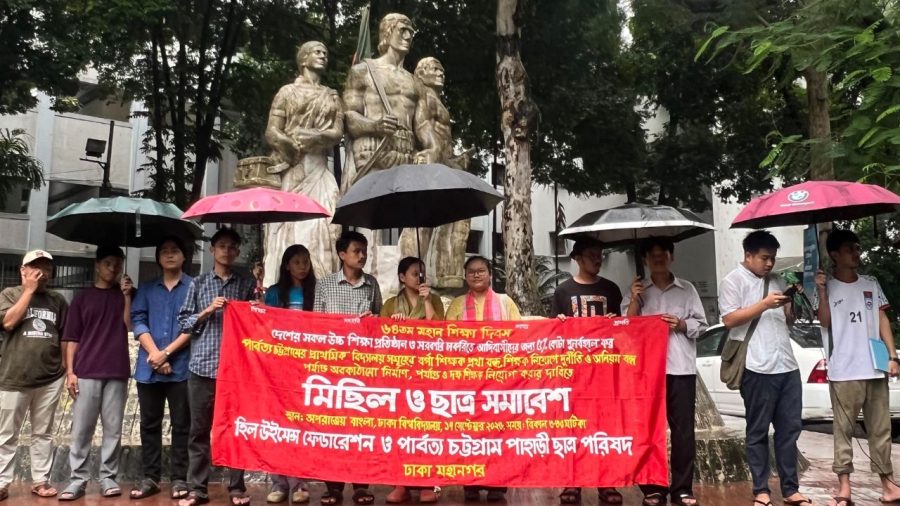

Parbatya Chattagram Pahari Chhatra Parishad (PCP) has demanded restoration of a 5 per cent quota for members of ethnic minority communities in all educational institutions and government jobs across the country.
The student organisation also called for an end to the practice of employing “proxy teachers” in primary schools across the Chittagong Hill Tracts (CHT), alongside an immediate halt to corruption and irregularities in teacher recruitment.
Moreover, it demanded adequate infrastructure and appointment of a sufficient number of qualified teachers in the CHT region.
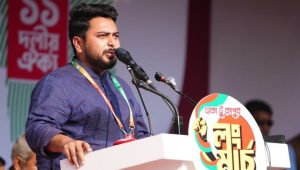
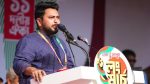
These demands were raised during a procession and student rally held in Dhaka on Thursday.
Hlamongching Marma, general secretary of PCP’s Dhaka Metropolitan unit, moderated the rally, which was chaired by Chandrika Chakma, president of Dhaka Metropolitan unit of the Hill Women’s Federation.
Nebai Ang Khumi, organising secretary of PCP’s Dhaka University unit, delivered the welcome address.

Several student leaders addressed the rally in solidarity, including Anik Kumar Das, president of Dhaka Metropolitan Committee of Socialist Students’ Front; Carry Chakma, vice-president of PCP’s Dhaka Polytechnic unit; Swagata Mrong, joint general secretary of Dhaka Metropolitan unit of Garo Students’ Union; Konej Chakma, president of PCP’s Dhaka Metropolitan unit; and Tumpa Hajong, sports and cultural affairs secretary of Ethnic Minority Youth Forum.
Speaking at the event, Anik Kumar Das said 64 years after the 1962 Education Movement, the country’s education system had still failed to undergo the changes envisioned at that time.
He highlighted that the increasing commercialisation of education was depriving children from poor and low-income families of access to learning.
Describing the education system in the CHT as particularly fragile, he alleged that widespread bribery and corruption in teacher recruitment were damaging the future of children in the hills.
Carry Chakma alleged that successive governments had contributed to the commercialisation of education and said provisions for primary education in ethnic minority children’s mother tongues, alongside the 5 per cent quota in education and public employment, had not been implemented effectively.
He warned that ethnic minority students were falling further behind as a result, asserting that students would continue to raise their voices to secure their rights.
Addressing the gathering, Swagata Mrong stressed that education is a fundamental right and that the state holds the responsibility to ensure equal access.
He pointed out that ethnic minorities continue to face discrimination in education and employment, demanding equality for ethnic minority communities in both the CHT and the plains.
Adding to these concerns, Srijon Mri said the state had failed to establish equality within the education system. He warned that unless effective measures are taken immediately, ethnic minority students will fall further behind, thereby hindering the country’s overall progress.
Konej Chakma mentioned that the primary goals of the 1962 Education Movement – to establish an equitable and people-oriented education system – remained unachieved.
He claimed that reducing the previously available 5 per cent quota in government employment and education had further marginalised ethnic minority communities.
He also alleged that, in the absence of elections to the three hill district councils, unelected councils were arbitrarily interfering in the region’s education sector.
Consequently, he demanded elections to the district councils in line with the CHT Accord and full implementation of the agreement.
Urging state intervention, Tumpa Hajong called on the state to take effective steps to turn the promise of an equitable education system into reality instead of leaving it confined to official documents.
She also mentioned the call for restoration of the 5 per cent quota for members of ethnic minority communities in education and government employment.
The programme concluded with the chairperson’s remarks, followed by a procession.