The traditional picture of Eid-ul-Adha in Bangladesh has long been associated with crowded cattle markets, transporting sacrificial animals home, caring for them for days, and struggling to find butchers on Eid day.
But in Chattogram, that familiar scene is gradually changing as package-based “shared sacrifice” services become increasingly popular among urban residents.
Ahead of Eid-ul-Adha, several cattle farms and agro-based companies in the port city have introduced modern “full-service shared Qurbani” packages that allow customers to participate in one or more shares of a cow without dealing with the usual hassles associated with sacrifice rituals.
The trend is drawing significant attention from middle-class families, busy professionals, and expatriate Bangladeshis whose family members often struggle to manage Qurbani arrangements alone.
Under the system, customers can purchase one-seventh or multiple shares of a cow by paying a fixed amount. The service providers then take responsibility for animal selection, rearing, slaughtering, meat processing, packaging. On the Eid day, customers receive hygienically processed meat directly from the farm.

One of the companies leading the trend is Meat Bazar Agro in Chattogram’s Baluchara area. The company has arranged 32 cows for sacrifice this year under three package categories priced at Tk17,000, Tk19,000, and Tk21,000 per share.
According to entrepreneurs, at least 10 companies in Chattogram, including Meat Bazar Agro, Sabera Agro, and Triple H Agro, are now offering similar package-based Qurbani services. Most of these businesses are heavily promoting their offers through Facebook pages and other digital platforms.
Sajjadur Rahman Sakib, entrepreneur of Meat Bazar Agro, told Times of Bangladesh that bookings for this year’s packages have already been completed.




“We are arranging Qurbani for 32 cows this year, and all bookings are full. The sacrifices will be completed in two slots on Eid day. Customers are showing strong interest because they no longer want to deal with the pressure of cattle markets and meat processing,” he said.
He added that the cattle collection process had already been completed and preparations for Eid operations were underway.
Many customers say the service has become a practical solution for city dwellers with limited time and manpower.
M Nazim Uddin, a private company employee in Chattogram, said his family had traditionally purchased sacrificial animals directly from cattle markets every year.
“There were always problems with transporting the cows, arranging caretakers, and hiring butchers. This year, I booked a shared Qurbani package at Meat Bazar Agro. I will simply collect the meat at the scheduled time on Eid day. It is a very useful service for busy urban residents,” he said.

Entrepreneurs claim the growing popularity of the service is linked to modern urban lifestyles where convenience, hygiene, and time management are becoming increasingly important.
According to market sources, most companies are offering three categories of packages depending on the size of the animal and the expected quantity of meat.
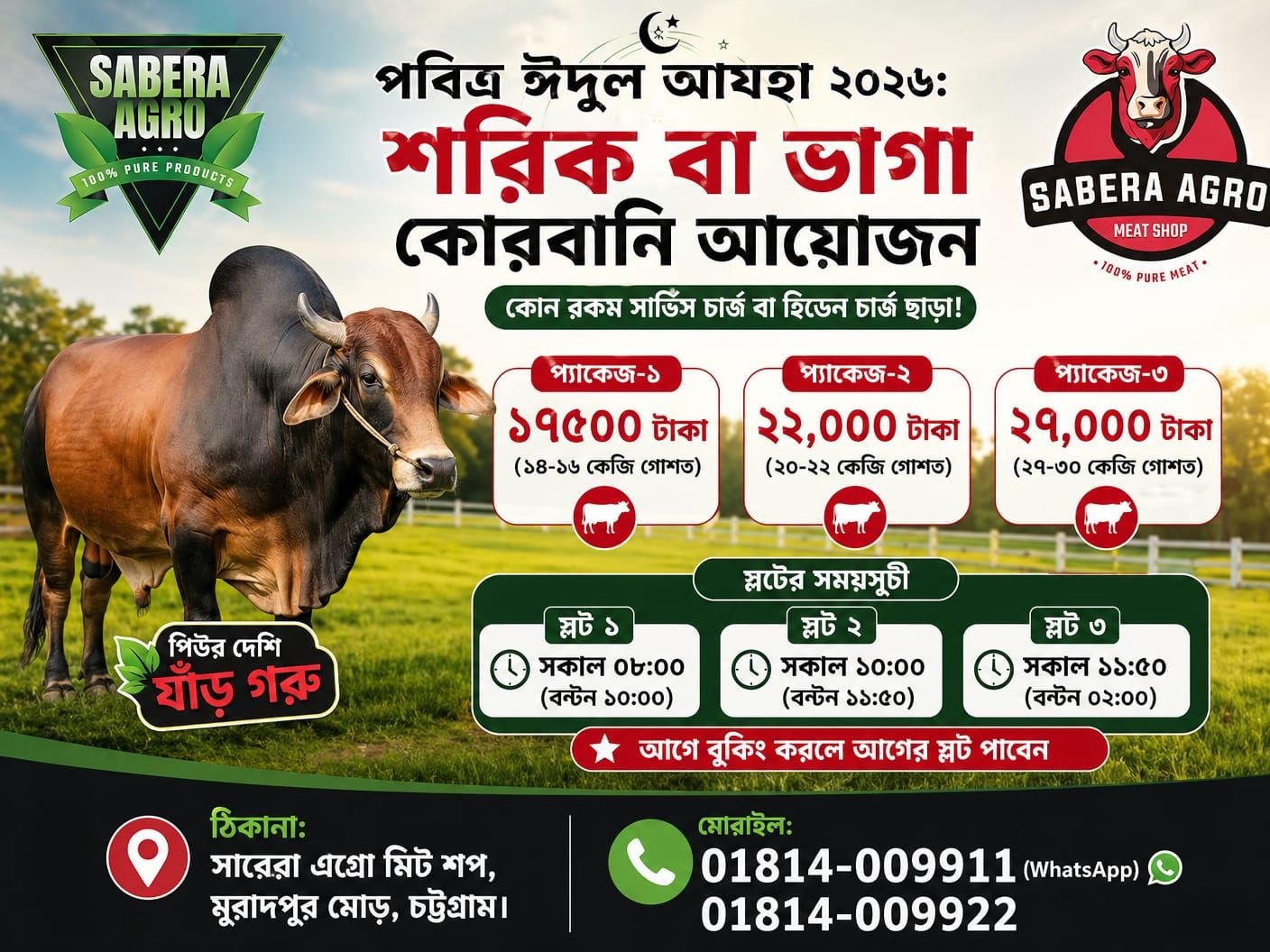
Muradpur-based Sabera Agro has also launched three package options this year. According to the company, Package-1 offers 14 to 16 kilograms of meat for Tk17,500, Package-2 provides 20 to 22 kilograms for Tk22,000, while Package-3 includes 27 to 30 kilograms of meat for Tk27,000.
The company has also introduced separate Qurbani slots at 8am, 10am, and 11am to reduce crowding and ensure smooth meat distribution.
Mohammad Omar, manager of Sabera Agro, said rising cattle prices have pushed many middle-class families toward shared sacrifice systems.
“As cattle prices continue to rise, share-based Qurbani has become an affordable and practical solution for middle-class and expatriate families. Our cattle are naturally raised and collected directly from northern districts including Pirganj, Kushtia, Rangpur, and Dinajpur,” he said.
He added that each cow would have a maximum of seven participants to ensure proper distribution and compliance with Islamic guidelines.
“This year, we are targeting around 65 to 70 cows under our special shared Qurbani packages, which means nearly 450 to 500 families will benefit from the service,” he said.