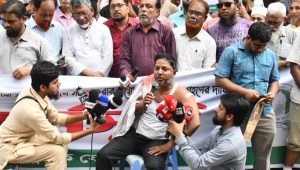
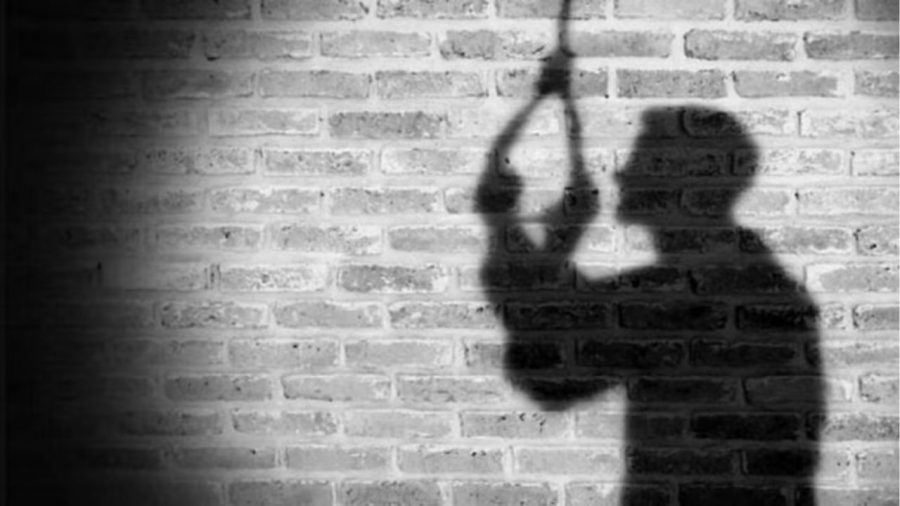

A journalist working from outside the capital has taken his life.
While police investigation is ongoing to ascertain the reasons for the suicide, speculation proliferates: illness, mental depression, loss of employment.
The journalist in question left a few letters and, in one, addressed to a long-time colleague, makes a request to collect his dues from the newspaper for which he worked and hand it over to his wife.
While this society still does not have the right mechanisms to come to the support of people with extreme thoughts, the point of this piece is not just about the lack of systems that could save a person at the edge of despair.
This is about a media person, a reporter, a writer who, before taking his life, had to request a former co-worker to try to get his dues.
In Bangla, the line was “jodi paro….” (if you can) which means the person to whom the letter is addressed to may face difficulties in getting the dues.
That the deceased could not get his arrears is very clear although it would not be right to state that failure to get his dues drove him to take an extreme step.
But, it could have been one of the causes, or perhaps the last straw.

What we can say with conviction is that a person deciding to take his/her own life is never happy and is usually bereft of all hope.
Suicide only knocks during acute sadness!
We can also assert that for many journalists, one of the causes of misery and angst is not getting the proper financial package promised to them.
Yet, these are the people who stand up to write about others who are deprived of their wages and they are the ones who inform us of the multifaceted plight of people from different social sections.
The finger is quick to point at the journalist when a media house comes under fire for either partisan reporting or skewed analysis.



In society’s black and white definition of a journalist there’s no place for taking a moment to understand the mitigating circumstances or the imponderables.
Perhaps a journalist was forced to give a certain slant to the report because s/he was tacitly asked (ordered) by the management to do so, or, maybe the reporter favoured one side for some quick benefits because non-payment of monthly salary, leading to loss of face at home, became the motivating/overwhelming factor.
What society forgets: journalists are humans, they are not news collecting robots.
They have families, children to look after, wife or a girl friend whose loving demands need to be met, house rent to pay and a lifestyle to maintain.
While social thinkers may deliver lofty lines about ideals, values and morality, in real life, status comes when a person is seen and perceived to be living with the basic creature comforts.
Bluntly speaking: would a journalist living in a slum be given the right respect? When a reporter comes wearing rags, the impression s/he sends is certainly not an enviable one.
No matter how much we denounce material instincts, to live with dignity and honour, a certain standard is a must.
Unfortunately, most media house owners do not want to understand that the image of a media entity is reflected thorough the journalist working for it or representing it.
If your journalist comes looking sharp and radiant, it’s the prestige of the house that is bolstered.
Actively involved in Bangladesh’s print media since 1993, I have seen that in many cases, senior journalists, too eager to fawn/grovel to owners (usually business magnates) are the cause of distress for mid and junior level journalists.
That a business baron owning a media outlet would want to use the paper, agency or television to advance his socio political leverage is an established fact.
This is the trend all around the globe.
However, the rights of the media workers can be ensured when top media leaders take a stand for journalists instead of siding with the media house owner.
They must empower unions or bodies which will have one key objective – the best facilities for the media worker.
Bangladesh now has a new government formed after a widely accepted democratic elections and if they want to make a mark, especially in fostering a robust media, a government supported media welfare body, aimed at giving platform to working journalists, is needed.
Please pay attention to the word ‘working journalists’ which means not high ups but mid and junior level journalists whose voices are drowned out under the platitudes of senior editors.
A peculiarity or aberration whatever one may call it is that while there are countless local, international NGOs, development partners engaged in a plethora of social sectors, very few, almost none, directly work for the long term-welfare of media professionals.
There isn’t a single organization, funded either locally or internationally, which addresses and then highlights the professional, personal travails affecting a journalist.
More than thirty three years into the media scenario, I end with one harsh line: a person who fights to end evils for others is in the end, all alone to tackle his/her own demons.