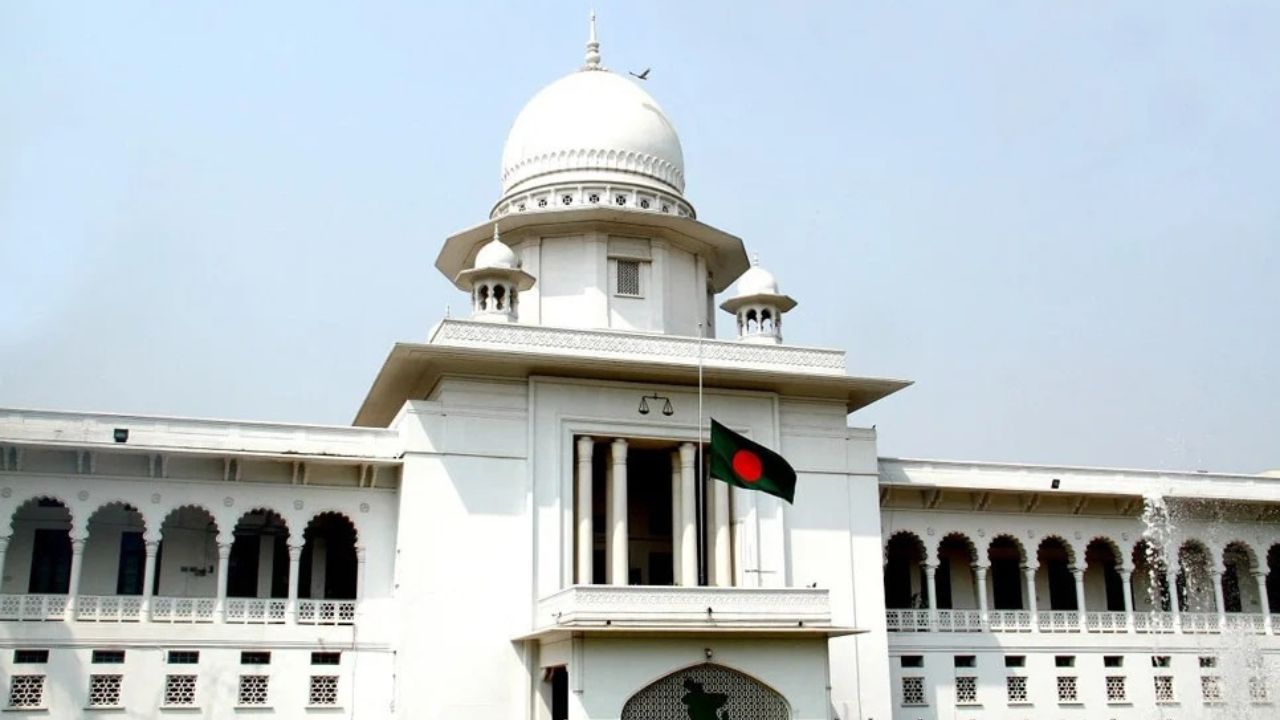
The government has planned to enforce major changes to Dhaka’s urban governance framework, introducing strict penalties and a long-awaited legal overhaul as the Rajdhani Unnayan Kartripakkha (Rajuk) begins the process of legitimising hundreds of thousands of unauthorised buildings across Dhaka.
Breaking a decades-long stalemate, Rajuk has drafted its first-ever policy to assess and regularise structures built without approved designs.
The government is also set to replace the 38-year-old Rajuk Act with a new legal instrument, the Rajdhani Unnayan Kartripakkha (Rajuk) Ordinance–2025, featuring tough enforcement provisions.
Urban planners say the new law and draft regularisation policy mark a significant step towards tackling Dhaka’s illegal construction, unplanned urbanisation, and recurring building safety risks. However, they emphasise that effective implementation, not new legislation, will prove the real challenge.
Legitimising buildings
Rajuk acknowledges that a vast number of buildings within its jurisdiction has been constructed without official approval.
The new draft policy proposes bringing such buildings under regulation if they do not violate the National Building Code or Rajuk’s master plan. Owners seeking legal status will be required to pay penalties equivalent to three to five times the design approval fee.

According to Rajuk sources, the draft policy has already been presented to the Urban Development Committee, which has made several recommendations.
Major reform
With the long-outdated Town Improvement Act of 1953 deemed irrelevant in today’s context, the government is moving to replace it with the Rajuk Draft Ordinance 2025.
The new ordinance introduces provisions on Rajuk’s accountability, urban redevelopment, land readjustment and government appropriation of land value gains, among other reforms.

Harsh penalties
The draft ordinance includes stringent penalties for a wide range of offences.
Violating the master plan will carry up to two years’ imprisonment or a Tk10 crore fine, or both; continued offences will carry a fine of Tk10,000 per day.
Building structures exceeding 10 feet in open space will draw a Tk50 lakh fine.
Filling low-lying land or obstructing natural water flow without approval will attract two years’ jail or a Tk10 crore fine.
Encroaching on roads for construction will lead to a Tk75 lakh fine or six months’ imprisonment.
Obstructing Rajuk’s work will result in four months’ jail or a Tk10 lakh fine.
Constructing a makeshift hut (kacha structure) without permission may bring a Tk5 lakh fine or three months’ imprisonment; continued offences will result in a fine of Tk2,000 per day.
Expert opinions
Under the new ordinance, Rajuk’s board will be expanded from five to ten members.
Rajuk Chairman Riazul Islam said that the final decision on the board’s composition and qualifications will be taken after consultations with professional bodies which, he added, “will be done very soon.”
President of the Bangladesh Institute of Planners Professor Dr Adil Muhammad Khan said Rajuk has become overly focused on development projects instead of its core regulatory responsibilities.
“Unless the bureaucratic structure is reformed, these changes will not deliver results,” he said. While acknowledging the new law and policy as a “major step” towards resolving Dhaka’s illegal construction and safety crisis, he reiterated that enforcement would be the real test.
DAP revision
The government has also approved, in principle, the revision of the 2022 Detailed Area Plan (DAP). The updated plan reduces Dhaka’s administrative blocks from 275 to 68 and limits the city’s area to 1,094 square kilometres.
Key Changes include increased building height and density limits (from 250 to 300), doubling of floor area ratio (FAR) in many zones, enabling 10–11-storey construction where five storeys were previously allowed, lifetime validity for occupancy certificates, mandatory sewage treatment plants for buildings on five kathas or more, and extension of application processing time from 45 days to 180 days.