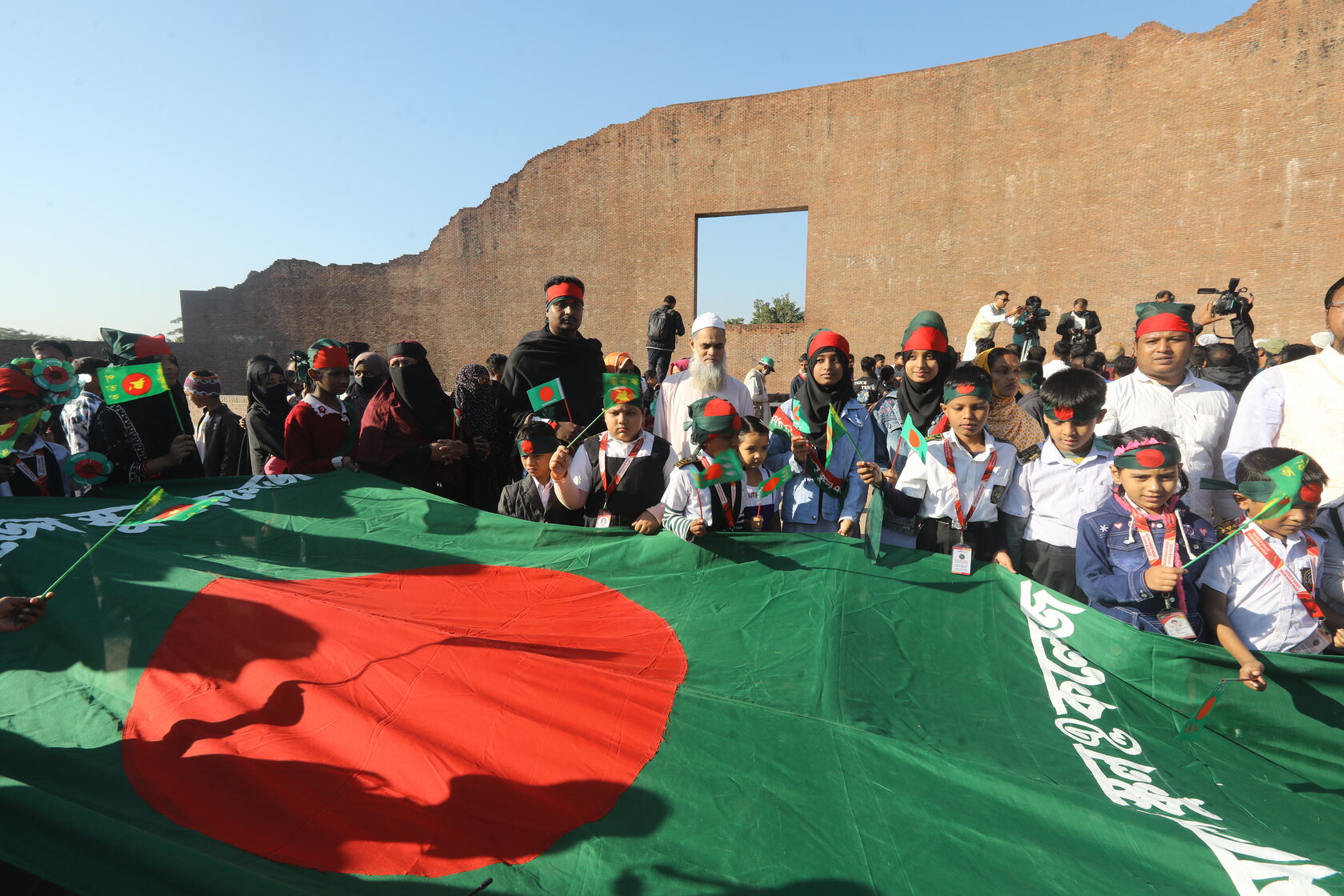

Two days prior to entering its 55th year as an independent nation, Bangladesh observed Martyred Intellectuals Day on Sunday, paying tribute to the great minds (and the individuals who housed them) which were summarily executed by the Pakistani military and their local collaborators during the final stage of Bangladesh’s 1971 Liberation War.
At 7am, President Mohammed Shahabuddin visited the Martyred Intellectuals Memorial in Mirpur, placing a wreath in homage to the martyred. Chief Adviser Muhammad Yunus soon followed the president, paying his respects to the fallen.
In silence they both stood, a mark of respect to te fallen intellectuals of our collective history, and perhaps, to a future that wasn’t.
After the official observance, once allowed, people from all walks of life entered the memorial premises, placing floral wreaths to honour the memories of the nation’s brightest minds to have graced the nation’s consciousness.
On this day in 1971, many of the country’s leading academicians, doctors, engineers, journalists, artistes, teachers and other prominent citizens were forcibly taken from their homes.
Blindfolded, they were taken to locations unknown, brutally tortured, and murdered.
Their bodies were later discovered in the killing fields of Rayerbazar and Mirpur, among others, disrespectfully dumped in ditches to rot.

As inevitable defeat inched close, the Pakistani army and their local collaborators – Al-Badr, Al-Shams and Razakar – carried out these planned killings with the diabolical aim of destroying the intellectual backbone of a nation on the brink of its birth.
Among the martyred intellectuals were Professor Munier Chowdhury, Dr Alim Chowdhury, Professor Muniruzzaman, Dr Fazle Rabbi, Sirajuddin Hossain, Shahidullah Kaiser, Professor GC Dev, JC Guha Thakurta, Professor Santosh Bhattacharya, Mofazzal Haider Chowdhury, and journalists Khandaker Abu Taleb, Nizamuddin Ahmed, SA Mannan (Ladu bhai), ANM Golam Mustafa, Syed Nazmul Haq, and Selina Parvin.
Family, friends, and relatives of some of these intellectuals, alongside freedom fighters and their respective families, could be seen paying homage at the Memorial.
Leaders and activists of various political parties and social organisations were also in attendance.



Led by Secretary General Mirza Fakhrul Islam Alamgir, leaders and workers of BNP lay down wreaths at the memorial site. National Citizen Party Convener Nahid Islam and the party’s leaders followed suit.
One by one, ideologically and politically misaligned groups united over this shared historical tragedy as they paid tribute.
Ganosamhati Andolon, Gonoforum, Nagorik Oikya, Communist Party of Bangladesh, Gono Odhikar Parishad, Bhasani Janashakti Party, Revolutionary Workers’ Party, BASAD, Jatiya Janata Party, Biplabi Communist League and Amar Bangladesh (AB) Party also paid tribute.
Across the country, special dua and munajat were offered at mosques, temples, and churches. Bangladesh Television and private television channels broadcasted special programmes, highlighting the day’s significance while national dailies ran special supplements to commemorate occasion.
However, the interim government’s intentions towards preserving historic Liberation War sites have come under question, as damaged structures at the Mujibnagar Memorial Complex remain unattended more than a year after they were vandalised.
Bangladesh’s provisional government during the Liberation War was formed on 17 April 1971, at Mujibnagar in Meherpur, with Sheikh Mujibur Rahman declared president, Syed Nazrul Islam vice president, and Tajuddin Ahmad as prime minister.
To preserve the historic oath-taking site at Baidyanathtala (Amrakanan), the Mujibnagar Memorial Complex was later built, featuring sector-wise maps of the Liberation War and commemorative sculptures.
Following the ouster of the Sheikh Hasina-led Awami League government on 5 August last year, the complex has been allowed to become one of many victims of widespread vandalism and looting.
More than 300 large and small sculptures, including those depicting battles across the 11 Liberation War sectors, were destroyed. The main gate of the memorial was also dismantled.
Speaking at the Mujibnagar Day programme on 17 April, Liberation War Affairs Adviser Faruk-e-Azam, Bir Protik, said the history of Mujibnagar cannot be erased and that there is no plan to change the name of the Mujibnagar government. He also assured that the damaged memorial would be restored.
Words offer little assurance faced with the fact that, even now, restoration work has yet to begin.
Back at the memorial, leaders of Dhaka University Central Students’ Union and students from Dhaka University, Dhaka College, Dhaka Commerce College, Residential Model College, and several other educational institutions paid could be seen throughout the day, paying homage to the great minds extinguished on 14 December 1971.
Former adviser Asif Mahmud Shojib Bhuyain also paid tribute at the Rayerbazar memorial earlier in the day.
Similar programmes were observed throughout the capital and the rest of the country, paying glowing tributes to the martyred intellectuals of the Liberation War.