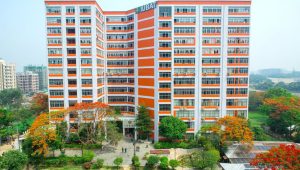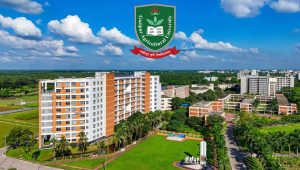




Nearly a year after allocating Tk20 crore to provide temporary accommodation for students, Jagannath University (JnU) has abandoned the short-term plan and decided to divert the money to contribute to the budget for building a permanent 10-storey hall instead.
The university has already invited tenders for the multi-storey building, although no work has begun on the temporary accommodation project originally intended to provide a rapid response to the institution’s severe housing crisis.
Students say the change could delay accommodation for several more years, leaving many of those who joined the movement for temporary halls unable to benefit before completing their studies.
The administration, however, argues that using the allocation for a permanent structure would make better use of the land and accommodate more students in the long term.
An additional Tk20 crore was allocated in the university’s 2025–26 fiscal year budget to address the accommodation shortage, according to university sources.
The money was initially intended to build temporary accommodation on the university’s seven-acre site opposite the Central Jail in Keraniganj. The administration had said the facility would be completed quickly and would accommodate more than 2,000 students.

The initiative followed a movement launched by teachers and students on 14 May last year. Their demands included accommodation allowances for 70 per cent of students, approval of a full university budget and faster implementation of the second campus project.
On 16 May, the then University Grants Commission Chairman, Professor Dr SMA Faiz, met the protesters and assured them that their demands would be addressed. The hunger-striking students subsequently ended their protest.
It was then decided that temporary accommodation would be built without delay on the Keraniganj site.
However, nearly a year later, construction has yet to begin. Instead, the Office of the Chief Engineer issued an e-tender notice on 29 June seeking bids for a permanent 10-storey student hall.



People associated with the university say the change is likely to significantly extend the implementation period, as a permanent structure requires design approval, tender processing, contractor appointment and lengthy construction work.
Permanent residential facilities are also planned at the university’s new campus, raising questions over the priority and timeline of the Tk20 crore project intended to address the immediate accommodation crisis.
Students said the delay had created uncertainty over whether those currently enrolled would ever benefit from the project.
“We were told that accommodation would be arranged within three months. Now it has turned into a project that will take several years,” said Md Tanvir Hossain, a student of the 2021–22 academic session.
“The biggest question is whether current students will benefit from it. We are now in our fourth year. A temporary hall could have helped us, but many of us may graduate before the permanent building is completed.”
Another student, Rahul Amin Rony, questioned why a permanent hall was being constructed at the Keraniganj site when permanent residential facilities were already planned for the second campus.
Student representatives alleged that the administration had not consulted them before replacing the temporary accommodation plan with a permanent building project.
Ferdous Sheikh, general secretary of the Jagannath University unit of Jatiya Chhatra Shakti, said the temporary halls had been proposed specifically to provide a quick solution.=====
“But the administration converted it into a permanent building project without consulting students or student organisations,” he said.
The university administration said temporary tin-shed structures would eventually have to be dismantled and that a permanent building would provide greater long-term benefits.
“It is not possible to make maximum use of the land with a tin-shed building,” said Md Helal Uddin Patwari, the university’s chief engineer.
“Taking future needs into consideration, we have decided to construct a permanent 10-storey student hall. The same site will be able to accommodate a larger number of students.”
Vice-Chancellor Professor Dr Md Roich Uddin said the Works Committee had approved the change.
“The allocation was originally made for temporary accommodation. However, based on the decision of the Works Committee, we have taken the initiative to construct a permanent building instead of a tin-shed structure,” he said.
“The tin-shed building would eventually have had to be demolished. A permanent building can be used for many years. For the time being, it will be used as student accommodation. Later, if necessary, it can also be used to provide housing for teachers, officers and employees.”