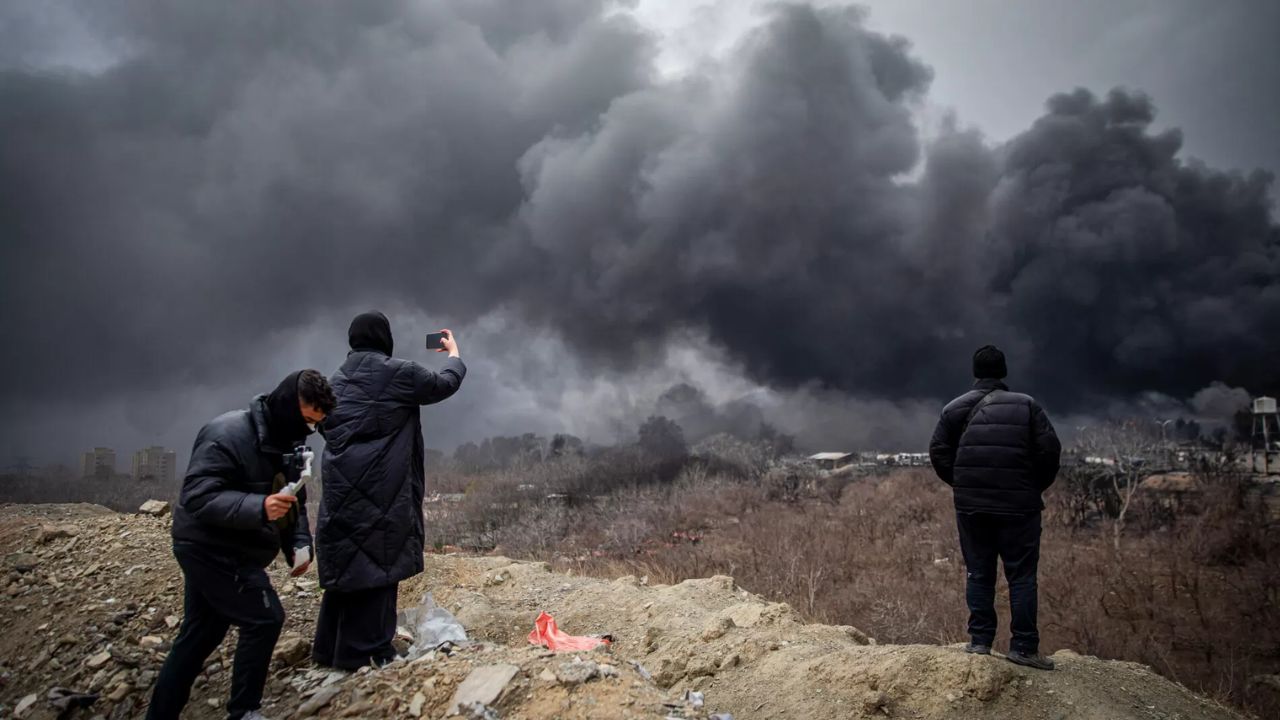



Terrified by explosions shaking Tehran and other cities, tens of thousands of Iranians have fled to small towns and villages seeking safety from the continuing bombardment by Israel and the United States.
The UN refugee agency said that in the first two days of the war about 100,000 people left Tehran, a city of around 9.7 million, though the real number of displaced is likely far higher, reports AP/UNB.
Pouya Akhgari, 22, has taken refuge in a village about 200 kilometres from Tehran in Zanjan province with relatives. The mountainous area has so far escaped airstrikes.
“It just feels so chaotic. I thought it’d be very short but it’s dragging on,” he told The Associated Press by a messaging app. “If it goes on like this, we’ll run out of money.”
In Ahvaz, 800 kilometres southeast of Tehran, a 39-year-old lawyer fled after a day of explosions shook her home. On 2 March she left with relatives and their dogs for the family’s strawberry farm in a rural town several hours away.

She said the town feels safer because it has no military bases. Yet the uncertainty remains constant.
The US-Israeli campaign has dealt heavy blows to Iran’s leadership, killing Supreme Leader Ayatollah Ali Khamenei and senior military figures while targeting the paramilitary Revolutionary Guard and the Basij force.
Khamenei’s son, Ayatollah Mojtaba Khamenei, has since been named the new supreme leader, and security forces remain active across the country.
The lawyer said Basij members appeared more heavily armed in town.


“They are waiting for the slightest movement” showing dissent, she said.
Although she once campaigned against Iran’s mandatory hijab and had stopped wearing it years ago, she now puts it on when leaving the farm to avoid provoking security forces.
Signs of quiet discontent persist, however. She said large crowds joined anti-government protests in January and that official mourning for Khamenei was observed only weakly in the town.
Another resident who fled Tehran described how blasts frightened his six-and-a-half-year-old son before the family decided to leave.
“You place him between you and your wife in bed, hoping he might feel safer,” he said.
While driving out of the capital they saw shattered cars and smoke rising across the skyline.
“The scene made the city look frightening,” he said.
They eventually reached a family home in a village beyond the Alborz Mountains overlooking the Caspian Sea, where they now spend their days walking through fields and trying to maintain routine.
Amid the upheaval, he said local residents showed “remarkable kindness”.
But leaving is not possible for everyone.
A 53-year-old man in Tehran said he cannot move his elderly parents and remains in the city despite the danger.
“At night, I go down to the parking garage, sit inside my car and scream out loud,” he said. “I pray for calm and for quieter days.”