


As part of their broader collaboration as strategic partners, Bangladesh and China have formed a Joint Research Team (JRT) to implement a Joint Action Plan (JAP). Both are focused on narrowing the trade gap – which ballooned to $21.48 billion in 2025 – to ensure a more sustainable commercial relationship.
This is a welcome transition in Bangladesh’s pivot towards China. However, most discourse surrounding the initiative remains myopic, stressing concessionary measures instead of mutually beneficial exchange. For example, stakeholders like the Bangladesh Garment Manufacturers and Exporters Association (BGMEA) seek deeper trade deals, and a stronger ‘backward-linkage’ base to overcome the strict value-addition thresholds under China’s customs rules. Experts go further, arguing for laxer value-addition thresholds alongside trade agreements to access Chinese markets.
While their prescriptions correctly identify Bangladesh’s narrow product mix as an obstacle, they betray a misunderstanding of China’s needs and Bangladesh’s comparative advantages. To effectively close the trade gap, the JRT should seek to incorporate Bangladesh’s heritage: Jute.
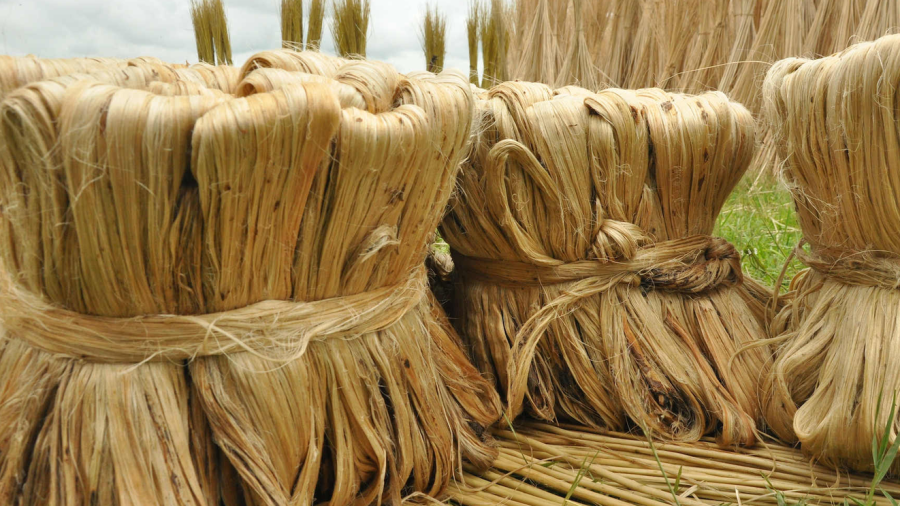
Jute has long been Bangladesh’s prized crop. Ever since gaining independence in 1971, Bangladesh has consistently been the world’s leading exporter of raw jute and manufactured jute products. However, decades of corruption, outdated machinery, and financial mismanagement have hollowed out the industry, leading to the collapse of the once-prosperous public manufacturing sector in 2020.

For all its success in keeping the industry alive, private producers have done little to modernise it. Bangladesh still remains the top exporter of jute by selling low-value products such as raw jute, yarn, and burlap sacks. Being indigenous, these products meet the value-addition thresholds for gaining duty-free access to China. However, their low margins mean they would barely dent the gap in bilateral trade.
Thankfully, China needs more than basic jute products. New regulations from China’s Ministry of Industry and Information Technology (MIIT) cap electricity consumption according to vehicle curb weights. In response, its electric vehicle industry has pivoted towards aggressive mass-reduction targets. One strategy is using natural fibre-reinforced composites like bamboo, flax, and hemp fibres instead of heavy plastics and fibreglass. The substitutions can cut part weight by 30%.




The efficiency gains – and the tax rebates tied to them – have led Chinese industry leaders to explore bamboo composites and bio-polymer blends. However, Bangladesh’s jute offers a more cost-effective and durable alternative. Virgin bast fibres offer the same durability as bamboo at a much cheaper price point. Jute caddies, an industrial byproduct of jute spinning, can be repurposed to produce pellet blends and non-woven substrates for EVs. While Bangladesh already exports both its raw jute and its caddies abroad, processing the products domestically instead would capture a greater value addition that is needlessly lost today. Structural limitations make domestic processing difficult. Bangladesh’s manufacturing base – built for low-margin mass production – lacks the technical sophistication needed to process jute for these high-value markets.
That is why the JRT should pursue more than trade agreements; it should court technology transfers and industrial investment from China.
The industrial upgrading would unlock new pillars of value addition for Bangladesh, allowing it to leapfrog up the global value chain. New supply chains, new markets, and higher margins would revitalise Bangladesh’s jute industry and add new jobs. Technological advancements would also open high-margin markets in Europe, whose growing EV industry could cushion Bangladesh’s export engine, currently propped up by trade privileges set to expire in 2029.
China also stands to gain from this. Bangladesh’s strategic location near Southeast Asia makes it a lucrative hedge against global supply chain risks. Its lower per-unit costs and natural endowments for jute production make it a cheaper and reliable source of bio-polymer blends for China’s Southeast Asian EV manufacturers and its domestic factories. The waste-to-value chains established by repurposing jute caddies integrate with the broader pledge for high-value utilisation of waste outlined in China’s 15th 5-Year Plan.
To turn this logic into practice, the JRT should prioritise three concrete steps. First, commission a joint technical feasibility study on jute-fibre and caddie composites that meet Chinese automotive material standards. Second, secure pilot offtake agreements with one or two Chinese EV makers or tier-1 suppliers to test real-world demand and quality. Third, structure targeted technology-transfer packages – focused on process know-how and quality systems rather than machinery alone – and link them to measurable local value-addition and quality benchmarks. These measures would give both sides clear metrics of progress and reduce the risk of cooperation stalling at the level of general commitments.
Charity will not close a $21 billion gap. Partnership will. Jute shows what that looks like: Bangladesh gets a revived export base, and China gets a cheaper, greener input for its EV supply chains. Dhaka has spent years arriving in Beijing with an outstretched hand. It is time to arrive with something China actually needs. Less begging, more bargaining. Concessions-first diplomacy has failed the relationship.
The views expressed in this article are solely those of the author
The writer is a geopolitical researcher and essayist based in Hong Kong