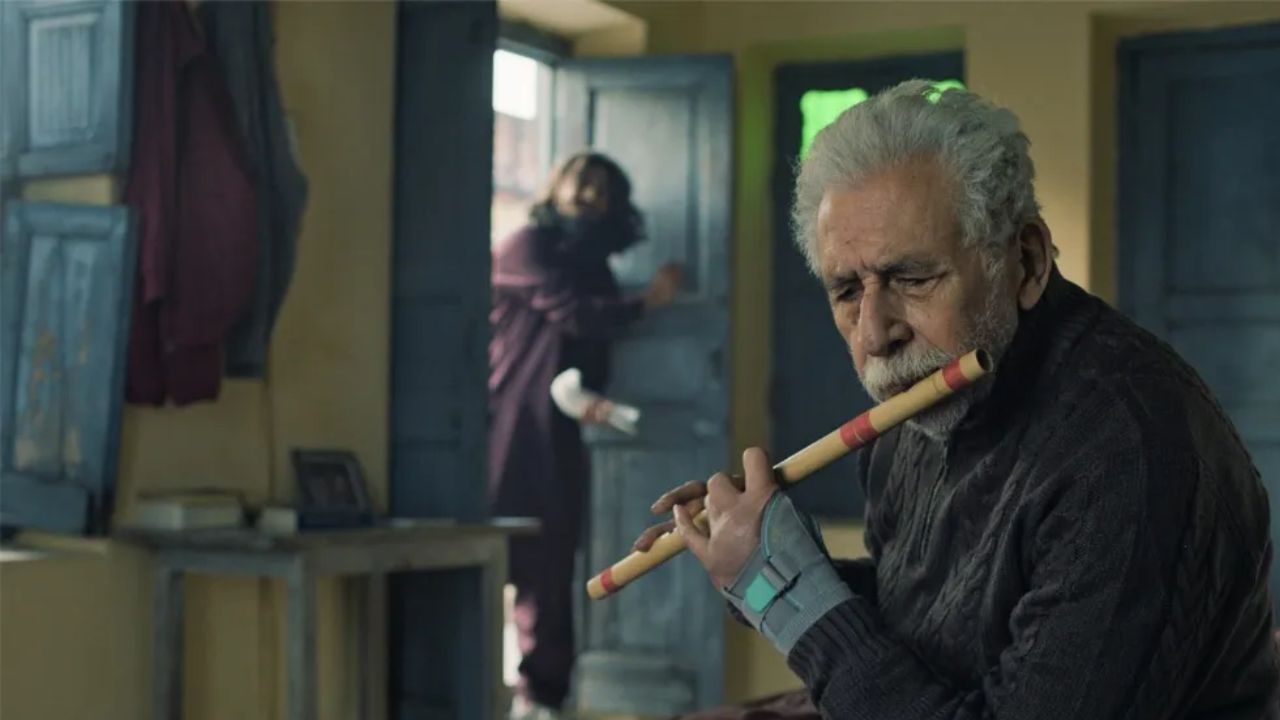



The real-life tragedy of a family in Punjab became an unexpected influence on filmmaker Gurvinder Singh while he was developing his latest film, Rehmat, reports Variety.
The family living in the house used as Rashid Ali’s ancestral home in the film lost their 19-year-old son to a drug overdose shortly after Singh and his team first met them.
Speaking to Variety, Singh recalled meeting the young man and said the experience deeply affected him as a filmmaker.
“The actual family that lives there lost their 19-year-old son after we met them for the first time. When I looked at him, the first thought that ran in my mind was that he was on drugs. And he died of an overdose within two months,” Singh said.
He added that the tragedy made it impossible for him to ignore the realities surrounding the film’s setting.
“How can that not affect you as a filmmaker planning a film in that scenario? How can you avoid depicting such a state of affairs?” he said.
Rehmat will have its world premiere in the Concorso Internazionale, the main competition section of the 79th Locarno Film Festival.
It is the only Indian feature competing in the section this year and will vie for the festival’s top prize, the Pardo d’Oro.
Adapted from short stories by Punjabi writer Ajeet Cour, Rehmat brings together three narratives set in present-day Punjab.

The film explores themes of displacement, inherited grief and the lingering impact of a divided homeland.
Singh said Cour’s writing resonated with his own family history. His grandparents belonged to the generation that migrated from Lahore and other parts of west Punjab to Delhi during Partition.
“I never experienced the Partition, but did feel a sense of trauma during the years of militancy and the anti-Sikh carnage in Delhi in 1984,” Singh said.
He described Rehmat as a form of personal closure, saying the film allowed him to express what he wanted to say about the divided land and its people.
The film stars veteran actor Naseeruddin Shah as Rashid Ali, a Punjabi Muslim man whose family left before Partition. After spending most of his life in England, Rashid returns to his birthplace.
Shah said he agreed to the project without knowing many details about the character.




“I’d seen and been deeply moved by Gurvinder’s films,” Shah said, adding that the director’s portrayal of the turmoil in Punjab had made a strong impression on him.
Interestingly, Singh approached Shah before the screenplay had been written.
He said he only had a rough outline of Rashid when he first contacted the actor.
Shah’s involvement, Singh said, gave him the confidence to develop the character further.
The director also praised Shah’s performance, saying he initially planned to observe the actor before deciding how to direct him.
Instead, he found himself needing to give Shah very little direction.
Singh’s preference for long, uninterrupted takes is also reflected in Rehmat.
The filmmaker said he finds the technique particularly engaging because it creates a strong sense of uninterrupted time.
However, he acknowledged that some scenes required montage rather than extended takes, with both approaches creating different forms of attention.
Shah, who is not Punjabi and does not speak the language fluently, said the limitation helped him portray Rashid as an outsider.
“I don’t speak Punjabi fluently but practice helped,” he said.
The actor also noted that he did not believe an actor necessarily needed to completely understand a character psychologically to portray them.
“Actors aren’t psychoanalysts. One must be able to empathize with the character’s situation,” Shah said.
The film’s locations also influenced Singh’s storytelling. He said the village, with its deteriorating 19th-century school building and neglected lanes, helped reshape the narrative during location scouting.
Speaking about Punjab today, Singh offered a bleak assessment, particularly regarding the younger generation and social attitudes in rural areas.
He pointed to issues surrounding caste, land ownership and gender inequality, saying many young women are choosing to leave for the West.
Alongside Shah, Rehmat stars Suvinder Vicky, Mita Vashisht, Navjot Randhawa and Diya Kamboj.
Punjabi poet Jaswant Zafar also makes his acting debut at 60, playing Harjap.
Singh said he cast Zafar because he believed the poet possessed many of the qualities he had imagined for the character.
Rehmat is produced by Singh and Arpana Caur, with Andrei Cosmin Illes and Némésis Srour as co-producers.
The film is a co-production between India’s Vahao Studio and Paris-based Pavo Films.
For Singh, the film marks another chapter in a career shaped by Punjab, its history and its people.
Asked what he plans to do next, the filmmaker said he is uncertain.
“I came to the cinema through some conspiracy of the universe. I grew up painting and writing. I am painting again these days,” he said.