


A film shoot, a promised celebrity interview and a roomful of furious journalists. Lajja has found itself at the centre of a controversy no publicity campaign would want.
Journalists allege they were lured to the set with the promise of an interview with Nusraat Faria, only to be roped into a film scene without prior notice and left waiting for hours without speaking to the actress.
Now, Faria has thrown a fresh twist into the saga, urging journalists to verify whether an artist has even agreed to an interview before turning up at a shooting location. Her statement has added a new question to an already messy row: who knew what, and who was using whom for publicity?
What began as a frustrating morning at a shooting location has spiraled into a public dispute involving journalists who say their time and professional resources were taken for granted, a production chief who has apologised for the misunderstanding, and an actress urging the media not to take anyone’s word at face value.
The drama unfolded at Diabari in Dhaka’s Uttara area on Saturday, 10 October. According to journalists from several media outlets, Jaaz Multimedia owner Abdul Aziz contacted them on Friday night, asking them to arrive at the set at 8am the next morning. He also told them that Faria would be available for interviews.
The promise appeared straightforward enough. The journalists say they turned up as arranged, with some reaching the location as early as 7am. Reporters, cameramen, vehicles and branded microphones were all part of the effort to cover the shoot and secure the interviews.
But, according to their accounts, the morning took an unexpected turn. The production team allegedly had the journalists appear in a scene from Lajja without telling them beforehand that they would be expected to act. They had arrived to report on a film, they say, only to find themselves becoming part of it.
Then came the wait for Faria. After spending hours at the location, the journalists say they approached the actress for the interviews they had been promised, only to be told that she had an upset stomach. She subsequently left the set, according to their accounts, leaving the journalists without the interviews and furious over how the assignment had unfolded.

The question was no longer simply why the interviews had not happened. If the journalists had been invited on the assurance that Faria would speak to them, had the actress herself been informed of the arrangement?
Faria’s Facebook statement has now brought that question into sharper focus, although it does not settle the conflicting accounts of what happened behind the scenes.
Addressing journalists directly, the actress urged them to verify why a producer, director or production house was inviting them to a shooting location before agreeing to attend. She specifically raised the possibility that their cameras, boom microphones and professional identities could be used to promote a production and boost its popularity.
She also advised journalists to contact the artist concerned before arriving at the set to confirm whether the artist knew about the proposed interview.
“One thing is extremely important to remember: has the artist whose interview is being promised actually given consent for it?” she wrote, stressing that journalists’ time was valuable and that what they were promised might not match what awaited them at the location.
Faria went on to point out that actors working on a film are committed to their projects, while interviews outside that work are a separate matter requiring the artist’s consent and preparation.


Her message was also a warning against rushing to judgement. Urging journalists not to accept one party’s account as the whole truth, she suggested that events behind the scenes might be presented in ways that concealed important details.
“Do not be driven by a spirit of retaliation,” she wrote, appealing to journalists to look beyond what they were being told and to consider the wider circumstances.
The statement did not directly name anyone, nor did it establish whether the production team had informed Faria about the promised interviews. But it introduced another layer to the dispute: while journalists say they were given an assurance that she would speak to them, Faria’s advice raises the question of whether that assurance had been secured from her in the first place.
Aziz, meanwhile, has acknowledged responsibility for the misunderstanding and apologised to the media outlets involved.
Speaking to Times of Bangladesh, he said the intention had been to promote Lajja, which had not received much publicity so far. He said he had not anticipated that the arrangement would lead to such a controversy.
“We wanted to promote the film because it had not received much publicity before. But I did not realise that this kind of misunderstanding would happen. If we had wanted this, I would not have used the channels’ original cameras. I would have used faulty cameras instead,” he said.
His apology has not erased the journalists’ frustration. Nor does it answer every question raised by Faria’s statement. The journalists maintain that they were called for interviews and made to participate in a scene without prior notice; Aziz describes the episode as a misunderstanding arising from a promotional effort; and Faria has stressed that an artist’s consent to an interview should not be assumed.
The fallout has exposed an awkward collision of expectations between a production team seeking publicity, journalists trying to deliver coverage to their newsrooms, and an actress whose promised availability has become central to the dispute.
For Muhib Al Hasan of Somoy TV, the problem was what his reporter had gained after the time and resources spent travelling to the location.
“They shot the scene, fine. But I sent a reporter. What did my reporter get out of it? A driver, a car, a cameraman and a reporter went there. What did they get? How could Faria dare to insult so many media outlets?” he said.
Robiul Islam Rubel of Jatiyo Arthoniti said journalists could not simply return to their offices after hours of waiting and offer the misunderstanding as an explanation.
“We have to answer to our offices. We cannot just tell them that a mistake happened. They got journalists with original branded microphones, and we still said nothing. We sat there from 7am until 12.30pm. Her stomach was fine all that time, but when it was time to speak to us, she suddenly had an upset stomach,” he said.
Makshudul Haque Imu of DBC was particularly critical of the allegation that journalists had been made to act in the film without being told in advance.
“Those who went there went for news. Nobody went to act in a film. They could simply have said so. We could have sent some students from Dhaka College or Titumir College instead. They could have gone and acted in the scene,” he said.
Faria’s response to the journalists’ specific allegations was not available beyond her Facebook statement. While Aziz has apologised, the accounts leave unresolved how the interview arrangement was communicated and why the journalists say they were drawn into a film scene without prior notice.
The irony is hard to miss. Lajja, whose story focuses on social awareness, is now attracting attention over a behind-the-scenes dispute about professional boundaries, consent and the use of media resources for publicity. Whether the episode stemmed from a breakdown in communication or something more deliberate remains unclear, but the controversy has left all sides facing questions about their roles in the affair.
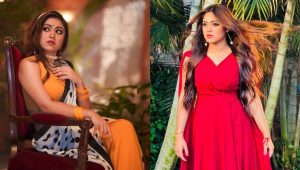
A joint production of Impress Telefilm and Jaaz Multimedia, Lajja is directed by MH Khokon, with Aziz writing the story. Azmeri Haque Badhan and Faria play the two central characters, marking the first time the actresses will appear together on the big screen. The makers have yet to announce the remaining cast members.
The two production companies signed an agreement at the Channel i office in early September, attended by Impress Telefilm and Channel i managing director Faridur Reza Sagar and Aziz. The film is scheduled for a theatrical release in 2027, followed by its availability on the OTT platform iScreen.
The makers first announced Lajja on International Women’s Day in 2024. Faria returned to Jaaz Multimedia after nearly seven years with Jinn 3, having made her big-screen debut in 2015 with the production house’s Aashiqui.
For now, the film’s publicity drive has become a controversy of its own. Journalists say they were promised interviews but ended up as extras; Aziz says he never intended the misunderstanding; and Faria is urging the media to verify what happens behind the scenes before drawing conclusions.
The central question remains: how did an invitation to cover a film turn into a dispute over who was using whom for publicity?