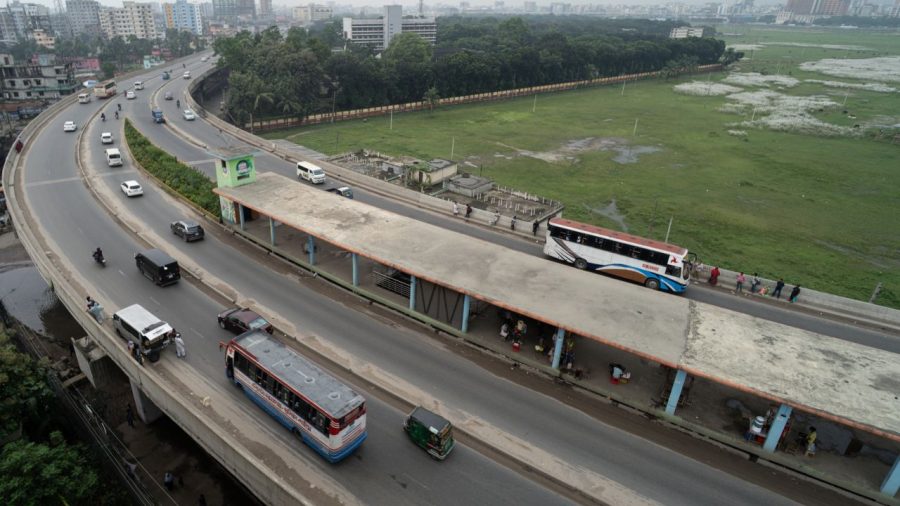

Bangladesh is already paying foreign loan instalments and interest for a Bus Rapid Transit (BRT) system that remains without a destination after more than 14 years and thousands of crore taka in spending.
The 20-kilometre corridor from Dhaka airport to Gazipur was once projected as a congestion-free, signal-free, affordable and environmentally friendly transport solution.
More than a decade later, that promise remains unfulfilled, turning the project into what critics describe as a classic example of poor planning and flawed execution.
More than Tk3,000 crore has already been spent, yet not a single BRT bus has entered service. Meanwhile, escalators and other equipment at stations started rusting after attacks on state facilities during the mass uprising two years ago.
What remains is a debt burden running into thousands of crore taka, to be repaid over the next two decades.
Mega projects in Bangladesh often begin with ambitious promises of economic growth, improved connectivity and easier lives. But as implementation progresses, revisions pile up, deadlines extend, costs rise and foreign debt accumulates.
The Gazipur BRT project followed the same path.
Project Director (additional charge) Rezaul Karim could not provide a clear picture of the project’s future.
“The latest discussion at Ecnec was that the project was not undertaken properly. However, we have not yet been able to take a final decision,” he told TIMES.
Costs rise, deadlines stretch
When approved in 2012, the project cost was estimated at Tk2,040 crore, with a completion deadline of 2016.
Since then, the deadline has been extended five times and the cost revised three times.
The third revision raised the project cost to Tk4,268 crore.
In 2025, the Road Transport and Highways Division proposed a fourth revision, adding another Tk2,329 crore and extending the deadline to 2029. The revised cost would have reached Tk6,597 crore.

Then interim government rejected the proposal.
Unused loans, mounting debt
Government data shows Tk2,810.62 crore has been spent so far, leaving nearly Tk1,500 crore unused.
Of the Tk3,022 crore in foreign assistance, Tk2,061.75 crore has been spent, while around Tk960 crore remains unused.
The Asian Development Bank’s (ADB) $100 million ordinary capital resources (OCR) loan and the French Development Agency’s (AFD) €45 million loan have been fully utilised.
Of another $60 million ADB concessional loan, 99 per cent, or $52.5 million, has been used.
The biggest uncertainty surrounds an additional $100 million ADB ordinary loan. Bangladesh has drawn $51.7 million from it, but the remaining amount could be cancelled if it is not used by 31 December this year.
The government must also pay a 0.15 per cent annual commitment charge on unused ADB ordinary loans. Funded by taxpayers’ money, the project has failed to serve commuters and has instead become a hazard for road users.
A €62 million AFD loan was taken to purchase and operate buses. Since no buses have been purchased, none of that money has been used.
The grace periods for older ADB loans have already expired. As a result, the government is now repaying principal and interest from the national budget despite the project remaining inactive.
Most of the approximately $249 million in disbursed loans remain unpaid. Even though the project has not become operational, debt repayments are being made from the finance ministry’s budget.
The country is also paying $7 million-$9 million annually in interest.
Repayment of the principal on the additional $51.70 million ADB loan will begin at the end of 2027.
A BRT without buses
A BRT system is built around specialised buses. Yet the biggest irony is that Bangladesh has not purchased a single bus in 14 years.
According to recommendations from the United Nations Economic and Social Commission for Asia and the Pacific (ESCAP) in 2017, the original plan was to operate 18-metre articulated buses with automatic doors. The plan was later abandoned.
The government then moved towards electric buses and floated a tender, but withdrew it later.
In April 2024, another tender was floated to purchase 137 diesel-powered air-conditioned buses. That effort also failed.
94.82 per cent progress, unusable infrastructure
ADB data shows the project has achieved 94.82 per cent physical progress.
Most of the spending has gone into road widening, flyovers, Tongi bridge, stations and depot construction.
Yet the infrastructure remains largely unusable.
None of the 15 stations built along the corridor is operational. An escalator installed at a station in Uttara is now out of service, while lifts and escalators are deteriorating from neglect.
Concrete barriers and iron fences separating BRT lanes have been damaged at several points along the 20-kilometre route.
Experts point to design flaws as a major weakness.
Roads narrow near stations, while staircases from footbridges occupy large portions of pavements. Designs at key intersections such as Abdullahpur, Bhogra and Gazipur Chowrasta have limited future transport options.
Work also began before a comprehensive feasibility study was completed and designs were finalised.
Poor coordination over utility relocation and inadequate drainage have contributed to year-round waterlogging and traffic congestion.
Too many agencies, little coordination
Three government agencies were involved in implementing the project.
The Roads and Highways Department was responsible for 16 kilometres of road widening, BRT lanes, six small flyovers and 25 stations.
The Bridges Division handled the four-and-a-half-kilometre flyover and the 10-lane Tongi bridge.
LGED was responsible for service lanes, Gazipur depot, traffic control equipment and streetlights.
Four consultancy firms supervised the work, while a Dhaka Transport Coordination Authority committee handled coordination.
A separate company, Dhaka Bus Rapid Transit Company Limited (DBRTCL), was formed in 2013 to operate the buses.
The company has 18 officials and employees, including a managing director, mostly drawn from other government offices.
But without buses, the company has had little practical work for 13 years.
It is now seeking responsibility for the proposed BusNet company.
But Md Nurul Amin Khan, managing director of DBRTCL, told TIMES, “It still remains uncertain whether the project will be continued, cancelled or moved forward in another form.”
Searching for a way out
After Ecnec rejected the fourth revision proposal, authorities began exploring alternatives and identifying those responsible for design failures.
Two committees were formed on 31 August 2025 under the leadership of the Road Transport and Highways Division’s senior secretary.
At a meeting chaired by then Road Transport Adviser Muhammad Fouzul Kabir Khan on 9 October, BUET Professor Shamsul Hoque was assigned to review the committees’ reports.
Rezaul Karim said the main question raised at Ecnec was whether the project had been properly conceived.
A high-level government meeting on the BRT’s future was held on 15 June under Prime Minister Tarique Rahman. Although investment and public suffering were discussed, no final decision was taken.
Four options on the table
Transport expert Hadiuzzaman told TIMES that four options are now being discussed.
The first option is to scrap the project completely, demolish existing infrastructure such as stations, platforms and lane dividers, and restore the road to its previous 3+3-lane highway structure.
The Bangladesh Institute of Planners, however, argues that abandoning the project with only 3 per cent infrastructure work remaining would be impractical. Demolition, removal of stations, ramps and escalators and contractor compensation could cost more than Tk1,000 crore.
The second option is to convert the BRT corridor into a toll-based express lane.
The third option is to complete the existing BRT plan.
The fourth option is to create an integrated public transport corridor by modifying existing buses to operate both on mixed lanes and the BRT corridor.
Hadiuzzaman said the prime minister is mainly focusing on the final two options.