


The government’s decision to launch a Tk20,000 crore bailout package for five troubled Islamic banks has once again brought Bangladesh’s long-standing use of public funds to rescue weak banks under scrutiny.
Under the initiative, First Security Islami Bank, Social Islami Bank, Union Bank, Global Islami Bank and EXIM Bank will be merged into a new entity, tentatively named Sammilito Islami Bank. It marks the country’s first large-scale direct bailout of distressed private commercial banks.
The move has revived wider concerns over the health of Bangladesh’s banking system, where repeated state interventions have long masked deeper structural weaknesses rather than resolving them.
Yet government-funded support for troubled banks is not new. For more than a decade, successive governments have repeatedly recapitalised state-owned banks to cover capital shortfalls, meet regulatory requirements and protect depositors. Economists say these capital injections have prevented immediate institutional collapse but have failed to resolve the structural causes of banking sector weakness, including poor governance, rising default loans and weak accountability.
Bailouts and recapitalisation history
Bangladesh currently has four state-owned commercial banks (SCBs)—Sonali Bank, Janata Bank, Agrani Bank and Rupali Bank. Bangladesh Bank classifies Rupali Bank as an SCB because the government holds a majority stake. Bangladesh Krishi Bank and Rajshahi Krishi Unnayan Bank are specialised banks, while Bangladesh Development Bank PLC (BDBL) operates as a development finance institution (DFI). These institutions are state-owned but are not included in the SCB category.
Because SCBs hold roughly one-quarter of the banking sector’s assets and deposits, their financial condition has a significant impact on overall financial stability.
Between FY2009-10 and FY2016-17, the government injected Tk15,710 crore (Tk157.1 billion) into state-owned commercial banks through direct recapitalisation from the national budget to address capital shortages and meet regulatory capital requirements. The funds came from government budget allocations rather than Bangladesh Bank.

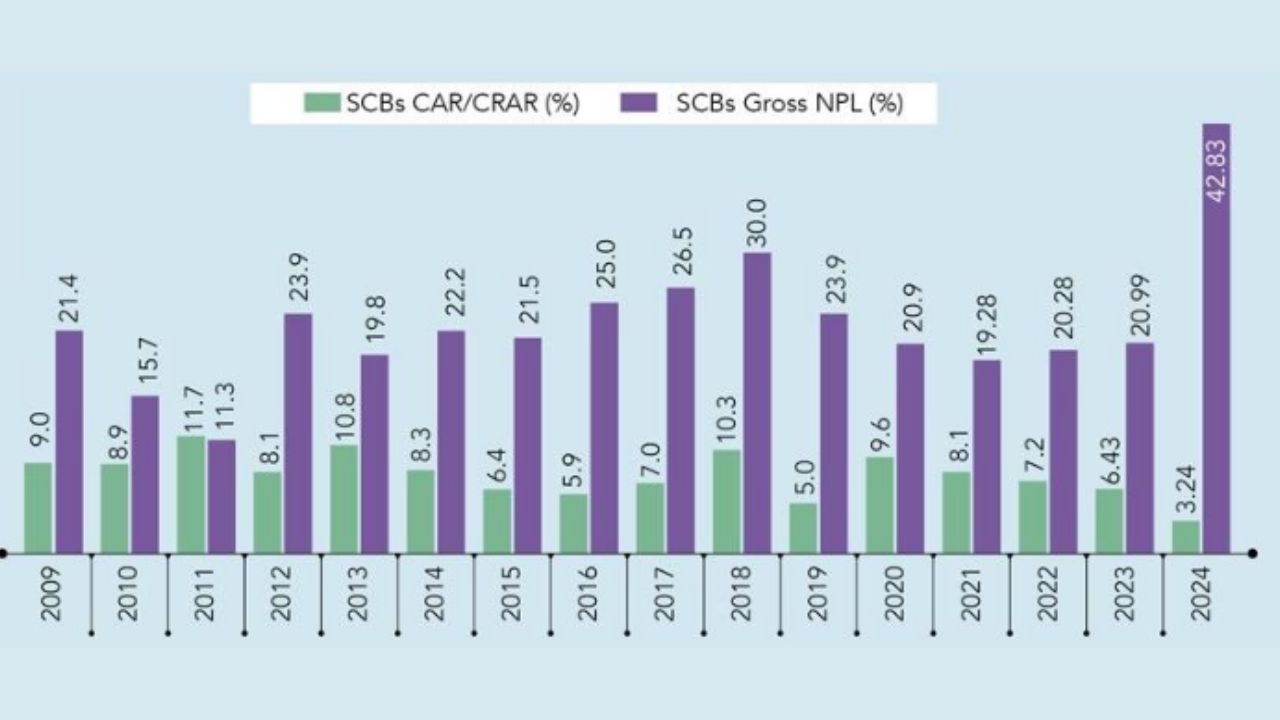
State-owned banks under pressure
Against this backdrop of repeated bailouts and growing fiscal exposure, bank performance is typically assessed through two key indicators that determine whether an institution is fundamentally stable or structurally distressed.
Two indicators are widely used to assess a bank’s financial condition: the Capital Adequacy Ratio (CAR), also known as the Capital to Risk-Weighted Assets Ratio (CRAR), and the Non-Performing Loan (NPL) ratio.
CAR measures how much capital a bank holds against its risk-weighted assets and reflects its ability to absorb unexpected losses. Under the Basel III framework adopted by Bangladesh Bank, every bank must maintain a minimum CAR of 10 per cent or at least Tk400 crore in capital, whichever is higher.
NPL refers to loans whose scheduled repayments have remained unpaid long enough to be classified as defaulted under Bangladesh Bank regulations. Rising default loans force banks to maintain larger provisions against potential losses, reducing profitability, eroding capital and limiting their ability to extend new credit.
Analysts therefore evaluate CAR and NPL together. Strong capital combined with low default loans generally indicates a healthy institution, while weak capital and high NPLs signal financial distress.



Bangladesh Bank’s latest data show that the condition of state-owned banks remains fragile. As of March 2025, the CRAR of SCBs had fallen to just 2.90 per cent, far below the regulatory minimum of 10 per cent. At the same time, gross non-performing loans accounted for 45.79 per cent of their total outstanding loans.
Specialised state-owned banks face even deeper problems. Their CRAR stood at negative 38.88 per cent at the end of March 2025, while 14.47 per cent of their loan portfolios were classified as non-performing.
Default loans remain the core challenge
Default loans have long been considered one of the biggest structural weaknesses in Bangladesh’s banking sector.
A 2019 review by the Centre for Policy Dialogue (CPD) described default loans as the defining feature of the country’s banking crisis. The think tank noted that although governments have repeatedly allocated funds to recapitalise troubled banks, the underlying problems remain unresolved and bad loans have continued to increase.
According to CPD, classified loans exceeded Tk1 trillion for the first time in March 2019, while the NPL ratio rose from 10.30 per cent in the previous quarter to 11.87 per cent.
CPD also found that between 2010 and 2018, cumulative default loans amounted to 31.50 per cent of GDP. During the same period, combined government spending on education and health totalled only 24.03 per cent of GDP—17.65 per cent for education and 6.38 per cent for health. The comparison illustrates the enormous economic cost of persistent loan defaults.
In 2018 alone, classified loans reached Tk893 billion (Tk89,300 crore), equivalent to 10.41 per cent of total loans and around 3.73 per cent of GDP.
The organisation further warned that the true scale of distressed assets would have been even larger without repeated loan rescheduling and write-offs. Outstanding written-off loans reached Tk401 billion by December 2018.
Loan restructuring has also produced limited success. CPD reported that 43.1 per cent of foreign trade loans and 42.6 per cent of commercial loans that were rescheduled for the first time in 2018 became non-performing again.
According to the think tank, recapitalisation and loan rescheduling alone cannot resolve banking sector weaknesses unless governance improves, political influence over lending declines and effective loan recovery mechanisms are enforced.
Structural weaknesses persist
The persistence of high default loans, weak capital buffers and repeated public recapitalisation has reinforced the view among analysts that Bangladesh’s banking vulnerabilities are structural rather than cyclical, requiring reforms beyond emergency financial support.
Economist Mustafizur Rahman said years of irregularities, political influence, weak supervision and wilful loan defaults have left many banks in such poor condition that government support has become unavoidable.
He said using taxpayers’ money to rescue banks is undesirable, but allowing financially distressed institutions to fail could create wider instability across the financial system.
“It is an unpleasant but necessary decision under the current circumstances,” he said.
However, Rahman stressed that recapitalisation alone cannot solve the problem. Those responsible for corruption, fraud and deliberate loan defaults must be held accountable, while legal efforts to recover defaulted loans should be strengthened. Authorities should seize collateral where appropriate, recover public funds and ensure the money eventually returns to the state.
He said the banking crisis did not emerge overnight and therefore cannot be resolved quickly. Temporary government support may be necessary to maintain confidence in the financial system, but it must be accompanied by comprehensive reforms.
Rahman also called for fundamental changes in Bangladesh’s lending culture so that political influence, pressure from powerful business groups and board interference no longer determine credit decisions. He urged Bangladesh Bank to strengthen supervision and improve governance across the banking sector.
He added that taxpayers are ultimately paying twice for banking failures—first when public deposits are lost through irregularities and loan defaults, and again when the government uses tax revenue to recapitalise troubled banks.
While temporary rescues may be necessary to preserve financial stability, he said Bangladesh must implement lasting reforms to ensure taxpayers are not repeatedly forced to finance future banking crises.