

The excitement of the World Cup has moved beyond stadiums and television screens and is now shaping the fashion market in Bangladesh, where football-themed sarees are gaining popularity.
Rajon Kumar Majumdar of Swapno Jatra said Argentina is the most popular design, making up about 70 per cent of total demand, followed by Brazil.
He explained that the company first introduced flag-themed sarees four years ago during the previous World Cup, which were well received. Initially, only Argentina designs were produced, but Brazil designs were added due to customer demand.
Rajon said the seasonal business yields around 20 per cent profit. About 40 per cent of buyers are from Dhaka, 30 per cent from outside the capital, and roughly 30 per cent are living abroad. Four years ago, the sarees sold at around Tk2,500, while this year the price is under Tk1,900. Sales are currently moderate, but demand is expected to rise as the World Cup progresses.
Another online seller, Horitoki, said World Cup sarees are attracting strong attention. Co-founder Anik Kundu reported over 500 sarees sold so far this season, with 30 to 50 daily orders. Argentina-themed sarees account for 55 per cent of sales, Brazil 40 per cent, and other teams 5 per cent.

Most buyers are men purchasing sarees as gifts, with expatriates from countries like the US and Canada also placing orders. Demand outside Dhaka is comparable to the capital.
The sarees are currently available at a promotional price of Tk1,500, set to rise to Tk1,690 when the World Cup begins.
Swapno Jatra manufactures the products in-house and expects sales to increase as the tournament nears.



Local online boutique Sharee GhAr is leading the trend. Owner Hedayet Sajid said the shop introduced Argentina-themed and “Seven-Up” theme-based sarees, the latter poking fun at Brazil. While jerseys remain the main choice for fans due to comfort, Sajid is promoting sarees as a fashionable alternative.
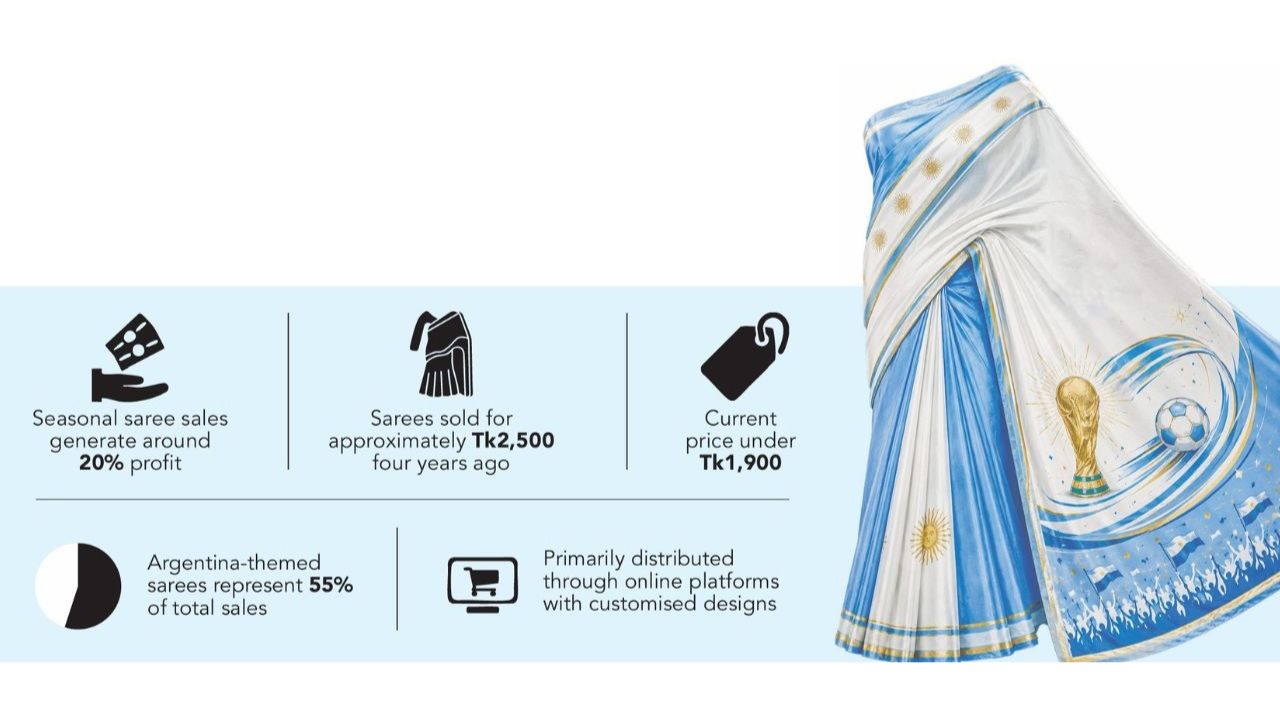
“The demand for these specialised sarees will surge as the tournament progresses,” Sajid said. Argentina-themed designs currently outperform Brazil-themed sarees. The store also sells jerseys through the platform Classy, but the focus is to encourage women to wear the themed sarees.
Order data shows significant demand outside Dhaka. About 30 per cent of orders come from Dhaka, 70 per cent from districts including Feni, Sylhet, and Lakshmipur, and 20 per cent from abroad, largely expatriates buying gifts.
Despite the niche market, production runs steadily to cater to both new and repeat customers, with profit margins between 20 per cent and 35 per cent. Sharee GhAr plans to release additional themed designs, anticipating continued demand throughout the month-and-a-half-long tournament.
Currently, World Cup-themed sarees are mainly sold via online platforms offering customised designs. Approximately 10 to 15 online jersey-focused platforms, including Valorex, Savageon, FitFreak BD, Dream Jersey BD, Jersey Wave BD, Jersey.com.bd, Jersey Junction BD, Jersey Club BD, and Jersey Addix, are active.
Many retail outlets also sell jerseys through physical and online channels, expanding availability across customer segments.
Raj Ahmed, owner of Brand Outlet, said the World Cup season drives business, with 50 per cent to 80 per cent of total sales still coming from the physical shop despite online expansion. Profit margins reach around 50 per cent. Male and female customers make up roughly 50 per cent each of the clientele.
Online seller Rakib Hasan Tuhin of Jersey Grand said sales rise significantly during major football events, from 5–6 jerseys daily to 10–12 per day. Argentina jerseys remain dominant, but Brazil jerseys have gained popularity following Neymar’s performances.
Most orders come from districts outside Dhaka, particularly Sylhet, Chattogram, and Kushtia. Jerseys are sourced from importers in China, priced between Tk1,500 and Tk3,000, with profit margins of 15–20 per cent.
Customer Sheikh Rafid said buying jerseys during major tournaments is a way to show support for favourite teams and players, adding that wearing a jersey enhances the World Cup experience. Argentina and Brazil jerseys are the most popular, reflecting strong fan bases and star-player loyalty.
The World Cup season has intensified consumer enthusiasm, with purchases driven by passion, team loyalty, and emotional connection rather than fashion alone.