
The impact of rising prices has spread to education supplies, with the cost of notebooks, pens and other stationery increasing by around one and a half times over the past four years.
Prices have remained broadly stable at these higher levels for about a year, pushing up students’ education expenses accordingly.
While the increase has had little impact on affluent families, middle- and lower-income households are feeling the strain and having to cut other parts of their monthly budgets to meet the cost of education supplies.
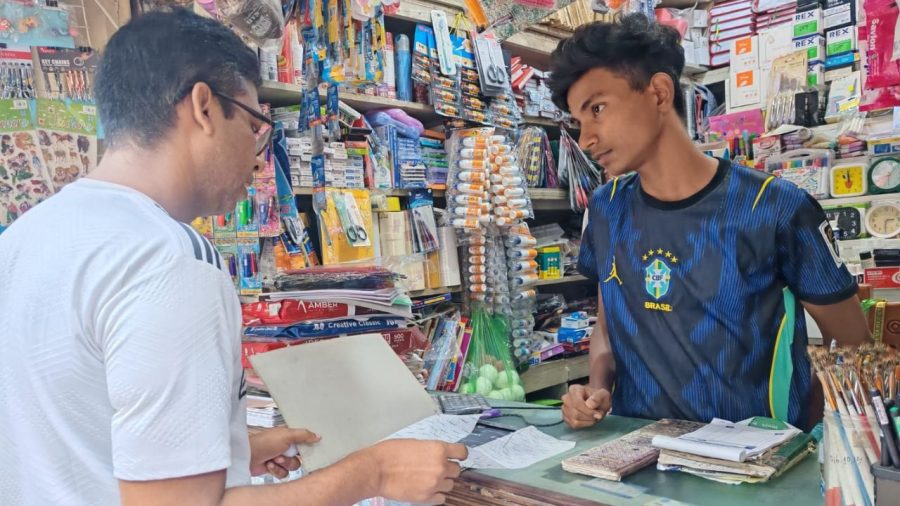
Visits to several stationery shops in Jashore city found that the prices of notebooks and other educational materials have become a growing burden for consumers.
Traders said current prices have remained largely unchanged for about a year, but notebooks, pens and other education supplies have become around one and a half times more expensive over the past four years.
A 124-page notebook is now selling for Tk50 at stationery and education supply shops.
The same notebook cost Tk35 four years ago and Tk40 a year ago.
A 300-page notebook is now selling for Tk110 to Tk115, compared with Tk65 four years ago and Tk100 a year ago.
Prices have risen at a similar rate for other notebooks, with a 160-page notebook selling for Tk60 and a 204-page notebook for Tk80.
Depending on the company, 72-page practical notebooks are selling for Tk80 to Tk90, while 96-page ones cost Tk100.
A few years ago, such notebooks were sold for Tk50 to Tk70.

A 300-page register book now costs Tk160 to Tk170, up from Tk120 to Tk140 previously.
A 500-page register book is selling for Tk300, compared with Tk180 to Tk200 earlier.
A 200-page register book now costs Tk120 to Tk130.
Prices of A4 paper have also increased.
A packet of 500 sheets of 60-gram paper is selling for Tk310, 70-gram paper for Tk330, 80-gram paper for Tk400 and 100-gram paper for Tk500.
A year ago, these packets were sold for around Tk100 less on average.
Pen prices have also risen, although the increase has had a greater impact at the wholesale level.




Pens that retailers previously bought for Tk45 a dozen now cost Tk50, while those that cost Tk50 now sell for Tk55.
At retail level, these pens are sold for Tk5 to Tk6 each.
Pens retailing at Tk10 each previously cost sellers Tk100 but now cost Tk110.
Meanwhile, Tk5 pencils have disappeared from the market and the wholesale price of Tk10 pencils has also risen.
Although eraser prices remain unchanged, their size has decreased.
Erasers priced at Tk5 and Tk10 are now considerably smaller than before.
A geometry box that could be bought for Tk60 about a year ago now costs Tk100.
Said Hasan, proprietor of Royal Stationery in Jame Mosque Lane, Jashore’s largest stationery market, said paper and notebooks have been selling at their current prices for nearly a year.
“Prices have risen significantly over the past few years. As a result, middle-income families have to adjust their monthly budgets to buy notebooks and pens,” he said.
Ahsanullah Moyna, proprietor of Moyna Stationery, said the cost of paper and pens has risen in line with price increases across the wider market.
“As a result, many customers now bargain before buying products. They are also trying to cut back on spending,” he said.
Mohammad Al-Amin, a salesperson at Royal Book Depot in the Collectorate Book Market on Muktijoddha Ali Hossain Moni Road, said pen prices have increased alongside notebook prices.
“However, the increase in pen prices has mainly been on a per-dozen basis, so the impact at retail level has been smaller. Erasers still cost Tk5 to Tk10, but each one is now smaller than before,” he said.
Hafizur Rahman, who runs a photocopy shop near Zila School intersection in the city, said rising ink and paper prices have also affected photocopying costs.
Customers are now charged Tk2.50 per page for one or two pages and Tk2 per page for larger quantities.
Photocopying costs are even higher outside the main city area, he said.
Rahman said that after covering the costs of paper, ink, electricity and machines, photocopy shop owners in the city are left with very little profit, making it increasingly difficult to make a living.
Yasmin Akter, a homemaker from the city’s Shankarpur area, said prices of almost everything in the market were already high.
Her two daughters attend school, meaning the higher cost of notebooks, pens and other stationery has forced the family to plan purchases carefully.
“Prices of many things in the market suddenly go up, but our income does not increase,” she said.
Subarno Papers and Stationery in Jashore’s Jame Mosque Lane is a dealer for Bashundhara Group notebooks and RFL Group stationery products.
Its proprietor, Fahmid Sami, said companies have raised the prices of all types of notebooks and stationery products over the past four years.
“We are selling them at those prices. The prices of notebooks and stationery products, particularly pens and pencils, have increased. Profit margins on these products are low. The price of some pens has increased by Tk2 to Tk3,” he said.
“The price of paper has increased somewhat more. We sell paper and stationery products wholesale to different shops in Jessore. They then sell the products after adding their own profit margins.”
Jashore Chamber of Commerce and Industry President Mizanur Rahman Khan said most stationery shops in Jashore city are members of the chamber.
“We have seen that the prices of notebooks of different sizes and page counts used in schools and colleges have increased,” he said.
He said global factors were behind the rise in prices.
“The raw materials used by these factories have to be imported from abroad.
As import costs have increased, production costs have also risen. As a result, consumers are having to pay higher prices,” he said.