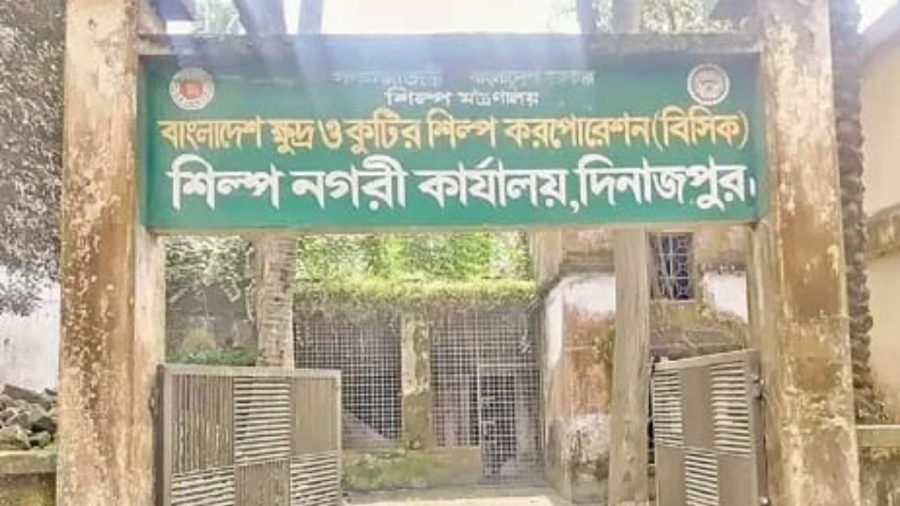

Despite completing 64 years since its establishment, the Bangladesh Small and Cottage Industries Corporation (BSCIC) industrial estate in Dinajpur has failed to develop into the expected industrial hub.
Although around Tk225.50 crore has been invested and thousands of people have found employment there, the industrial area still lacks a boundary wall and an effective drainage system.
Waste management remains weak, while waterlogging occurs during the monsoon. Entrepreneurs have complained that these problems prevent them from receiving expected services. Businesspeople also said new entrepreneurs are losing interest in setting up industries there.
The BSCIC industrial estate was established in 1962 on 35.14 acres of land at Pulhat in Dinajpur city at a cost of Tk45.54 lakh.
The project was completed in 1972. At the time of establishment, 189 industrial plots were allocated, covering 28.74 acres.
According to BSCIC data, the industrial estate currently has 54 industrial units, of which 52 are in production.
Messrs Habiba Aluminium Industries (Pvt) Ltd and Messrs Rupon Oil and Feeds (Pvt) Ltd have remained closed due to becoming loan defaulters after taking bank loans and pending court cases.

The industrial estate houses various industries, including food processing, rice mills, engineering, chemical, forest-based industries, bakeries, silver products, automatic flour mills and pulse and oil mills.
According to plot classifications, there are 33 A-type plots measuring 15,000 square feet each, 42 B-type plots measuring 9,000 square feet each, 64 C-type plots measuring 4,500 square feet each and 65 D-type plots measuring 2,250 square feet each.
BSCIC data showed that around 4,825 workers and employees are employed at the industrial estate. Of them, 3,377 are men and 1,448 are women.
The total investment in industrial units stands at Tk225.50 crore, while the annual production value is Tk302.58 crore.




The government earns Tk201.54 lakh annually from the industrial estate through various sectors, according to BSCIC data.
The revenue included Tk165 lakh from income tax and value-added tax (VAT), Tk0.03 lakh from telephone services, Tk1.35 lakh from electricity, Tk4.26 lakh from land development tax, Tk0.90 lakh from municipal tax and Tk30 lakh from service charges and transfer fees.
Despite such investment and employment generation, weak infrastructure has emerged as the biggest challenge.
The lack of a boundary wall has raised security concerns in the industrial area. At the same time, poor drainage causes water to accumulate during the monsoon, creating difficulties for workers’ movement and the transportation of goods to and from industrial units.
Entrepreneurs have also complained about regular accumulation of waste around the industrial area.
They said without infrastructure development and regular services, operating existing industries becomes costly.
Entrepreneurs said they have to pay Tk4.31 per square foot annually, including the service charge of Tk3.50, VAT and land-related charges.
They alleged that despite making regular payments, they are not receiving the expected services.
Dinajpur Rice Mill Owners’ Group President Md Nuruzzaman Sarker said BSCIC should take immediate steps to identify and resolve issues, including drainage improvement, construction of a boundary wall and security concerns.
Dinajpur Chamber of Commerce and Industry President, Askorpur Union Parishad Chairman and auto rice mill owner Md Abu Bakar Siddique said service charges were increasing every year, but expected services were still unavailable.
“As a result, new entrepreneurs are losing interest. Without proper services and government support, it is not possible to create new entrepreneurs,” he said.
However, BSCIC authorities said initiatives had been taken to resolve the problems.
Dinajpur BSCIC Deputy General Manager Md Zahedul Islam acknowledged various issues, including the absence of a boundary wall, road conditions, drainage and waste management.
“The industrial estate needs renovation. An estimate for allocation for constructing a boundary wall in the 2025-26 fiscal year has been sent to the head office. Once the allocation is received, the boundary wall will be constructed and other problems will be addressed,” he said.
Businesspeople and entrepreneurs questioned why basic infrastructure and service shortages had not been resolved despite more than six decades of investment, production and employment growth at the industrial estate.
They said if the existing problems were addressed quickly, Dinajpur BSCIC could become not only a place for sustaining old industries but also a major centre for creating new industries and employment.