
For years, the National Cricket League’s longer format carried an unflattering nickname. It was often called ‘picnic cricket’, a label that reflected the perception of a competition where standards, facilities and even the seriousness surrounding first-class cricket fell short of expectations.
That picture has gradually started to change.
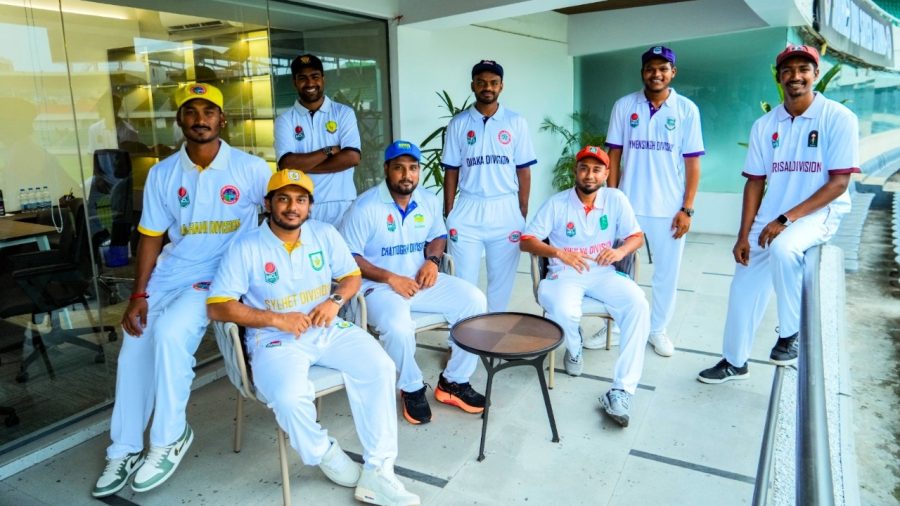
Better match fees, improved allowances, fitness testing, air travel and upgraded logistics have all contributed to a different NCL in recent years. Now, as the 28th edition approaches, the Bangladesh Cricket Board has added another touch to its first-class identity, coloured baggy caps for the eight divisional teams.
On Wednesday, the captains of the eight teams were presented with their specialised first-class baggy caps at a ceremony at the Tigers Den inside the Sher-e-Bangla National Cricket Stadium in Mirpur.
It was a small ceremony, but there was something symbolic about seeing the captains in their white jerseys and coloured caps, posing together in the balcony of the newly formed Tigers Den. For a competition that has spent years trying to establish a stronger first-class culture, the scene offered a glimpse of a changing identity.
The NCL begins on October 3 and runs until November 17. Eight divisional teams will play seven rounds of four-day cricket, with each side facing the other seven once. The team finishing top of the points table will be crowned champions.

Rangpur captain Akbar Ali, Dhaka’s Mahidul Islam Ankon, Rajshahi’s Pritom Kumar, Chattogram’s Yasir Ali Rabbi, Khulna’s Mohammad Mithun, Barishal’s Iftekhar Hossain Ifti, Mymensingh’s Rakibul Hasan and Sylhet’s Zakir Hasan attended the ceremony.
The captains later arrived at the press box in pairs for a series of media interactions. Yasir and Pritom came first, followed by Rakibul and Zakir. Akbar then joined Mahidul, while Mithun, the oldest captain in the competition, arrived alongside Barishal’s Ifti, the youngest.
There was even a small reminder of the generation gap. When Mithun began his first-class career, Ifti was only four years old. But the caps were the day’s main attraction, and each captain appeared eager to put the new symbol of first-class cricket on his head.
Sylhet’s skipper Zakir Hasan was asked about Sylhet’s yellow cap.



“The green colour represents Sylhet’s tea. Since our national team has the baggy green, I assume that might be why the cap is yellow. I don’t actually know the exact reason, though. It’s just my assumption,” the left-hander said.
Barishal’s maroon cap stood out among the eight. Mithun could not resist a joke after seeing Ifti wearing it.
“He looks pure Caribbean,” Mithun said with a smile.
For Yasir, however, the significance was less about the colour and more about what the cap represents.
“Despite debuting in 2012, this is the first time I’ve seen the NCL have a ceremony like this. I was really excited when I heard about it. The baggy cap carries a lot of prestige, especially for those of us who love Test cricket,” he said.
Yasir also spoke about how much the competition has changed from the days when the NCL was casually dismissed as ‘picnic cricket’.
“At one point, the NCL was called ‘picnic cricket’. But over the last two or three years, the board has improved things significantly. Fitness tests have been introduced, match fees and allowances have increased, and we now travel by air instead of bus. I don’t think there are many areas where the NCL is lacking anymore,” He said.
Yet the caps were not the only change waiting for the players this season.
After using Dukes balls since 2022, the NCL is returning to Kookaburra, the ball used in the competition before the switch. The change could alter the balance between bat and ball.
The hand-stitched Dukes, with its pronounced seam, tends to retain its movement for longer and has offered pace bowlers greater assistance, particularly early in an innings. The machine-stitched Kookaburra, meanwhile, has traditionally been more familiar to Bangladesh’s domestic cricketers.
Mahidul acknowledged that the Dukes had presented a particular challenge.
“Dukes was actually quite challenging for us, especially the batters, as it swings for a long time. But it helped everyone improve. We’re used to the Kookaburra, so if we have the skill and commitment, hopefully every team can handle the challenge and do well,” he said.
Akbar does not expect the return of the Kookaburra will make run-scoring straightforward.
“I don’t think scoring runs is easy in any form of cricket. You always have that challenge because you don’t get easy balls,” he said.
For Mithun, the changing NCL is best understood by looking back at where he started.
The Khulna captain made his first-class debut in 2006, when the financial rewards and facilities were far removed from what players receive today. The BCB has now raised the first-class match fee from 75,000 to Tk 1,50000 BDT.
“I don’t think you can compare where I started with where we are today. I made my debut in 2006, when I was in the Under-17 setup. We used to get Tk 800 as daily allowance, and the match fee for playing 10 matches was Tk 25,000. Everyone knows how much things have changed since then,” Mithun said.
A BCB official, speaking on condition of anonymity, said the coloured caps may be a new addition to the NCL, but they are part of a broader effort to strengthen the identity and tradition of first-class cricket.
“The baggy cap is more than just a cap. It represents first-class cricket and carries a sense of pride and tradition. We wanted to give the NCL that identity, and this initiative is a step in that direction,” the official told TIMES.