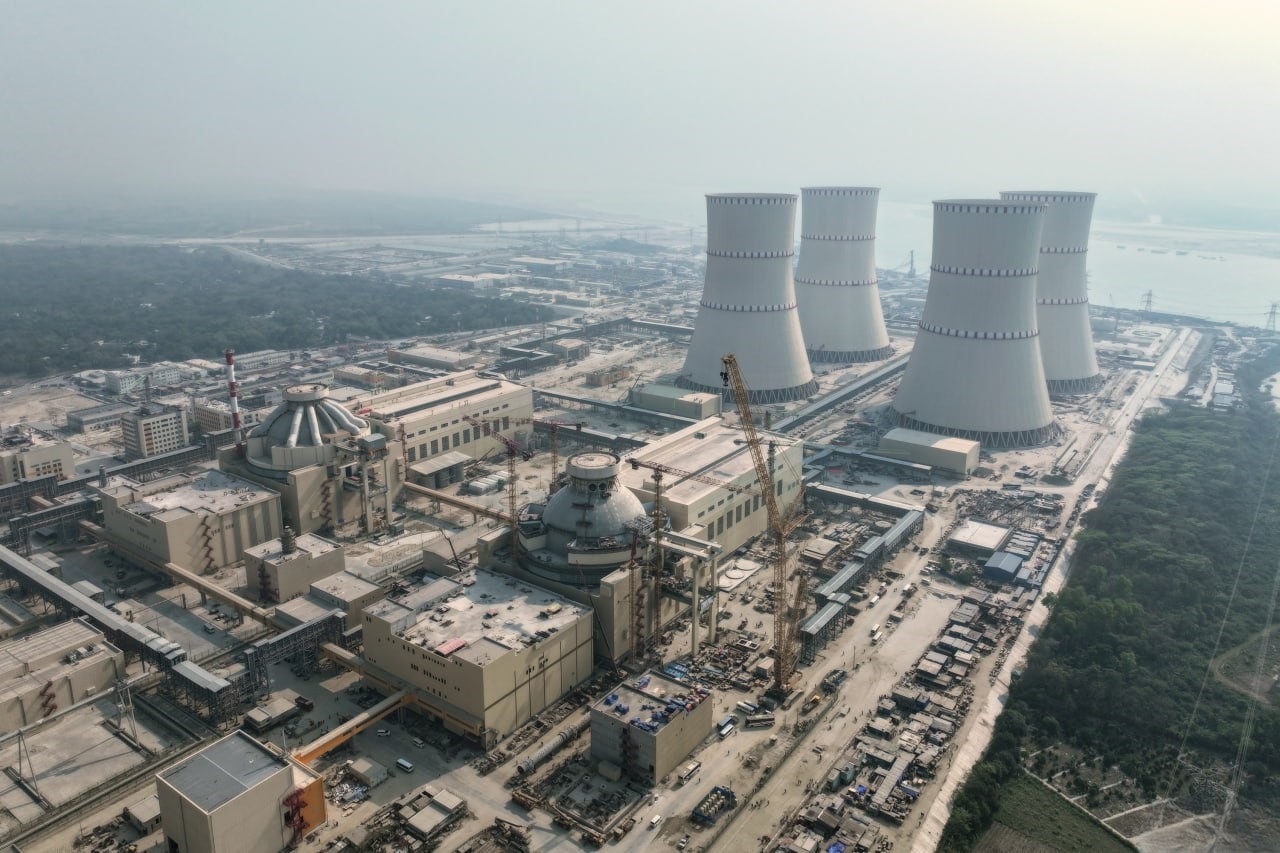



If everything proceeds as scheduled, Bangladesh is on the verge of reaching a major milestone by delivering electricity generated from the Rooppur Unit 1 reactor to the national grid for the first time.
While this achievement will undoubtedly mark a historic moment, it represents only the culmination of an extensive and systematically sequenced process from design, construction to commissioning.
This process involves comprehensive testing, inspection and verification of all structures, systems, components, equipment and safety-related installations to ensure their readiness and compliance with the required standards before the reactor enters trial electricity generation.
The Rooppur Nuclear Power Plant comprises two VVER-1200 Generation III+ reactor units, each with an installed electrical capacity of 1,200 MW. Commissioning activities for Unit 2 are anticipated to commence next year. The project is being implemented by Atomstroyexport, a subsidiary of Russia’s State Atomic Energy Corporation, Rosatom.
Understanding the different phases of a nuclear power project—from design and construction to commissioning—and the time required for each is important for the public. Following the completion of design and construction, including the associated pre-commissioning activities, the project proceeds to the commissioning stage.
It is important to understand that commissioning does not conclude when electricity is first supplied to the national grid, nor is its completion determined by a political calendar. Understanding how the work proceeds can help readers distinguish routine pauses from genuine problems in the weeks ahead.
The project’s contractual schedule divides the process into four stages, A to D, each with several sub-stages, followed by a guarantee period. The durations discussed below are planned figures, not actual elapsed times.

The journey begins long before nuclear fuel is loaded into Unit 1. Stage A, described as pre-commissioning alignment activities, is the longest stage. It accounts for fifty-five of the planned sixty-eight months before commercial operation and focuses on demonstrating that the plant is ready. Stage A has five sub-stages.
The first, A-0, is the preparatory stage and is planned to take thirty-nine months. It begins with the pouring of concrete for the Unit 1 reactor on 30 November 2017 and covers the preparatory work needed for systematic testing: completing installations, preparing test programmes and procedures, and training and licensing the staff who will operate the plant.
A-1, which covers the testing of systems and equipment, is planned to take nine months. Each electrical, cooling, ventilation and control system is checked individually and then in combination to confirm that pumps, valves, power supplies and instruments perform as intended.
Attention then shifts to the reactor itself. A-2, the containment test, is planned to take one month. The containment structure, designed to keep radioactive material inside even in an accident, is typically pressurised to confirm its strength and leak-tightness.
A-3, the reactor’s cold and hot tests, is planned to take about three months. The reactor’s main circuit is first operated at ordinary temperature and then heated towards operating conditions – at a pressure of 16.2 MPa and a temperature of 329 °C – without nuclear fuel in the core.




These tests can reveal leaks, faulty instruments and other weaknesses while mistakes are still relatively inexpensive to fix. After these tests, A-4 allows engineers another three months to open up and inspect the reactor’s main installed equipment as a final check.
Meanwhile, the supply and storage of nuclear fuel, listed as a separate activity (B-0) in the project schedule, proceeds in parallel with these sub-stages.
All the fuel for Unit 1 arrived at the site in October 2023 and has remained in storage, allowing inspections and preparations to take place before fuel loading. International Atomic Energy Agency (IAEA) safeguards inspectors have checked the fuel and applied seals in accordance with non-proliferation requirements.
Stage B, known as physical start-up, begins only after Stage A has been completed. It is planned to take two months in total. Its first sub-stage, B-1, covers fuel loading and subcritical tests and is planned to take one month. Fuel assemblies are lowered into the reactor core; a ceremony marking the start of fuel loading at Unit 1 was held on 28 April 2026.
During this period, the reactor is deliberately kept in a subcritical state, meaning it cannot sustain a chain reaction. Instruments monitor neutron levels, while engineers test the control rods and safety systems as fuel is loaded.
The second sub-stage, B-2, covers the first criticality test and physical tests at the minimum controllable power level. It is planned to take one month. First criticality is the point at which a controlled, self-sustaining nuclear chain reaction begins. Criticality occurs at only a tiny fraction of the reactor’s full power, usually below one per cent. Subsequent tests confirm that the reactor behaves as designed, including how it responds to control-rod movements, neutron flux and changes in fuel and moderator temperatures.
This stage is not intended to produce electricity. Although Stage B was planned to take two months, it extended from late April into October. The delay illustrates why careful testing matters. In September, faults in the reactor’s pressure-relief safety valves postponed the start of the chain reaction. Russian specialists addressed the problem, and the system passed high-pressure tests. The regulatory body then approved B-2 on 8 October 2026. The reactor achieved first criticality on 11 October 2026.
The project’s current position is the Stage C, known as power start-up, uses the reactor’s heat to produce steam at different power levels. This process has already begun after the regulatory approval. Over the planned one-month period, power is increased in carefully controlled steps, with checks at each level.
The steam drives the turbine, and the generator is synchronised with the grid—that is, its electrical output is matched to the grid before the connection is made. Before electricity generation begins, the operator must obtain a trial-operation licence from the regulatory body. Unit 1 is expected to connect to the grid initially at low power—first at 5 per cent, then 10 per cent and 15 per cent of nominal power, before rising to around 35 per cent.

An initial supply of about 300 MW has been announced by the authority, against a full capacity of 1,200 MW. Integrating a large unit is itself a challenge for the national grid, which must also be prepared to respond if the unit suddenly disconnects.
Once connected to the grid, the unit enters Stage D, described as pilot commercial operation. This is a prolonged trial period planned to last ten months. During D-1, output power is raised towards 100 per cent of nominal power and then reduced to test how the plant and the grid respond together. D-2 involves integrated testing at full power. It is practiced that the unit must demonstrate at least three days of continuous, full-capacity base-load operation.
Throughout this period, Bangladeshi reactor operators work alongside Russian operators and experts to gain experience, while testing continues even as electricity is supplied to the grid.
The planned ten-month trial-operation period is followed by provisional take-over. The plant then enters a twelve-month guarantee-operation period, after which final take-over takes place. In total, the schedule allows sixty-eight months from the start of A-0 to the end of Stage D, followed by twelve months for the guarantee period—eighty months, or about six and a half years. In reality, the process has taken longer.
If Unit 1 connects to the grid for the first time in November, roughly nine years will have passed since construction began in late 2017, compared with the planned fifty-eight months (under five years) to reach that point. From here on, each step—from grid connection through trial operation and the guarantee period—will proceed only after the required safety tests have been passed and the regulator has given its approval.
In sum, we should not expect everything to change overnight in case of nuclear power plant. The first grid connection will probably involve a modest level of output, and brief pauses or interruptions are normal during testing.
Each step requires regulatory approval. The proper test of Rooppur is not whether the first electricity reaches the grid on a promised day, but whether every stage is completed correctly and safely. Bangladesh will become the world’s 33rd country to generate nuclear power, but the first grid connection will be a milestone, not the finish line.
The final milestone, reliable commercial operation, still lies beyond ten months of trial operation and a year of guarantee operation.
Dr Md Shafiqul Islam is a Professor, Department of Nuclear Engineering, DU & Former Visiting Professor, Nuclear Science and Engineering Department, MIT, USA. Email: [email protected]