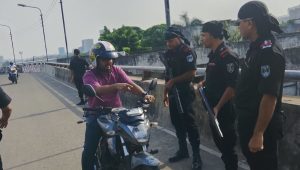
At Karwan Bazar intersection in Dhaka, traffic never truly pauses. Engines roar, horns scream, and the air feels heavy with constant sound.
For traffic police officer Enamul Haque, this noise has become part of daily survival. Thirteen years on Dhaka’s busiest roads have left a permanent mark on his health.
“Even when I sleep at night, there is a buzzing sound in my ears,” he said.
He spends most of his duty hours standing amid blaring horns. Over time, his hearing has weakened. He now struggles with ear problems and cannot afford proper treatment.
In Dhaka, horns sound on every road, at any time. Awareness efforts have come and gone without lasting impact. Government attempts to restrict horn use on certain roads were introduced but later faded away. Yet Environment Department leaflets still warn on special occasions: “Noise pollution can even cause death.”
A study titled Evaluation of Noise Pollution Impact on Health in Dhaka City, published in the international journal Frontiers in Public Health, found that most areas of Dhaka exceed permissible noise levels. It identified vehicle horns, modified motorcycles and construction work as major sources.
The study also linked long-term exposure to heart disease, sensory damage, reduced productivity and mental health decline.
Medical science states that prolonged exposure to noise above 70 decibels increases the risk of hearing loss, high blood pressure, heart disease, sleep disorders and stress. In Dhaka, night-time noise has reached up to 107 decibels in some areas, with even higher levels during the day.
For more than six years, Mehdi Haque, general secretary of the Bangladesh Cartoonists Association, has been working to raise awareness on noise pollution.
He told TIMES of Bangladesh that people avoid honking inside cantonment areas because they know punishment exists.

Action against noise pollution remains largely limited to special drives by the Department of Environment. Although police recently received legal authority to act, enforcement remains weak.
No urban planning behind noise crisis
Associate Professor from the Public Health Department of Bangladesh Medical University said the country lacks proper urban planning Romen Rayhan said there is no proper urban planning in the country.
“In many countries, people avoid building homes near roads due to noise. They plant trees along roadsides to reduce sound. Here, land near roads is expensive. Industries are also located near residential areas,” he said.
Citing Japan, he added that airports there are built near the sea to reduce noise impact on people.
Horn noise unbearable
Under the 2006 Noise Pollution Control Rules, silent zones in Dhaka allow a maximum of 40 decibels at night and 50 during the day. Residential areas allow 45 decibels at night and 55 during the day. Mixed, commercial and industrial zones have higher limits.
However, enforcement remains weak.



Romen Rayhan said control must start at the source.
“Horns above 40 decibels should not be allowed, and imports must be restricted,” he said.
Benjir Ahmed, owner of car importer company ‘U Cars’, said no such import restrictions exist.
“Some horns are not hydraulic but produce similar loud sound. These should be banned,” he said.
Motorcycle assembly plants in Bangladesh also face no restrictions on horn intensity.
According to Bangladesh Road Transport Authority (BRTA) rules, motorcycle horns are allowed up to 85 decibels. Violations can lead to fines of up to Tk10,000 under the Road Transport Act 2018. But enforcement remains mostly on paper.
New wave of modification culture
In Bangshal of Old Dhaka, loud aftermarket exhausts and horns are openly sold.
Replica exhausts of brands like SC Project, Akrapovič, Yoshimura and LeoVince often exceed 100 decibels. Air horns and sirens can reach 110 to 150 decibels. Online platforms also sell 140-decibel motorcycle horns.
Sohail Rana, an employee at a “Bike Hospital Zone” workshop in Bangshal, said silencers can be modified to produce any level of sound.
“We cut the original pipe and install our own modified exhausts,” he said.
Custom exhaust trends are rising. Deep rumble, throaty growl and high-pitched roar sounds have become popular.
Teenagers and young riders are increasingly adopting these modifications as a trend.
A first-year student at Udayan Higher Secondary School, Siam Ahmed, spent Tk11,000 to install a loud exhaust due to peer pressure.
“It is a trend now,” he said.
He also admitted that pedestrians often react negatively on the streets.
Mechanics say modified bikes have increased significantly over the past two years. Some remove silencers entirely, while others add parts to increase sound. Residents say the situation has become unbearable.
Health risks
A Bangladesh Medical University study found that 65 per cent of traffic police in Dhaka suffer from hearing and sleep problems due to high noise exposure. Among drivers, 10 per cent have permanent hearing loss and 17 per cent have temporary issues.
A Nature Portfolio study titled Spatiotemporal Patterns in Air Pollution and Sound in Dhaka, Bangladesh found that long-term exposure above 70 decibels increases risks of hearing loss, hypertension, heart disease, sleep disorder and stress. It recorded up to 111 decibels in Azimpur and 107 decibels in Motijheel.
Regulations remain on paper
The Noise Pollution (Control) Rules 2025 divide areas into silent, residential, mixed, commercial and industrial zones. Silent zones within 100 metres of hospitals, schools and government offices ban horns and loudspeakers. Residential areas prohibit horn use between 9pm and 6am.
In 2007, several roads in Dhaka were declared horn-free under a caretaker government. Later, parts of Airport Road were also restricted. Plans to expand the ban citywide never materialised.
Construction sites must use sound barriers, but compliance remains rare. Loudspeaker use for social, religious and political events requires permission, but enforcement remains weak.
Violations can lead to up to one month in jail or fines between Tk5,000 and Tk50,000. However, such actions are rarely taken.
Department of Environment project manager Md Fazle Elahi told TIMES, manpower shortage is a major barrier.
“We have only three magistrates, which is far below requirement. They also handle brick kilns, polythene and noise cases,” he said.
Although 65 traffic sergeants were trained and given sound meters, one sergeant in Shahbagh said they still do not have the equipment.
Elahi added that stricter control over importers is needed.
In Dhaka, silence is no longer part of the city’s rhythm. Horns, engines and modified exhausts fill every gap of sound, leaving little space for rest. For those who stand on its roads every day, the noise is not background anymore—it is life itself.