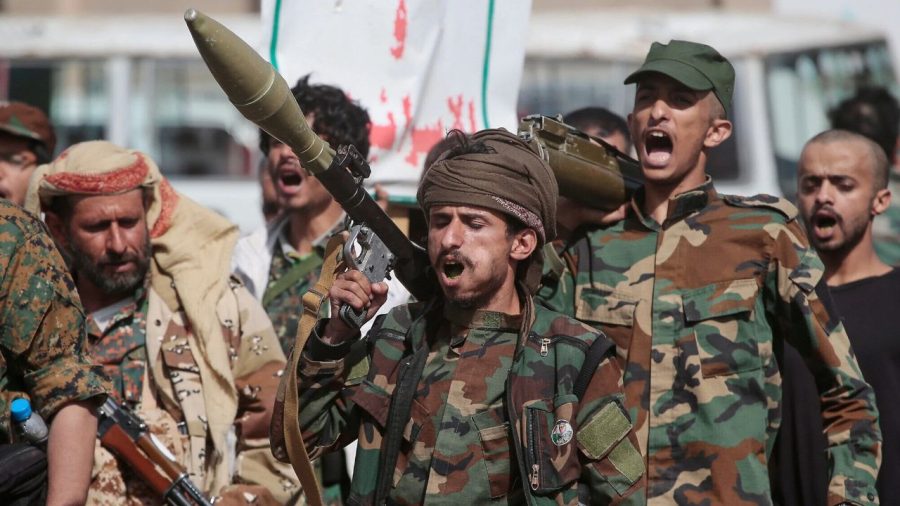

Yemen’s Iran-backed Houthi militants have claimed responsibility for launching drone and ballistic missile attacks on Saudi Arabia’s capital Riyadh and energy facilities along the country’s Red Sea coast.
Saudi authorities said on Saturday that their air defences intercepted and destroyed a ballistic missile fired towards Riyadh. They did not confirm any other strikes or report casualties, reports BBC.
A large column of black smoke was seen rising from fuel storage tanks near King Khalid International Airport in Riyadh, while flights were temporarily disrupted. Explosions were also heard in the capital.
Saudi authorities issued air raid alerts overnight, marking the first such warnings in Riyadh since fighting between the Houthis and Saudi-backed forces escalated in July. The authorities later issued an all-clear.
The US State Department urged Americans in the Middle East to “exercise vigilance and be prepared for potential flight cancellations and other travel disruptions”.
“Iranian-supported Houthis have engaged in hostilities against Saudi Arabia, including civilian airports. This military conflict has the potential to escalate rapidly,” it said in a statement.

It added that Americans “should seriously reconsider travel to and through the region”.
Saudi-led coalition spokesman Major-General Turki al-Maliki said air defences also thwarted “hostile attempts to target civilians” in Bish, Taif, Farasan and Yanbu.
In an online statement, Houthi military spokesman Yahya al-Sarea said the group had used a “large number of ballistic and cruise missiles and drones” to strike “sensitive sites” in Riyadh and facilities belonging to state-owned oil and gas company Aramco in Yanbu on the Red Sea coast.
He said the attacks were “in response to the Saudi enemy’s criminal attempts” to target Sanaa, the Yemeni capital controlled by the Houthis.




Earlier, al-Sarea accused Saudi Arabia of carrying out 300 strikes across Yemen over the previous week.
The Houthis have been fighting Yemen’s internationally recognised government, which receives Saudi backing.
The group has carried out several attacks inside Saudi Arabia in recent months. It also claimed this week that it had shot down a Saudi fighter jet over Yemen.
According to an unconfirmed AFP report citing military sources from both sides of Yemen’s civil war, fighting between the Houthis and Saudi-backed government forces killed 48 people on Saturday.
The Houthis said 31 of their fighters were killed, while government sources reported 17 deaths among their soldiers, AFP reported.
The International Organization for Migration, a UN agency, said on Friday that the number of people displaced by the recent fighting had risen above 104,796.
Several apparent explosions were heard in Riyadh on Saturday, while King Khalid International Airport experienced major disruption. Flight-tracking website FlightRadar24 reported delays and cancellations.
An AFP journalist saw firefighters attempting to put out flames from a burnt-out Aramco fuel tank.
Saudi Civil Defence sent mobile phone alerts overnight warning of possible danger in Riyadh and other areas before issuing an all-clear on Saturday morning.
Residents told AFP, speaking on condition of anonymity, that they heard what appeared to be a series of explosions after the alerts were issued.
“I heard the alarm, then my windows shook,” said a 27-year-old resident of northern Riyadh. “It was definitely scary. I was not expecting this.”
The Houthis recently took control of the strategic Red Sea port city of Mokha and Perim Island, which lies near a key shipping route used by the Gulf state for exports to Asia and Europe.
The group said its naval blockade was a response to a Saudi blockade of ports and airports in Houthi-controlled north-western Yemen.
Saudi vessels have depended on the Red Sea route to export oil since the war involving the US and Israel and Iran effectively shut the Strait of Hormuz.
On Friday, investment banking giant JP Morgan said it was struggling to assess the impact of the war on oil prices. In a rare note to investors, it said, “we simply don’t know how to model the endgame”.