Bangladesh will not join any geopolitical alliance, reaffirming its longstanding policy of strategic non-alignment.
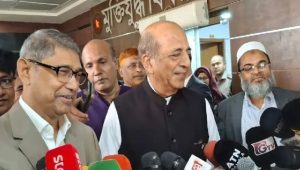
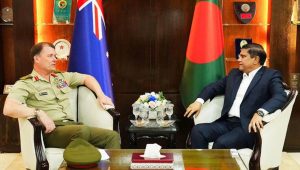
Foreign Minister Khalilur Rahman made the remarks after meeting United States Assistant Secretary Paul Kapur, who arrived in Dhaka on Tuesday. The visit marked the first round of political consultations between the two governments since the new administration, led by Tarique Rahman, assumed office.
“We took office only two weeks ago. We need time to review our Indo-Pacific outlook before making detailed comments,” the foreign minister said. “Our top priority is ensuring the security and stability of our country. We will not join any alliance.”
Referring to the ongoing crisis in the Middle East, he warned that prolonged international conflicts pose serious economic risks for Bangladesh. “For a country like ours, the impact of such instability could become unbearable,” he said, citing concerns over energy supply and trade disruptions.

The foreign minister stressed the need for exercising restraint by all parties and urged early resolution of the conflict through dialogue and diplomatic means in order to minimise loss of life, prevent further destabilisation in the region and beyond.
Bangladesh–US political consultation
During the political consultation, senior Bangladeshi policymakers and Assistant Secretary Kapur discussed trade and economic cooperation, the Middle East crisis, and energy security.
The issue of the Bangladesh–US reciprocal tariff agreement featured prominently in the discussions. Kapur underscored the importance of implementing the provisions of the agreement to boost bilateral trade and investment. In response, the foreign minister reiterated the government’s commitment to policy continuity, particularly in the economic sector, to maintain investor confidence.



Reciprocal tariff deal
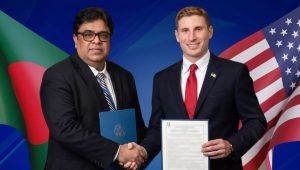
Bangladesh and the US signed a reciprocal tariff agreement on February 9, just days before the national election. However, subsequent developments — including a ruling by the US Supreme Court striking down aspects of the tariff decision — have created uncertainty over its implementation.
The foreign minister said that while a 15 percent tariff currently applies under Section 122, the government is negotiating to prevent potential tariffs under Section 301 from rising to 19 percent. The goal, he said, is to ensure Bangladesh remains competitive with regional peers such as India, Vietnam, Cambodia, and Malaysia.
Addressing concerns that the agreement could force Bangladesh to choose between major powers such as the US and China, the minister said the language of the deal mirrors similar agreements signed by other regional countries and does not entangle Bangladesh in geopolitical rivalry.
Under the agreement, Bangladesh has committed to purchasing $22 billion worth of US goods over 15 years, including energy and other essential commodities. The minister noted that the deal includes both an exit clause — allowing withdrawal with 60 days’ notice — and an entry clause requiring formal notification before enforcement, ensuring room for review and renegotiation if necessary.
Commerce minister sees scope for renegotiation
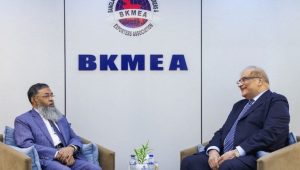
Commerce Minister Khandaker Abdul Muktadir described the agreement as a negotiated outcome reflecting the interests of both sides.
“In any international agreement, both parties have demands. Some clauses favour one side, while others benefit the other. The objective is to reach a win-win situation,” he told journalists after Kapur met him.
He cautioned against viewing the deal as entirely positive or negative at this stage, saying many of its provisions could strengthen future trade relations. He also confirmed that the government is closely monitoring developments following the US Supreme Court’s ruling on tariffs.
“No agreement is final,” the commerce minister said. “Every agreement has scope for amendment and renegotiation. If necessary, changes can be made through further discussions.”