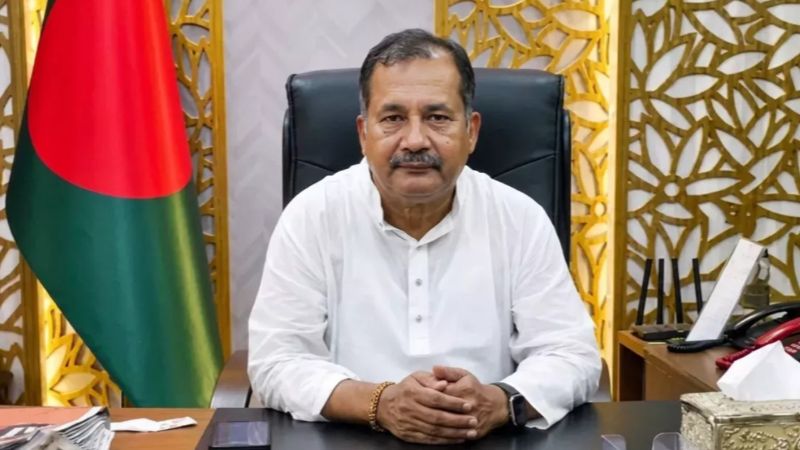
Commerce Minister Khandaker Abdul Muqtadir said the transition to a circular economy is no longer just an environmental discussion but a crucial prerequisite for Bangladesh’s industrial competitiveness, sustainable growth, and stronger positioning in global markets.
He made the remarks as the chief guest at a seminar titled “Accelerating Circular Economy Transition through SWITCH2CE Pilot Initiatives in Bangladesh” held on Wednesday in Dhaka.
The global market is changing rapidly. Sustainable production is now one of the determinants of competitive capability in international trade, he said.
Buyers, investors, and consumers are now interested in production systems that reflect efficiency, responsibility, and long-term stability. Pilot activities conducted under the “SWITCH to Circular Economy” programme have already proven that the transition is not a conceptual idea but is realistic, achievable, and already underway, he added.

The minister highlighted that pilot projects involving H&M Group and Bestseller have generated effective experience in textile waste management, recycling systems, and value chain coordination within the textile and garment sectors.
He said a circular economy will ensure efficient resource use, waste reduction, strengthened supply chain stability, and increased innovation and value addition. Success depends on the coordinated efforts of the government, industry, global brands, technology providers, and development partners.




Addressing LDC graduation, Muktadir warned, “After LDC graduation, Bangladesh will face a completely new economic reality. We will lose low-interest loan facilities and many LDC-based trade preferences. Therefore, we must make our economy more competitive and investment-friendly from now on.”
He pointed out that Bangladesh’s logistics-cost-to-GDP ratio is approximately 16 percent, compared to the global average of 10 percent. To reduce this, the government has tasked a Danish company with operating a terminal at Chattogram port, with plans to involve more international firms in the future.
To simplify the investment environment, the government plans to introduce a system where businesses receive temporary approval immediately after registration to start operations, with 12 months to secure permanent licences.
Muktadir further said, “We want to turn the One-Stop Service into a true one-stop service. Investors will no longer have to move from one office to another.”
He concluded by saying all Bangladeshi products, including RMG, pharmaceuticals, leather, and jute, must be sustainable to survive global realities. While the world recognises the need to protect the ecosystem, developed economies, which are primarily responsible for the carbon crisis, must lead the way in building a sustainable global future.
The event was jointly organised by the Ministry of Commerce and the Bangladesh Garment Manufacturers and Exporters Association (BGMEA).
Md Abdur Rahim Khan, secretary of Ministry of Commerce, presided over the seminar. The special guests include the Head of the European Union Delegation to Bangladesh Ambassador Michael Miller and BGMEA President Mahmud Hasan Khan.