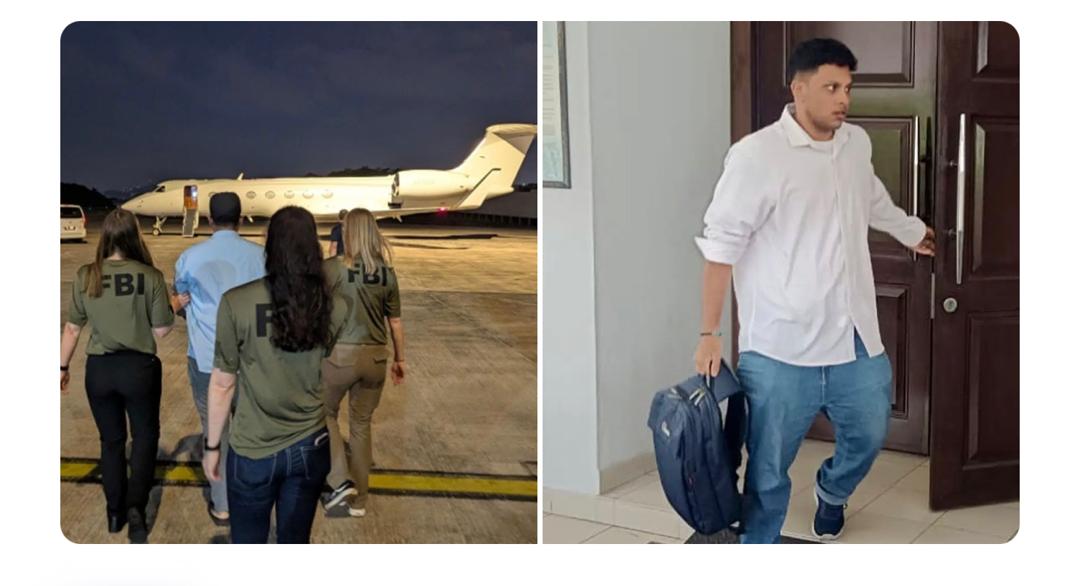

The transfer of Bangladeshi national Zobaidul Amin from Malaysia to the United States has drawn attention to what US prosecutors describe as one of the most extensive online child-exploitation investigations ever pursued in Alaska.
At the centre of the case, investigators say, is not merely a single offender but what they describe as a coordinated sextortion operation that targeted minors across several countries through social media platforms.
The case now unfolding in the US District Court for the District of Alaska began quietly in late 2021 with what initially appeared to be a single report of online exploitation. In December that year, a teenage girl in Alaska contacted police after someone she met online threatened to distribute intimate images of her unless she complied with further demands.
What first appeared to be an isolated sextortion incident quickly widened. Subpoenas issued to social media companies and cloud-storage providers revealed that the activity extended far beyond a single victim. As investigators followed the digital trail, they began uncovering what prosecutors would later describe as a far larger exploitation scheme involving victims across multiple jurisdictions.
According to the US Department of Justice, the case involves the alleged exploitation of hundreds of minors in Alaska, elsewhere in the United States and internationally. Many of the victims were under 18 years old, some as young as 11.
Investigators eventually identified Zobaidul Amin, now 28, a Bangladeshi national who was living in Malaysia at the time and reportedly studying medicine at a private university. Authorities say the digital footprint linked to him included numerous social-media accounts and online identities allegedly used to contact minors.

Prosecutors say Amin often posed as a teenager online. In some instances he used photographs of real teenage boys to make profiles appear authentic. In others he presented himself as a teenage girl or claimed to be gay in order to gain the trust of potential victims.
On July 13, 2022, a federal grand jury in Alaska returned an indictment against Amin outlining a series of charges linked to the alleged operation. Malaysian authorities arrested him in September that year following cooperation with US investigators.
For several years the case remained largely out of public view while legal proceedings continued in Malaysia and the US sought his transfer. That process concluded in March 2026 when Amin was transferred to Alaska to face charges in federal court.
At his initial appearance he entered a plea of not guilty, and the case is now proceeding through the US judicial system.




The federal indictment lists 13 counts against Amin. One of the most significant is Count 3 — child exploitation enterprise — a charge that under US law is used only when prosecutors believe multiple individuals were involved in an organised system of exploitation.
However, publicly available court documents do not identify the alleged co-conspirators referenced in the indictment, leaving unanswered questions about how many others may ultimately be implicated.
Other charges include conspiracy to produce child pornography and production of child pornography. The indictment also contains a criminal forfeiture allegation, which could allow authorities to seize assets connected to the alleged offences if a conviction is obtained.
According to prosecutors, the alleged scheme relied heavily on deception and psychological pressure. Initial contact with victims was typically made through social media platforms such as Instagram.
Victims were often led to believe they were speaking with someone their own age. Conversations could unfold over hours or days, frequently focusing on school, relationships or personal struggles. Once trust was established, prosecutors say the interaction was steered toward requests for intimate images.
After a victim sent an image, the tone of the conversation allegedly changed rapidly. Prosecutors say victims were threatened with exposure if they refused further demands. Screenshots of friends lists and followers were sometimes used as leverage to demonstrate that images could be distributed widely.
According to court filings, some victims’ explicit images were in fact sent to people connected to them online.
Victims were often directed to continue communicating through Snapchat, where prosecutors say the coercion intensified. Some were pressured to send images repeatedly over extended periods.
The indictment also suggests the scheme expanded through victims themselves. In some cases, prosecutors say victims were told the harassment would stop if they introduced the perpetrator to other girls or provided images of additional individuals. In one instance cited in court documents, a victim introduced 15 new girls in an attempt to end the threats.
Investigators say such cases often exploit the dynamics of teenage online culture. When perpetrators present themselves as peers, requests for images may initially appear to be part of a trusted relationship.
By the time threats emerge, many victims already feel psychologically trapped.
Court documents indicate that explicit material obtained from victims may have been shared with other individuals involved in the alleged conspiracy, though their identities and locations have not been publicly disclosed.
The structure described in the indictment has drawn comparisons among observers to other large digital exploitation cases, including South Korea’s Nth Room scandal, where encrypted chatrooms were used to distribute coerced images and videos.
Authorities have not made a direct comparison in the Amin case. However, the presence of alleged co-conspirators and a large number of victims suggests investigators may still be examining the broader scope of the operation.
Prosecutors must now prove the allegations beyond a reasonable doubt as the case proceeds through the US federal courts.