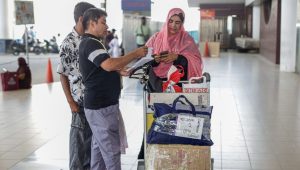
The tears in Sweety Bibi’s eyes tell a story of profound despair as she pleads for a way back home. Standing beside her with a somber face is Danesh Sheikh, accompanied by Sweety’s two young children, Kurban Hossain and Imam Hossain.
For over a year, these four Indian nationals have been living a life of crushing uncertainty in a remote village in the Chapainawabganj district under Rajshahi division, victims of a “push-in” by the Indian Border Security Force (BSF).
Despite clear directives from the Supreme Court of India, the Indian government has yet to repatriate its own citizens. Today, a mother with two children and a husband separated from his wife find themselves surviving on the charity of a poor local villager in Bangladesh.
Delhi to Kurigram Border: A living nightmare
The victims hail from Dhitar village in the Murarai Police Station area of Birbhum district, West Bengal. Driven by poverty, they had moved to India’s capital, Delhi, where Danesh Sheikh and Sweety Bibi worked as cleaners to make ends meet.
Their lives were shattered in June 2025 when Delhi Police abruptly detained them on suspicion of being “Bangladeshis.” Without any legal process, they were transported to Assam and, under the cover of night, forcibly pushed into Bangladesh across the Kurigram border by the BSF.

“When we tried to return, the BSF beat us and drove us back into Bangladesh,” Sweety Bibi told TIMES of Bangladesh. “They threatened that if we tried to enter India again, they would shoot us dead.”
Terrified, the group spent some time in Kurigram and Dhaka before arriving in Chapainawabganj. There, they were arrested by the Bangladesh Police for illegal entry and spent three months and ten days in prison before being released on bail.




A family divided: Agony of selective repatriation
Following their release, a complex legal struggle ensued. Faruk Hossain, a resident of Kalyanpur village in Chapainawabganj, stepped forward to provide them shelter under his own custody on humanitarian grounds, following a court order.
Faruk’s family ties to India prompted Mofijul Sheikh – a representative of the then-Trinamool Congress Rajya Sabha member Samiul Huq – to visit Bangladesh.
Mofijul noted that the Supreme Court of India had ordered the Indian government to repatriate a pregnant woman, Sonali Khatun, and her child, Sabbir, within 10 days. In response, the Bangladeshi court also granted bail to six Indian nationals, placing them in Faruk Hossain’s care.
On 5 December, the BSF finally accepted Sonali Khatun and her son Sabbir Sheikh through the Sonamasjid Land Port. However, in a move that left the family shattered, they refused to take Sonali’s husband, Danesh Sheikh, or Sweety Bibi and her children.
“We were all supposed to be taken back,” a bewildered Danesh Sheikh told TIMES. “They took my wife and child, but I don’t know why they left me and the others behind”.
Faruk Hossain, the group’s benefactor, is a man of limited means. While he opened his doors out of compassion, the financial strain of supporting four extra people for a year has brought him to the brink of bankruptcy.
“I am a poor man. I no longer have the ability to bear their expenses,” Faruk told TIMES, appealing to journalists as a final hope. “Please, make arrangements to send them back to their own country, India.”
‘Only Indian govt can explain’
The local administration in Bangladesh maintains that they have fulfilled their obligations. Abu Saleh Md Musa, the Deputy Commissioner (DC) of Chapainawabganj, stated that Bangladesh has consistently tried to repatriate these individuals.
“The issue was resolved legally through the Bangladeshi courts, and we contacted the Indian authorities through diplomatic channels,” the DC said. He expressed his own confusion as to why, after repatriating two individuals, the others were left behind.
“There is no reason to keep these Indian citizens in Bangladesh. Only the Indian government can truly explain why they have not been taken back.”