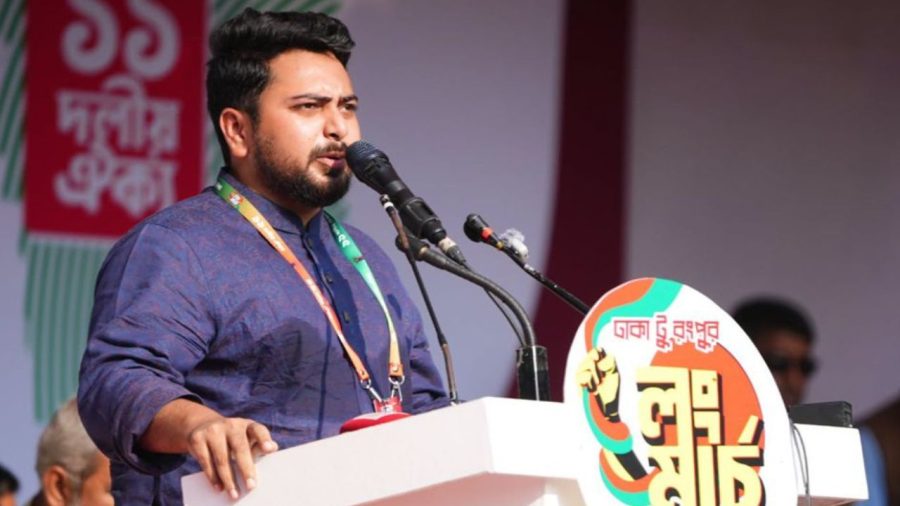



A familiar tension in Dhaka-Delhi relations has surfaced again, with Indian politicians and media outlets raising questions about Bangladesh’s alleged role in protests in New Delhi after National Citizen Party (NCP) Convener Nahid Islam expressed solidarity with demonstrators demanding the resignation of India’s Chief Election Commissioner Gyanesh Kumar.
The protests, led by the youth-driven Cockroach Janta Party (CJP), have focused on electoral accountability, the Special Intensive Revision (SIR) of voter rolls and the independence of India’s election institutions.
Nahid’s support has prompted speculation in India about possible foreign involvement in the demonstrations, echoing longstanding concerns in Bangladesh about alleged Indian interference in its domestic politics.
On Monday, West Bengal minister Dilip Ghosh was asked whether Bangladesh had any role in the protests. He suggested that foreign forces were attempting to destabilise India.
“It has been said time and again that foreign forces are behind the attempt to destabilise India. Backing is coming from abroad,” he said, adding that funding channels had been blocked and that this was contributing to the protesters’ anxiety.
The remarks reflect allegations of foreign involvement in the protests, but no evidence establishing a role for the Bangladesh government was cited in the comments provided.

In a statement issued on Saturday, Nahid expressed solidarity with the Indian youths protesting against the electoral roll revision process and demanding accountability from the Election Commission.
Drawing parallels with Bangladesh’s July 2024 student-led uprising, which helped bring down the Sheikh Hasina government, he argued that struggles for accountable governance and human dignity were interconnected across South Asia.
“This struggle is not yours alone,” he said.



Nahid warned against majoritarianism, authoritarianism and communal hatred shaping the region’s future. He also criticised the Delhi Police’s handling of the demonstrations, including the detention of protesters, organisers and journalists and restrictions on internet access around Jantar Mantar.
Concerns about electoral integrity and institutional independence, he argued, should be addressed through transparent answers rather than barricades and censorship.
His statement has placed Bangladesh’s domestic political transition and India’s current political tensions in the same regional debate, although his expression of solidarity does not in itself establish any official involvement by Dhaka in the protests.
The demonstrations in New Delhi have unfolded amid repeated protests over electoral issues and wider concerns about the functioning of public institutions.
The current mobilisation has centred on demands for Gyanesh Kumar’s resignation and objections to the Special Intensive Revision of electoral rolls. Critics of the process have raised concerns about its implications for voters, while Indian authorities and the ruling Bharatiya Janata Party (BJP) have faced pressure to respond to the allegations.
Claims that foreign forces are supporting the protests have also drawn criticism within India.
Human rights activist Choton Das said the BJP was seeking foreign links because it was alarmed by the movement.
He argued that the scale of the protests had unsettled the ruling establishment and suggested that Prime Minister Narendra Modi, Home Minister Amit Shah and Gyanesh Kumar would face growing pressure from the demonstrators.
The competing claims have added a cross-border dimension to a protest movement that is primarily focused on India’s electoral institutions and domestic politics.
Bangladesh and India have frequently faced disagreements over political developments and allegations of interference in each other’s internal affairs. Nahid’s statement has now brought that tension into the debate surrounding India’s youth-led protests.
For critics of the Indian government, the allegations of foreign involvement risk diverting attention from protesters’ demands. For those raising concerns about outside influence, Nahid’s public support has become a point of scrutiny.
The central issue, however, remains whether India’s authorities can address the demonstrators’ concerns over electoral transparency and institutional independence.
The Cockroach Janta Party is a youth-led movement whose name originated in a controversy involving a derogatory comparison of online activists and unemployed young people to cockroaches by a senior judicial figure. Its demonstrations have called for electoral reforms and Kumar’s resignation.
As the protests continue, the exchange of accusations risks widening the political debate beyond India’s domestic institutions and further complicating sensitivities in Bangladesh-India relations.