


For generations, the Bede community lived on boats, travelling between riverbanks and earning a living through snake charming, traditional healing and other itinerant occupations.
That way of life is changing as families settle permanently on land, take up new professions and send their children to school.
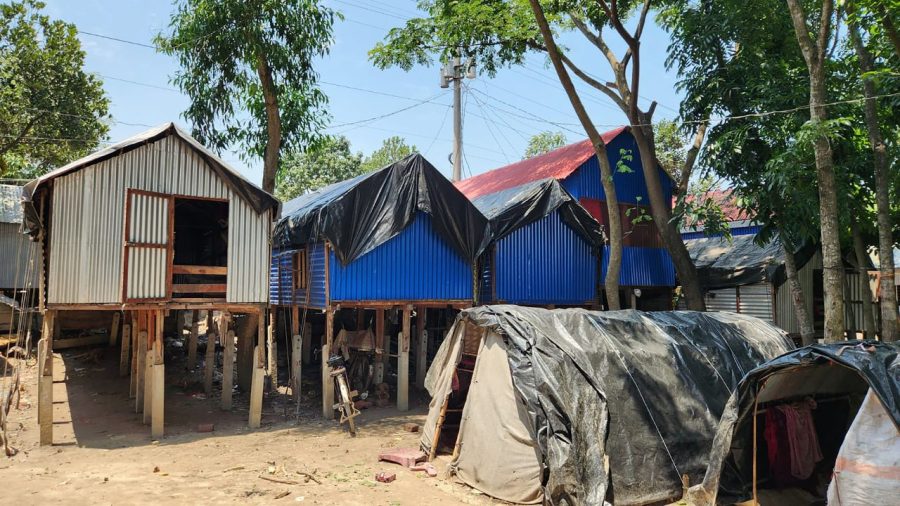
In Madaripur’s Shibchar upazila, at least 50 Bede families, comprising more than 250 people, have lived along the abandoned Pachchar–Kawrakandi road for nearly 20 years, gradually replacing their nomadic lifestyle with permanent homes and new livelihoods.
Many have abandoned their ancestral occupations to drive battery-powered vans, sell ice cream or work as masons.
As incomes improve, some families are replacing makeshift shelters with larger houses.
Children now attend nearby primary schools and madrasas, although many leave education before reaching secondary school to begin working.
Relatively better-off families, however, aspire to provide their children with further education.

The transformation contrasts with a traditional Bede song: “We cook at one landing place and eat at another. There is no limit to our happiness.”
In Madbarerchar union, rows of huts and modest houses line both sides of the abandoned road, beyond homes built under the government’s Ashrayan housing project.
Residents said their ancestors came from Munshiganj’s Bikrampur area, travelling by boat and living temporarily along riverbanks before settling in Shibchar.
Hasibul, a community member, said declining demand for traditional services had prompted families to seek alternative livelihoods.



“We have lived here for nearly 20 years. Initially, we stayed in tents beside the government road and continued our ancestral occupations,” he said.
“But people no longer have much faith in those practices, and earnings have declined. That is why we started changing professions.”
He said the shift had improved earnings for many families, gradually reducing their dependence on ancestral occupations.
Another resident, Dayal Sardar, said shrinking river routes had also contributed to the transition.
“River routes are gradually drying up, making boat travel difficult. We came here by boat but never returned to that life,” he said.
“We have built houses and lived here permanently for nearly 20 years.”
Dayal said many residents had registered as voters, while others had married local women, strengthening their ties to the area.
“We are sending our children to school. Previously, we had no opportunity to study. Now, living alongside local people, our children are becoming interested in education,” he said.
Traditional occupations are also declining among Bede women.
Kulsum, a resident, said she previously travelled between villages offering traditional cupping treatments and selling remedies for rheumatic pain.
“Such work is no longer in demand. Men are taking up other jobs, and changes are beginning among women too. Fewer women now travel to villages for work,” she said.
Local residents said around 40 to 50 Bede households had settled in the area.
Although the traditional sardar, or community leader, system remains, families are increasingly adopting lifestyles similar to those of neighbouring communities.
Madbarerchar Union Parishad Panel Chairman Sultana Ferdousi said the families had effectively become permanent residents.
“Previously, they led a floating life. Now they have built houses beside the abandoned road. The Union Parishad also provides them with assistance,” she said.
Each morning, men leave for work while children head to school or madrasa.
Despite limited educational opportunities, the community continues working towards greater financial security and integration into mainstream society.