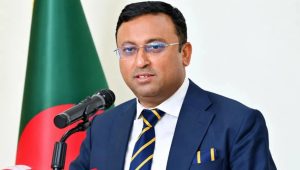
Home Minister Salahuddin Ahmed has assured that Bangladesh is committed to the safe, voluntary, dignified, and sustainable repatriation of forcibly displaced Myanmar nationals (FDMN), noting that regional and international coordinated diplomatic efforts are being intensified to achieve this outcome.
He made the remarks as the chief guest at a seminar titled “Rohingya Crisis: Way Forward – Towards Sustainable Repatriation and a Durable Regional Solution,” organised by the Foundation for Strategic and Development Studies (FSDS) at a city hotel on Sunday.
The seminar was presided over by Maj Gen (retd) Fazle Elahi Akbar, chairman of FSDS, while Md Ismail Zabiullah, adviser to the prime minister on public administration ministry (ministerial rank), spoke as the special guest.
Regional coalition needed
In his address, Salahuddin emphasised that unilateral efforts by Bangladesh alone are insufficient for sustainable repatriation, highlighting the need to forge a strategic regional coalition and a coordinated approach involving key stakeholders such as China, ASEAN, the United Nations, and Japan.
He noted that Yohei Sasakawa, special envoy of the Japanese government on national reconciliation in Myanmar and chairman of The Nippon Foundation, recently visited Bangladesh, during which both the prime minister and the home minister held detailed discussions with him, securing assurances of comprehensive co-operation from Japan.

He added that the prime minister is scheduled to visit Japan later this month, where further talks will take place to accelerate the repatriation process.
Highlighting the evolving geopolitical and security environment in Rakhine State, Salahuddin Ahmed, home minister, pointed out that alongside the de jure government, the Arakan Army (AA) controls a major portion of the territory.
Consequently, solution pathways are currently being explored through various diplomatic channels, including informal communications.




However, he affirmed that peaceful repatriation remains the core objective and Bangladesh will keep all options open as a final resort while continuing diplomatic dialogue.
Strategic diplomacy
Delivering his speech as special guest, Md Ismail Zabiullah, adviser to the prime minister on public administration ministry affairs, stressed that the Rohingya crisis is not merely a humanitarian or bilateral issue, but one deeply linked to national interests, regional stability, and international geopolitics.
Given the complex dynamics over past decades and the changed political and military situation in Myanmar, he advocated transitioning from crisis management to strategic diplomacy, from temporary relief aid to sustainable repatriation, and from fragmented initiatives to a unified national strategy.
He also underscored the necessity of exerting pressure on Myanmar and the international community to guarantee the safe and dignified return of the Rohingyas to their homeland alongside safeguarding their rights and protection.
UNGA platform
Speaking to journalists after the seminar, Salahuddin Ahmed, home minister, shared that Bangladesh’s election as president of the UN General Assembly this year provides a stronger platform to raise the repatriation issue before the global community.
He expressed optimism that a sustainable path to rapid repatriation can be formulated through international talks with support from regional neighbours and partners, including China, Japan, India, the United States, and the European Union.
Three thematic papers were presented during the seminar. Prof Dr A.S.M. Ali Ashraf presented the first paper examining the political and security background amidst changing realities in Myanmar and Rakhine.
Prof Shahab Enam Khan presented the second paper covering development, connectivity, and repatriation in Rakhine. Brig Gen (retd) Shafayat Ahmad delivered the third paper outlining strategic pathways for Bangladesh and regional diplomacy.
Participating in discussions on the papers, speakers underscored that repatriation extends beyond physical resettlement, requiring a conducive environment that guarantees returning citizens’ security, citizenship, housing, livelihoods, and social acceptance among local communities as essential elements of a lasting solution.
The event brought together distinguished domestic and foreign diplomats, representatives of international organisations, retired military officers, researchers, academics, and representatives from news media.