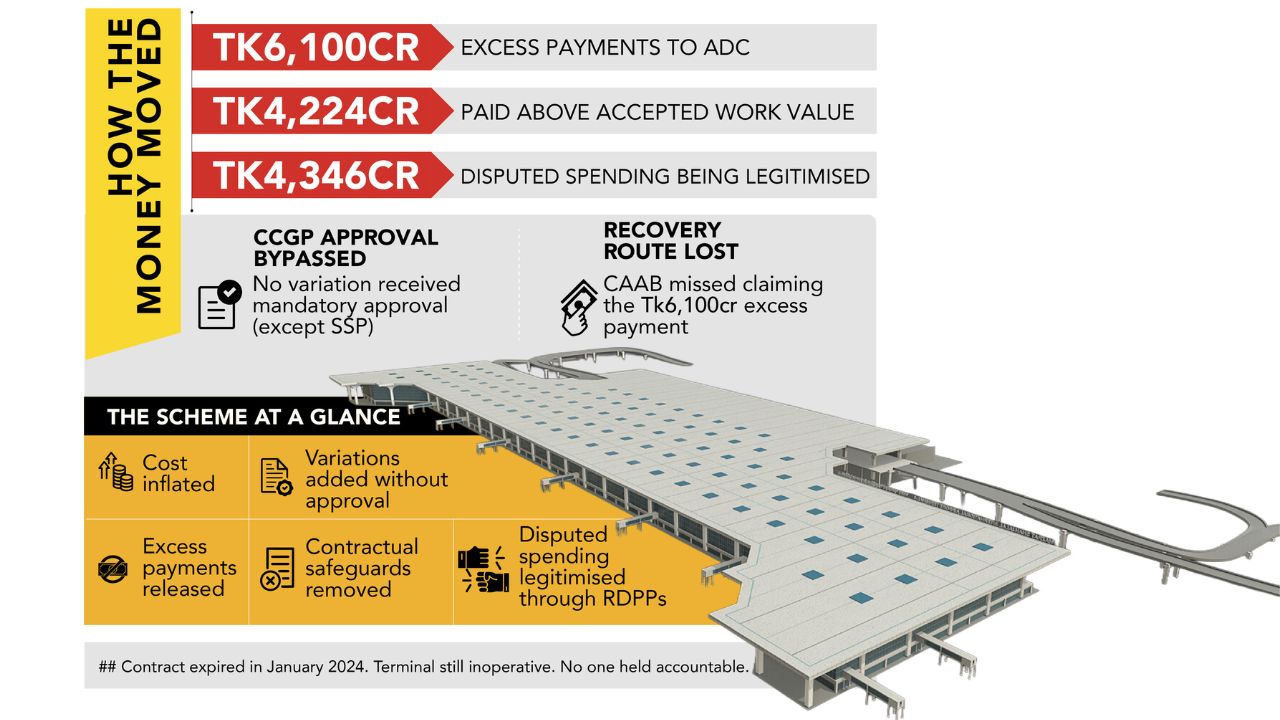



Corruption and financial irregularities worth Tk8,441 crore occurred in the construction of the third terminal at Hazrat Shahjalal International Airport.
The plundering took place in a systematic manner as the cost of the yet-to-finished terminal spiraled in various steps, revealed a TIMES of Bangladesh investigation.
A nexus of local and international agencies, bureaucrats, politicians, and businessmen siphoned thousands of crores from the Japanese-funded project through overpayments, fabricated bills and vouchers, inflated prices, unauthorised expenditure and blatant breaches of public procurement rules, found the investigation.
As part of the investigation, TIMES also analysed nearly 6,000 pages of contracts, bills, variation orders, audit reports and loan and project documents to detect a similar pattern misappropriating public money during the ousted Awami League government, interim administration and the present BNP government.
In 2017, AL government approved a Tk13,610 crore project to construct the third terminal. Of this, Tk9,170 crore was the core expenditure excluding VAT, taxes and customs duties. It was revised first under the Sheikh Hasina-led government and then again under the Mohammad Yunus-led interim administration pushing the total cost to Tk21,365 crore. The core project cost alone rose by Tk7,055 crore – nearly all of which was swallowed.
Of the funds looted from the project, the Japanese and South Korean contractors received at least Tk6,100 crore in excess payments. The Civil Aviation Authority of Bangladesh (CAAB), the implementing agency, facilitated the excess payments while misappropriating more than Tk2,000 crore along with locally involved agencies and persons.
One government audit uncovered Tk6,323 crore irregularities, while the TIMES investigation identified another Tk2,118 crore.
Bureau of Research Testing and Consultation (BRTC) of BUET, entrusted with the responsibility for supervising the entire project, covered up the plundering by endorsing the disputed decisions and works, documents show.
Negligence by the international consultancy consortium further inflated both the project’s cost and duration.

Instead of checking misappropriation, the interim government revised the project in 2025 incorporating Tk3,267 crore which was already spent without mandatory clearance of the Cabinet Committee on Government Purchase. The BNP government is set to allocate another Tk1,079 crore for the project’s contractor.
Investigation found in each such step in which the project cost was enhanced is aimed at allowing the nexus to plunder money.
The consequences extend far beyond the money already lost. Taxpayers must now service the JICA-backed debt, while even CAAB officials question whether the still-idle terminal will deliver the promised passenger services or generate the projected revenue.
The project is financed by the JICA under Japan’s Official Development Assistance programme, with additional funding from the Government of Bangladesh. The contract was awarded to Aviation Dhaka Consortium (ADC), a joint venture of Japan’s Mitsubishi Corporation and Fujita Corporation and South Korea’s Samsung C&T Corporation. Supervision was assigned to NOCD Joint Venture, comprising Nippon Koei, OC Global, CPG and DDC.
The project covers the third passenger terminal, taxiways, aircraft aprons, import and export cargo terminals, an elevated approach road and a multi-storey car park.
Documents show decisions on key financing, consultancy, implementation and expenditure were finalised prior to the approval of the Development Project Proposal. The project was then prolonged through planned mismanagement and strategic delays, creating repeated opportunities for variations, new rates and additional payments. When objections arose, explanations and institutional opinions were assembled after the fact to legitimise decisions already made.

Contractual safeguards were also repeatedly bypassed. Records obtained by TIMES show that the project director, CAAB officials, officials of relevant ministries, engineers, domestic and international consultants and the contractor were responsible. But key individuals were given safe exits, while most officials who were involved are still overseeing the project.
Assuming office, the Tarique Rahman-led government initiated no investigation in the massive irregularities and corruption.
Documents show CAAB remained silent until auditors exposed the irregularities. It moved to claim Tk6,100 crore that ADC got in excess, but that option was already expired. Analysis of project records reveals ADC was overpaid by Tk4,224 crore against the accepted value of works executed, driven largely by unauthorised variation orders.
Transparency International Bangladesh Executive Director Iftekharuzzaman told TIMES that the project had been plagued by mega-corruption enabled by a three-way nexus among politicians, bureaucrats and business interests.
“An independent investigation must identify those responsible and recover the money looted from the project,” he said.
Iftekharuzzaman added that JICA could not evade responsibility for the corruption. “The consultants were selected by JICA. JICA and all other foreign institutions involved must be held accountable.”
Civil Aviation and Tourism Minister Afroza Khanam Rita said that the irregularities had occurred under previous governments claiming that his government would identify those responsible. “We are examining the matter.”
Asked why the government was proceeding with the third RDPP before identifying those responsible, the minister said investigations will take time. “The public will ultimately bear the loan burden, so we must ensure both accountability and the project’s early operation,” she told TIMES.
Asked to comment on the overall allegations of irregularities and CAAB’s planned course of action, Chairman Md Mostafa Mahmood Siddiq referred TIMES to Project Director Md Nuruddin Chowdhury, but he declined to comment.
Decisions first, legitimacy later
The handling of steel screwed piles (SSPs) reveals how the project’s procurement process was manipulated: controversial decisions were taken first, then retrospectively legitimised through official approvals and variation orders.
During tender negotiations, 1,699 SSPs were included without soil testing. After subsequent tests reportedly failed, the SSPs were replaced with bored piles through the first variation order.
CAAB sources alleged that the SSP provision had been inserted primarily to steer the contract towards a particular bidder.
A steering committee recorded in 2020 that the redesign would not increase the contract price, and the Cabinet Committee on Government Purchase approved it on that basis. Authorities later claimed savings of $80 million. Yet a Tk125 crore “omission charge” was simultaneously created for the contractor.
Under the contract, CAAB approval was mandatory for any variation increasing the contract price by more than 1 percent and increasing the quantity above 25 percent.
Records show that authorities subsequently approved Tk3,530 crore in additional work through 673 variation orders and eight value-engineering exercises which were Tk2,882 crore above the original allocation.
Apart from the SSP variation, no variation order above Tk50 crore obtained the mandatory approval of the CCGP. Under the second RDPP, this unauthorised expenditure was legitimized.
BUET’s mysterious role
On 7 April this year, the government formed a 10-member Amicable Settlement Committee, nine of them drawn from the project chain under scrutiny. Relying on ADC submissions and NOCD JV certifications, the committee endorsed a Tk16,225 crore contract value and cleared the way for the contractor’s unjustified final payment.
Before approving the second RDPP in 2025, the Planning Commission questioned the project’s additional expenditure and sought an opinion from BRTC of BUET, the same institution entrusted with top supervision while the irregularities occurred. Md Shamsul Hoque, team leader of the Top Supervision, responded through an unreferenced letter that was nevertheless accepted.
The letter acknowledged procedural breaches and financial irregularities but shifted blame to the international consultant, although the consultant could neither set new rates nor issue the TOC without CAAB approval. By overlooking CAAB’s decisions and its own supervisory failures, BUET gave the disputed expenditure institutional cover.
Hoque also served as amicus curiae to the Dispute Board of the project but arrived 42 minutes late for its final meeting, after key claims, costs and contractual positions had been discussed.
Hoque declined to comment.
Third RDPP for cost escalation
The Foreign Aided Projects Audit Directorate raised objections involving Tk6,323 crore. At a 15 July 2026 review of the third RDPP, the Planning Commission made resolution of those objections a condition for extending the project period.
Separately, the Office of the Comptroller and Auditor General identified Tk4,469 crore in irregularities, overpayments, state losses and recoverable sums under 27 heads. These included fabricated and unverified bills, payments for quantities exceeding actual work, unauthorised scope changes, off-contract prices, inconsistent soil-removal claims, excessive markups on subcontracted work and consultants’ taxes charged to public funds. Contract prices also remained unchanged after designated countries of origin were altered and cheaper products imported.
Despite the unresolved objections, with no responsibility fixed or funds recovered, the third RDPP is being placed before the next ECNEC meeting.
Project’s contract ended in 2024 but the vital terminal is yet to open. Authorities are now targeting a partial opening in December 2026.