


It was 2020, during the coronavirus pandemic. While a journalist was doing a live broadcast from the court premises in Old Dhaka, a street child named Maruf came in front of the camera and said, “The lockdown imposed by the minister is fake.”
Later, after his comment went viral on social media, his family was traced, and he was handed back to his parents with the help of a private organisation called the Sohomormita Foundation and the police.
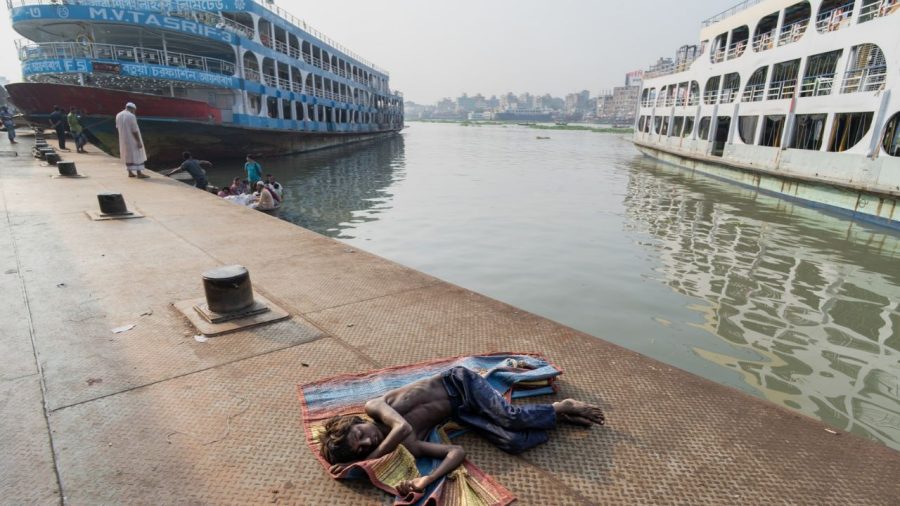
Maruf used to stay at Bahadur Shah Park in Old Dhaka. Even now, around 40 homeless children can be seen frequenting the area. But no initiative has been taken to track down their families or loved ones.
One of the children is a 13-year-old girl from Shariatpur. She ended up at the park when she was seven.
The girl said her father left the family when she was very young. Her mother found it difficult to run the household, so she was sent to live with her aunt. Unable to endure abuse there, she boarded a launch with no particular destination in mind. After arriving in Dhaka, the park became her “home”.
Another boy, believed to be around 10 years old, does not even know where he was born. He remembers that some time ago, driven by hunger, he grabbed a bag from a passenger heading to Sadarghat and ran. After being caught, he was beaten so badly that his forehead split open, the scar from the stitches still visible.
These stories are not just those of three children. According to a Unicef survey, there are at least 3.4 million street children, and there is ample reason to fear that the harshness of their lives may one day push them towards what many deem to be “antisocial” behaviour.

Law enforcement agencies, researchers and social scientists say these children, cut off from mainstream society, are becoming involved in theft, mugging, begging and other crimes, either out of a struggle for survival or under the influence of criminal groups. But initiatives to trace the families of children like Maruf are seen only when their stories go viral.
Dhaka University sociology professor Salma Akhter said that unless action is taken, millions of street children could become a kind of “time bomb” for society.
She told TIMES: “These children, facing crises of identity, social protection and shelter, are becoming easy targets for crime. Some are becoming involved in crime, while others are being used by criminals.”
Md Tawohidul Haque, associate professor at the Institute of Social Welfare and Research at the University of Dhaka, said disadvantaged and street-connected children are easy targets for drug dealers because their ability to resist is limited.
An eight-year-old child living at Sadarghat Launch Terminal used to collect bottles and work as a porter. Out of curiosity, he began taking “dandy” with drug-addicted children of his own age. “Dandy” is an intoxicant made by putting glue or solution (used in shoemaking) into a polythene bag and inhaling it.




He later became addicted. To pay for the addiction, he joined others in pickpocketing passengers and snatching mobile phones and bags. He also began being used by the “big brothers” of criminal groups and, at times, carried drug consignments.
“They give a few taka for doing this work,” he admitted. “With that money I can take a little dandy and sometimes get some food.”
Law enforcement agencies say such children are increasingly involved in mugging and adolescent crime across the city. Their lack of a fixed address, and the fact that they may live in one area and commit crimes in another, make police work more difficult.
ActionAid Bangladesh says the country still lacks an integrated child protection system, a reliable national database, adequate urban child welfare services and sufficient budget support.
Former Dhaka Metropolitan Police commissioner Md Sarwar said police can help identify families, move children to safe places and coordinate rehabilitation, but cannot carry the burden alone because of manpower constraints.
He said the Ministry of Social Welfare, government child-protection bodies, NGOs and donor agencies need to work together.
However, government initiatives do exist.
The Pathakali Trust was established in 1989 and renamed the Shishu Kalyan Trust in 1992 to provide primary education and vocational skills to disadvantaged and working children. It now runs 205 Shishu Kalyan primary schools across districts and upazilas.
The government has also adopted the National Children Policy 2011, the Children Act 2013 and other social protection programmes for vulnerable children.
Through the Department of Social Services, programmes provide drop-in centres, open shelters, counselling, non-formal education, healthcare and rehabilitation.
But the reach remains limited.
The 85 government children’s homes have only 10,300 approved places, while six Chhotomoni Nibash facilities have a total approved capacity of 600.
A proposed five-year “Rehabilitation Project for Street Children and Children at Risk”, running until June 2031, carries an estimated cost of around Tk420 crore.
Experts say the problem is not only the number of shelters or the size of budgets. Children need to be identified before they end up on the streets, brought under birth registration, linked to education and social protection and protected from drugs and criminal networks.
Salma Akhter said short-term projects often help – but only while funding lasts. “During a project, attention to the children increases. But after the project ends, many of them are no longer followed up.”
Abdullah Al Mamun, head of child protection and child rights governance at Save the Children, said children without birth registration effectively remain absent from government records.
He said local government bodies, ward councillors, city corporations and local administrations could jointly identify them and arrange birth registration, vaccination, healthcare and education. He also suggested biometric identification as they grow older, where necessary.
For children already living on the streets, Mamun said rehabilitation plans should vary according to age and circumstances. He also proposed ward-based monitoring systems in major cities, coordinated by the Department of Social Services, city corporations and private organisations.