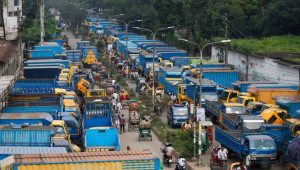
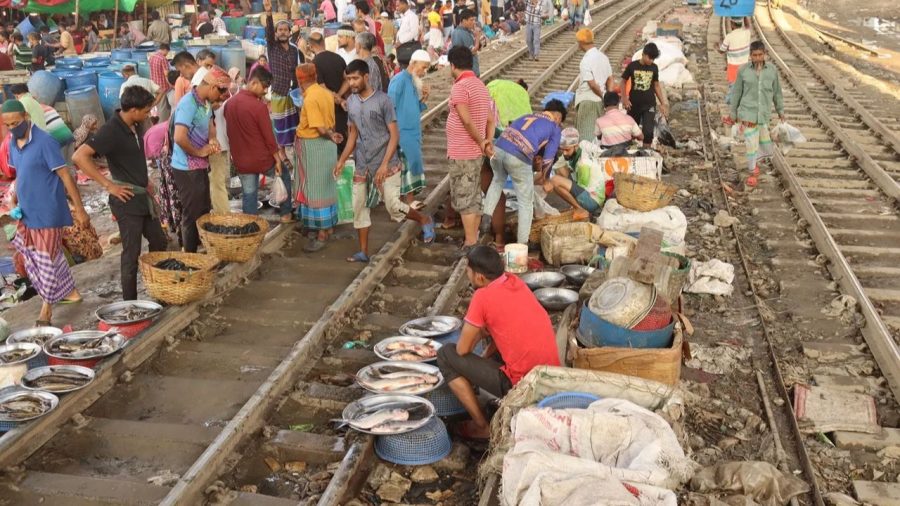



The government’s plan to relocate Karwan Bazar’s wholesale kitchen market to Gabtoli aims to ease severe traffic congestion in central Dhaka. Traders at the city’s largest wholesale kitchen market, however, fear the move could cost them regular custom and increase the expense of supplying daily essentials.
Urban planners and trade experts remain divided over the potential benefits.
Some argue that shifting the market will reduce pressure on central thoroughfares and improve access for retailers in western Dhaka.
Others favour modernising the existing facility or warn that relocation demands a comprehensive transport and logistical blueprint.
Prime Minister Tarique Rahman directed the market’s relocation during a high-level meeting on Dhaka’s congestion, public transport, and traffic management on 29 August.
Government officials argue that housing a massive wholesale hub in the city centre places undue strain on the road network, caused both by heavy long-distance lorries arriving from across the country and delivery vehicles distributing produce across Dhaka.

Shifting intensive commercial activities to the city’s perimeter, they maintain, will alleviate this gridlock.
Traders fear losing custom
For Rifat Hossain, a trader at Karwan Bazar for 26 years, the primary concern is whether buyers will follow merchants to Gabtoli. Many local businesses have operated here for three to four decades, with some spanning generations. Recent reports that the site may move even further, beyond Gabtoli to Amin Bazar, have heightened worries over livelihoods.
“An even bigger problem is losing custom,” Rifat said, noting that central Dhaka buyers would face higher transport fees, while traders struggling with reduced sales would find it difficult to cover additional operational expenses.




Mohammad Kayes, another trader, highlighted that Karwan Bazar houses over 800 shops and supplies major institutions, including Police Lines and the armed forces.
Whether these institutional clients will continue purchasing from the new site remains uncertain. A market’s commercial viability, he stressed, relies heavily on longstanding customer relationships.
Traders also question how much the relocation will reduce daytime congestion, pointing out that primary wholesale deliveries occur between 10 pm and 3 am. But commuters passing through Kazi Nazrul Islam Avenue say that the road faces severe traffic congestion even at dead of the night.
Previous attempts to move the market date back two decades; a Tk206 crore project initiated in 2006 stalled due to delayed execution and strong trader resistance over accessibility and business survival.
Planning holds the key
Mosleh Uddin Hasan, general secretary of the Bangladesh Institute of Planners, acknowledged that market operations contribute to traffic issues, though its presence alone is not the sole cause. Poor operational management is equally to blame.
“If moving the market means taking mismanagement with it, what is the benefit? The same issues will arise wherever it is relocated,” Hasan warned. He stressed that future planning must incorporate connecting roads, metro rail stations, and the elevated expressway.
Adil Mohammed Khan, professor of urban and regional planning at Jahangirnagar University, advocates modernising the current site instead. Since heavy wholesale activity occurs overnight, he attributes daytime congestion to illegal parking, street vendors, and weak municipal oversight. Upgrading infrastructure and regulating traffic flow could resolve these issues without displacement, which he warned might inflate food prices for low- and middle-income families nearby.
Supply chains and cost shifts
Retailers in central Dhaka rely on Karwan Bazar to restock frequently at low transport costs. A shopkeeper from Hatirpool noted that transporting goods currently costs around Tk200 by rickshaw-van or Tk100-120 by rickshaw. Shifting to Gabtoli would force him to source from Chawkbazar or pass added transport costs onto consumers.
Vegetable vendor Hakim estimated that an increase of Tk2-5 per kg in freight would directly raise retail prices.
Professor Khan cautioned that Karwan Bazar stabilises vegetable prices across central Dhaka; disrupting this distribution ecosystem could trigger price spikes in surrounding neighbourhoods.
Conversely, Muhammad Ismail Hossain, a professor of marketing at Dhaka University, believes the advantages could outweigh the drawbacks. Gabtoli would offer greater convenience for retailers in Mirpur and Mohammadpur, though traders in Eskaton, Moghbazar, and Malibagh would face higher costs.
Nasrin Akter, another marketing professor, emphasised that moving a centralised hub requires re-engineering the capital’s entire supply chain. Dispersing goods through smaller, fragmented vehicles from the outskirts could raise overall logistical expenses, particularly since Gabtoli itself suffers from heavy traffic.
Detailed distribution routes and urban planning must be established before any move occurs.