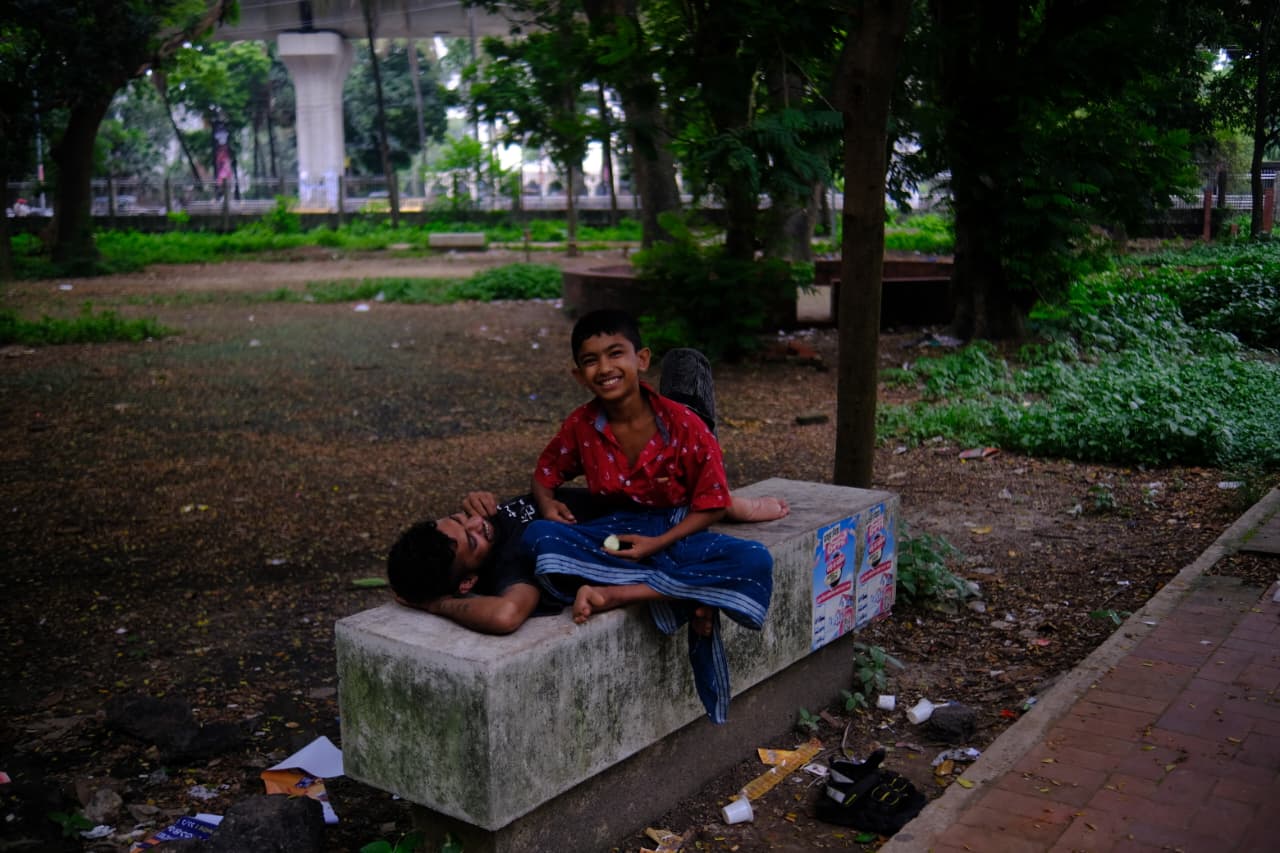
At around 10 years old, Sadik (not his real name) has already lived through a childhood shaped by survival, loss and exploitation.
His life revolves around Suhrawardy Udyan, a sprawling public park in central Dhaka. After losing a leg in a road accident as a child, Sadik used to sell flowers around the Dhaka University TSC area, moving with the help of crutches.
But as his family struggled to make ends meet, his mother brought him back to the park in search of better earnings.
Today, Sadik sells drugs there. He is among dozens of children who have been drawn into an organised drug network operating inside the historic park, according to police officials and people living there. Many of these children, who once sold flowers, cigarettes, betel leaves or water, have become couriers for drug dealers before some eventually become users themselves.
During the day, the activity is visible inside the park. A group of people controlling the trade operate openly, while many also live in makeshift settlements under trees, near temporary food stalls or on patches of open grass. At a place locally known as the “Flower Canteen”, around 10 to 12 people were sitting together, chatting and spending time with children.


Pointing towards them, Sadik said, “Everyone here is one family. We live together.”
Children between the ages of eight and 16 are commonly used in the network, police said. Their involvement is partly driven by poverty and partly because legal procedures for children mean they are often released quickly after being detained during raids.
A police officer at Shahbagh Police Station said some people previously involved in flower-selling around the “Flower Canteen” later became involved in drug trading, using floating children living in the park for their operations.
“The law treats children differently. Their cases and investigations are handled separately. We send them to court, and decisions regarding their release or bail are taken by the court,” the officer said.



A ‘family’ built on the streets
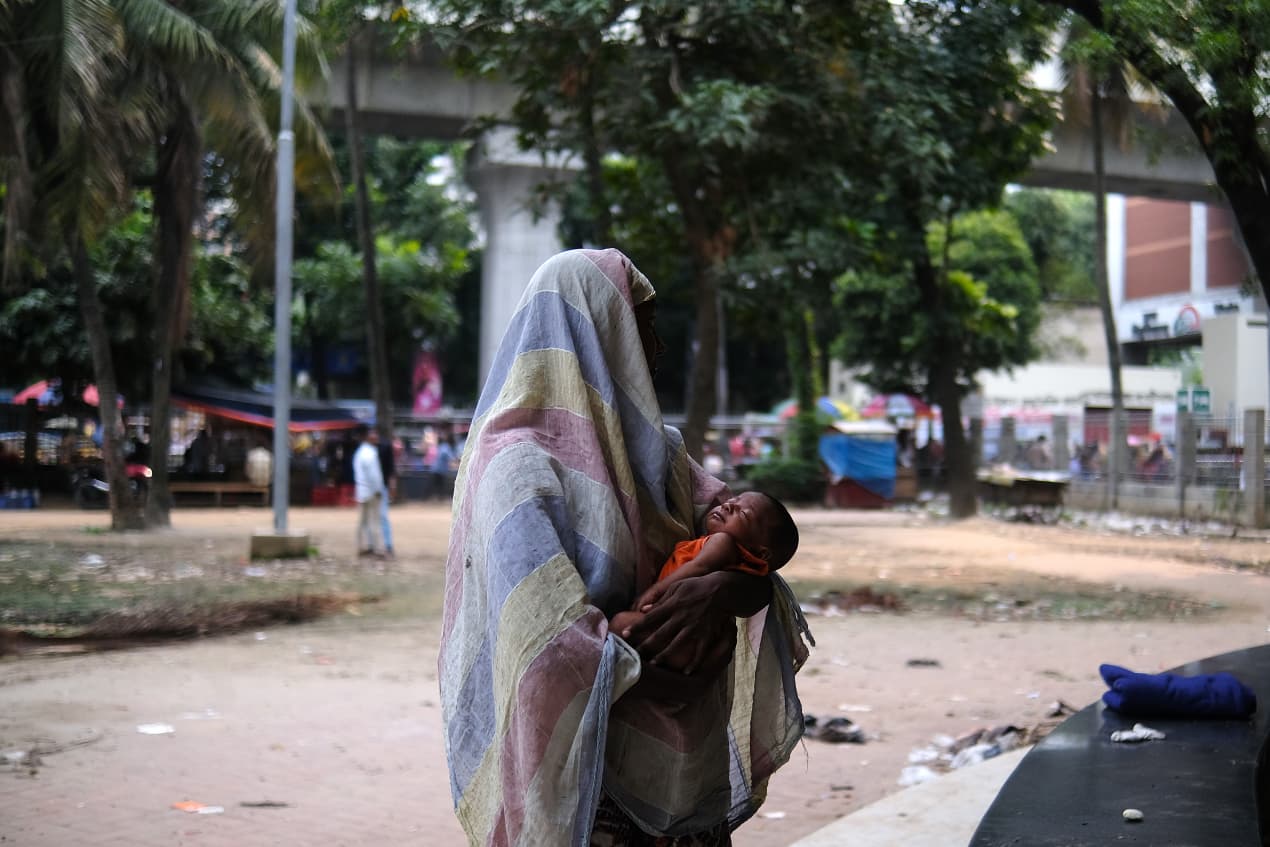
For many living in Suhrawardy Udyan, the park is more than a temporary shelter. Some were born there, grew up there and have witnessed marriages and deaths within its boundaries.
They describe themselves as a “family”. Smriti and Mohammad Akash are one such couple. They married while living in the park. Akash has spent about 12 years there, while Smriti says she has lived there for three decades. Smriti once sold flowers but later became involved in selling cannabis.
“I sell when he is afraid, and he sells when I am afraid. We earn around Tk500 to 600 in profit a day,” she said. Several groups operate in the park and identify themselves as separate families, residents said.
A person at the Flower Canteen said a woman named Paruli was once involved in the flower business before a man named Nabi allegedly brought many people into the drug trade. Smriti said some groups became less active after the killing of Dhaka University Chhatra Dal leader Shahriar Alam Samy.
“After Samy bhai was killed, many members of Mehdi bhai’s group, including Kobutor Abbu, Abu, Ripon bhai and Mokbul bhai were arrested. They are no longer active,” she said.
According to Smriti, the trade was once controlled by Mehdi’s mother, known locally as “Mukta Khala”, who allegedly controlled an area stretching from the Shaheed Minar to Khichuri Patti before her death from heart disease. Residents said groups linked to Nabi, Alika, Rekha Khala and Rabbi are currently among the more active groups.
Humayun, who said he had been involved in the trade for five years, described the operation as highly organised despite its chaotic appearance.
“People enter this business step by step. At first, newcomers do small jobs. Later, they become close to bigger dealers and take on greater responsibilities. Then the struggle for control begins,” he said. At the top, he said, are the main controllers. When police raids are announced, sellers quickly disappear into crowds. Some throw away cannabis packets or hide them inside their clothes and secret pockets, residents said.
A failure of child protection
Khairul Chowdhury, a professor at the Department of Sociology at the University of Dhaka, said the issue should not be viewed only as a drug problem but as a wider failure of child protection.
“The drug issue must be considered within the broader framework of child safety and protection. Ensuring children’s health, education, nutrition and security should be the priority,” he said. He said the existence of street children reflected failures within both family and state systems.
“A street child is not a natural identity; it is a manifestation of crises within society and the state,” he said. Questioning why children remain on the streets despite government-run orphanages and rehabilitation systems, Khairul said they could be brought under compulsory education, boarding schools, rehabilitation programmes and healthcare services.
For children like Sadik, however, Suhrawardy Udyan remains both home and workplace – a place where survival often comes before childhood.