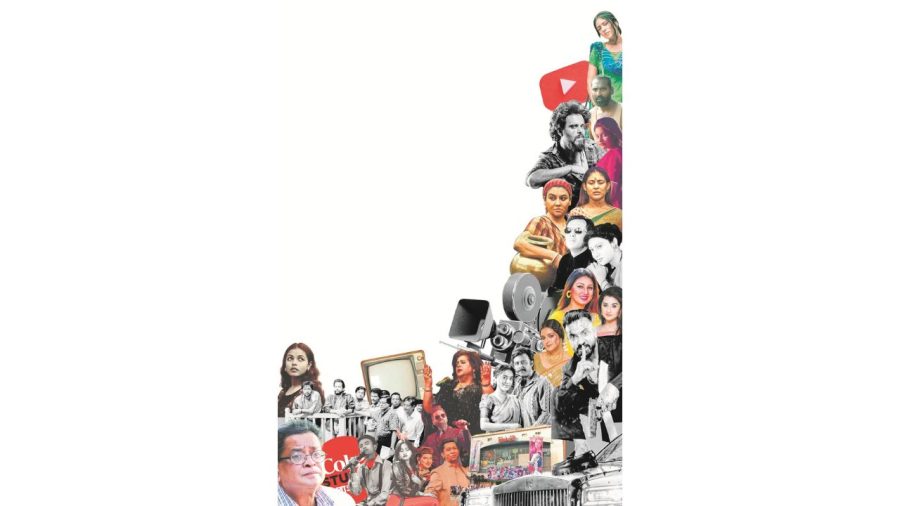



There was a time when Bangladeshis took to the streets for a fictional man. He was not a politician or celebrity. It was Baker Bhai, the television character created by Humayun Ahmed for Kothao Keu Nei. When his death became emotionally unbearable for viewers, people protested and petitioned to save him. Baker Bhai still died, but his fate revealed something extraordinary: a fictional character had become real enough in the public imagination to provoke a reaction in the real world.
That is the Bangladesh I keep thinking about when I look at our entertainment industry today. We still have talented actors, gifted musicians, ambitious filmmakers and creators whose work reaches major international festivals. Yet something feels different. Bangladesh continues to produce entertainment, but are we still producing the kind of culture that becomes part of a country’s collective memory?
Bangladesh did not begin its cultural life by looking elsewhere for an identity. Bengal already had a remarkable literary, musical, theatrical and cinematic tradition. Rabindranath Tagore became a global cultural figure, while Satyajit Ray transformed Bengali cinema into a language recognised far beyond Bengal. Zahir Raihan showed during the Liberation War that cinema could be more than entertainment. Stop Genocide became a powerful document of 1971, while Jibon Theke Neya used popular cinema to reflect political reality.
After independence, films such as Ora Egaro Jon, Titas Ekti Nadir Naam, Surja Dighal Bari and Golapi Ekhon Train-e continued that tradition. Ritwik Ghatak’s Titas Ekti Nadir Naam, based on novel, was rooted in the lives of communities along the Titas and represented the work of one of South Asia’s most important filmmakers. The past was not a spotless golden age; commercial and formulaic films existed too.
Yet the finest work felt unmistakably rooted in its own place, carrying its rivers, villages, families, politics, humour, grief and contradictions without needing to pretend to be somewhere else.
Television then created perhaps Bangladesh’s most powerful shared cultural space. Ei Shob Din Ratri, Bohubrihi, Ayomoy, Kothao Keu Nei and Aaj Robibar became household experiences rather than programmes. Humayun Ahmed understood that popularity and substance did not have to be enemies. His stories were accessible and entertaining, yet his characters had enough depth to become part of people’s lives.
Remarkably, Aaj Robibar was later dubbed into Hindi and aired on India’s Star Plus in 2017, a reminder that cultural traffic once travelled outward from Bangladesh too.

The same confidence existed in music. Runa Laila became a regional star across Bangladesh, India and Pakistan, while Sabina Yasmin became one of Bangladesh’s defining voices. Azam Khan, Souls, Miles, LRB and James gave different generations their own sound, later followed by musicians such as Tahsan, Habib Wahid and Arnob. They did not all sound alike, and that diversity was precisely the richness: Bangladesh could create its own version of cool rather than simply import it.
Then technology opened the windows wider. Satellite television brought Indian serials into Bangladeshi homes; Star Jalsha, Zee Bangla and characters such as Pakhi became household phenomena. Turkish dramas, especially Sultan Suleiman, followed, while YouTube and streaming eventually made borders almost irrelevant. A Bangladeshi viewer could move from Dhaka to Kolkata, Istanbul, Karachi, Mumbai or Los Angeles without leaving the sofa.
There is nothing inherently wrong with that. The problem begins when influence stops being an ingredient and becomes the recipe, when the question shifts from “What story do we want to tell?” to “What story is working right now?”
That change is visible on television and cinema. Pakistani dramas have gained a strong following, while some Bangladeshi productions have borrowed their structures and dynamics; Eta Amaderi Golpo, for instance, has been discussed alongside Kabhi Main Kabhi Tum. Adaptation is not new, but there is a difference between inspiration and repeatedly searching elsewhere for the blueprint of success.




The same concern surrounds commercial cinema. The violent, hyper-masculine vocabulary popularised by Hindi action films such as Animal can be seen across South Asian commercial cinema, including films such as Borbad, Rakkhosh and Taandob. This does not mean Animal caused them or that every Bangladeshi action film is an imitation. The larger question is why the grammar of commercial success so often seems to arrive from elsewhere before we develop our own.
We often say filmmakers are simply giving audiences what they want, but audiences do not develop tastes in a vacuum. Broadcasters commission, producers finance, platforms promote, and algorithms determine what people encounter. Familiarity becomes expectation, expectation becomes ‘demand’, and the cycle reinforces itself.
Yet Bangladesh has clearly not run out of talent. Tareque Masud’s Matir Moyna reached Cannes Directors’ Fortnight and won the FIPRESCI Prize. Abdullah Mohammad Saad’s Rehana Maryam Noor became the first Bangladeshi feature selected for Cannes’ Un Certain Regard.
Rubaiyat Hossain’s Made in Bangladesh travelled internationally, while The Difficult Bride became the first Bangladeshi feature selected for Venice’s Orizzonti Competition and later reached Toronto and London in 2026. The talent, international recognition and stories are still there. What appears to be missing is the bridge between exceptional work and mass cultural life.
Bangladesh’s entertainment landscape now sits between ambitious festival cinema and commercial productions competing through stars, spectacle, action and virality, with OTT increasingly occupying the middle. Actors such as Chanchal Chowdhury, Zahid Hasan and Mosharraf Karim continue to prove the strength of local performance, while Chanchal, Siam Ahmed, Nusraat Faria and Arifin Shuvo have crossed into Indian productions.
Projects such as Aynabaji, Hawa, Roid and the growing OTT ecosystem also show that audiences can embrace original Bangladeshi work. So, this is not a story about talent disappearing. It is about talent becoming disconnected from cultural scale.
Perhaps the clearest symbol is the cinema hall. Bangladesh had around 1,435 halls in the early 1990s; recent estimates put operational halls at roughly 141, with only about 60 operating throughout the year. Every closure means more than a business disappearing: it removes a shared physical space where generations experienced Bangladeshi stories together.
That helps explain why Baker Bhai feels so distant. Today’s audiences are not necessarily less emotional or less interested in stories; the ecosystem that allowed one story to become everyone’s story has largely disappeared.
Nostalgia alone, however, is not the answer. We cannot and should not recreate the 1990s. Technology, economics and audiences have changed. The difference was not that everything made then was better, but that the best work could become both popular and meaningful. Humayun Ahmed could create national obsessions without sacrificing depth; Runa Laila could become a household name while crossing borders; Zahir Raihan could combine political urgency with artistic ambition; Tareque Masud could tell deeply local stories to the world.
There are reasons for hope, and some of the strongest can be heard in today’s music. Bachelor Point became a major contemporary phenomenon by creating characters and humour rooted in local realities, while Coke Studio Bangla has shown that modernisation does not have to mean cultural erasure. Since its launch in 2022, the platform has brought together established and emerging Bangladeshi artists, folk traditions, regional sounds and contemporary production, creating songs such as Nasek Nasek, Bulbuli, Bhober Pagol, Deora and Tati.
Its third season brought together more than 180 artists from Bangladesh and around the world, while its fourth season continued that cross-cultural approach, including collaborations connecting Bangladeshi and Turkish musicians. By May 2026, Coke Studio Bangla had accumulated more than 4 million subscribers and over 926 million global views, showing that distinctly Bangladeshi musical traditions can find audiences far beyond the country.
The distance between Runa Laila’s Mast Kalandar and a viral song such as Lichur Bagane is enormous, but popularity itself is not the enemy. The harder question is what survives: which songs, characters and films will still tell future generations what Bangladesh felt like?
A country that can reach Cannes, Venice and Toronto has not forgotten how to tell stories. What we may have lost is the ability to make the exceptional mainstream.
Bangladesh does not need another Humayun Ahmed, Razzak, Zahir Raihan or Runa Laila. It needs creators capable of doing what they did for their own generation: making something so unmistakably of this place and this moment that audiences beyond Bangladesh want to experience it precisely because it is ours. We do not need to stop watching the world. We need to become interesting enough that the world wants to watch us.
Bangladesh has rivers full of stories, cities full of them, families full of them and a history rich enough to fill generations of films, songs and dramas. What we need is confidence to believe those stories are enough.
The next great Baker Bhai, Humayun Ahmed, Runa Laila or Zahir Raihan may look and sound nothing like their predecessors, and perhaps they should not. But if we give today’s creators the freedom to create rather than reproduce what has already worked elsewhere, Bangladesh may once again produce entertainment that does more than occupy our screens. It may produce something far more difficult and valuable: a culture people remember, claim as their own and carry beyond the borders of the country that created it.
Author is the In-charge, Entertainment Desk at Daily TIMES of Bangladesh