


Walk down any bustling street, hop onto a crowded bus, or navigate a crowded pavement in Dhaka, and you will witness a cultural phenomenon that defies modern sanitation.
Whether it is a dramatic clearing of the throat culminating in a projectile expectoration or the artistic deployment of a betel-leaf-induced crimson splatter across a freshly painted white wall, public spaces double as open canvases.
Urination finds its sanctuary right on the sidewalk, while sneezing is treated not as a private biological necessity, but as an aerosolised gift delivered directly into the faces of fellow commuters.
The consequences are as predictable as they are ugly.
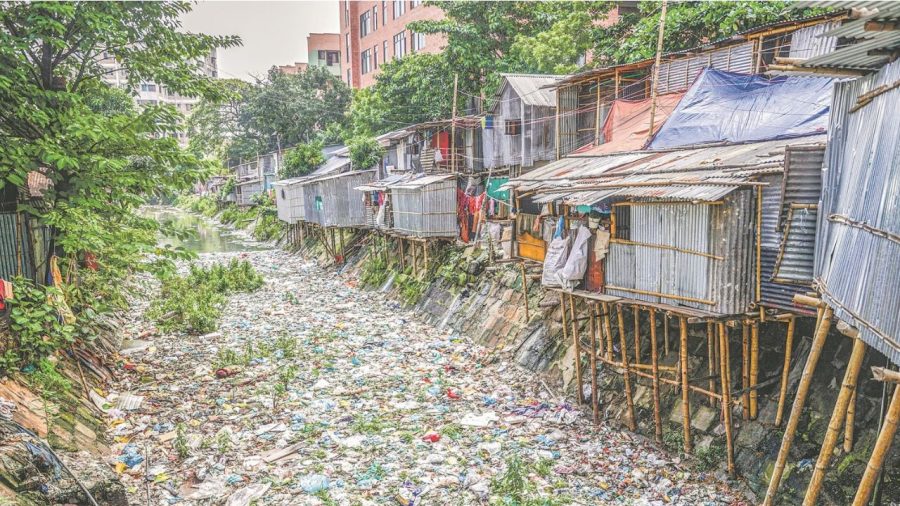
Households perpetually battle seasonal colds, footpaths practically morph into subterranean streams of biological runoff, aesthetic urban structures proudly sport bizarre maroon abstract art of unveiling, and open-air coughing matches actively incubate tuberculosis.
Bangladesh remains one of the top thirty high-risk countries globally for tuberculosis, yet a modicum of awareness is apparently too high an administrative price to pay.
Naturally, the eternal question arises: Is there no remedy? The standard playbook dictates that we must educate the masses.
But try explaining public hygiene to someone, and you are far more likely to be lectured on why their customised method of environmental defilement is actually a sacred cultural right.

When persuasion fails, one naturally looks to the law. But verifying if a law exists, and then discovering whether it is actually enforced, turns into a bureaucratic labyrinth. Who has the spare time to chase wild boars in the administrative forest?
Take, for instance, the Smoking and Tobacco Products Usage (Control) Act, which prescribes a fine of up to 2,000 taka for public smoking.
Have you ever heard of its enforcement? If it happens at all, it occurs with the spectral rarity of a lunar eclipse, leaving zero psychological impact on the public psyche. Similarly, legal provisions against spitting on public streets supposedly exist.
Under the Dhaka Metropolitan Police Ordinance of 1976, Section 80 makes it an offense to spit in public if it annoys pedestrians, punishable by a 200-taka fine. Similar municipal police acts in Chattogram, Rajshahi, Sylhet, and Barishal outline fines ranging from 100 to 300 taka.
Yet, hearing about these laws being enforced is about as likely as discovering a unicorn grazing in Motijheel.




Globally, nations take a far less philosophical approach to bodily fluids in public. Singapore treats spitting as an elite financial offense, with first-time offenders facing fines up to 1,000 Singapore dollars, doubling on a second offense. Dubai imposes fines ranging from 500 to 1,000 Dirhams for public expectoration.
London treats it as antisocial behaviour under council rules, handing out instant on-the-spot fines between 80 and 150 pounds. Even across the border in various Indian states, spitting or paan-staining incurs strict penalties ranging from 200 to 5,000 rupees.
Public urination and garbage dumping carry similarly toothless 200-taka fines in our statutes—penalties that exist solely on paper, gathering digital dust in government gazettes.
Experts will invariably argue that before enforcing laws, we must build public awareness. Brilliant! Never mind that this year’s health sector budget allocation hovers around a meagre 1.01 percent of the GDP, with no distinct line item explicitly earmarked for teaching adults how to use a tissue.
In India, awareness-raising activities are conducted through various national missions under the Ministry of Health and Family Welfare (MoHFW).
A significant portion of this mega project across rural and urban areas is spent on generating public awareness. In recent budgets (such as the 2025–26 and 2026–27 fiscal years), allocations have been increased in India to raise awareness about diseases like cancer, diabetes, hypertension, and mental health.
Special emphasis is being placed on raising awareness about dietary changes and the health risks of fast food or ultra-processed foods.
Furthermore, every Indian health scheme or programme includes a specific sub-budget called ‘IEC’ (Information, Education, and Communication). Health awareness advertisements and campaigns are run on television, radio, newspapers, and social media using this fund.
In the United Kingdom, through Public Health England or equivalent departments, massive budget allocations are made for smoking cessation, obesity control, and mental health awareness.
In Australia and OTC (Other Traditional/Comparable) countries, annual budgets are set aside specifically for promoting better quality of life and screenings (such as breast or colon cancer screening awareness) rather than focusing solely on post-diagnosis treatment.
Among low-and-middle-income countries, Vietnam and the Philippines allocate a good portion of their GDP to public health and primary healthcare awareness.
To be fair, Bangladesh is not entirely incapable of monumental public health victories. The historic oral rehydration therapy campaign of the 1980s, spearheaded by the government alongside ICDDR,B and BRAC, successfully taught households across the country how to mix saline by hand, proving that mass awareness can indeed scale when backed by genuine will.
However, modern lifestyle challenges require modern, relentless infrastructural backing. Without institutional support, expecting individuals to magically transform their civic habits is like asking a fish to climb a tree and complain about the lack of stairs.
To break our collective addiction to open-air contamination, the state must implement a triad of legal, infrastructural, and communicative transformations:
Rigorous legislative evolution: Legislation must evolve past archaic municipal bylaws to introduce robust, modern federal penalties for public expectoration and improper waste disposal. Existing tobacco control laws require actual enforcement rather than decorative existence, backed by mobile courts handing out instantaneous spot fines.
Infrastructural modernisation: Infrastructure must finally catch up with population density through the construction of clean, accessible public toilets, the placement of dedicated spittoons and dustbins at every transit hub, and the establishment of genuine, designated smoking zones far away from innocent bystanders.
Technological surveillance: Technology should play a role via digital monitoring and CCTV networks to catch repeat offenders who treat public roads as their personal waste bins.
Multi-tiered public campaigns: Comprehensive educational campaigns must infiltrate school curricula, media channels, and religious sermons alike to reframe public hygiene as a collective moral duty rather than a personal choice.
Ultimately, if these structured interventions fail to civilise our public habits, the state has only one logical frontier left: uncompromising, relentless, on-the-spot financial penalties for anyone caught turning our shared cityscape into an open-air garbage dump.
Otherwise, we might as well drop the pretense of civilisation and honestly accept that we are quite content living inside a glorified wasteland.
Author is the Deputy Editor of Daily TIMES of Bangladesh.