


Mariam Islam is a citizen of both Bangladesh and the United States. She frequently travels to the US alone. She is frustrated by the behaviour of immigration officials at Bangladeshi airports and the barrage of questions they subject her to.
When she travelled to the US in 2015, she was unmarried. At Shahjalal International Airport, an immigration official asked why she was travelling alone and why her parents were not accompanying her.
Immigration officials even wrote down her US address on a piece of paper. When she travelled for the second time in 2017, she was asked, “Where is your husband?” When Mariam said she was unmarried, the next question was, “Why haven’t you got married?”
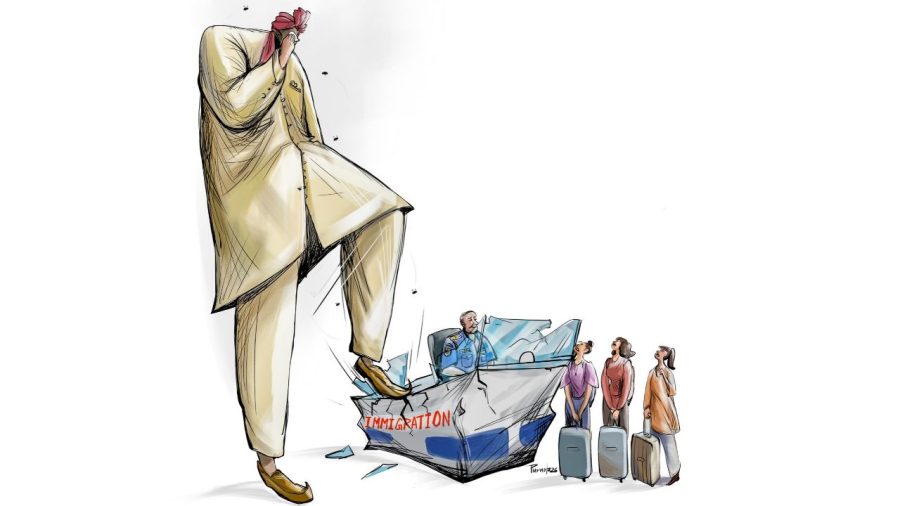
Such unwelcome behaviour by immigration officials towards unmarried women travelling abroad is nothing new. Rather, such questions and conduct have become almost routine. Immigration officials appear to have little concern that women may feel annoyed or humiliated by such questions.
Because of this mindset, three young women were stopped from travelling to Nepal and sent back from the airport. But the three women have decided not to let the matter go. They filed a writ petition with the High Court, and a bench of the court is now seeking accountability.
After the issue reached the High Court, Special Superintendent of Immigration Police Moniruzzaman told TIMES that the three women had been questioned as part of their efforts to “prevent human trafficking”.
But former Inspector General of Police (IGP) Baharul Alam believes a deeper social psychology lies behind such behaviour by immigration police. “This society is not women-friendly. When police see a woman traveling alone at night, they approach her in way that she is a bad woman. If a young woman returns home at night, another woman may also make negative comments. These stereotypes exist within our society itself.”

Under the Constitution and law, freedom of movement is a fundamental right of a citizen. But the personal curiosity, patriarchal mindset and questioning beyond their legal authority by officials sitting at immigration counters are repeatedly undermining that right.
Since I had a US passport, Mariam said they [immigration police] could not keep her there for long but she had to give a lot of explanations. “They also questioned my parents’ citizenship. I was asked, ‘If you get married, will your husband become a citizen?’”
Some of her female acquaintances travelling abroad have also been taken into separate rooms and asked irrelevant questions such as whether they would return, whether they would abscond and whether they were in a relationship with anyone.
Married women are not spared the harassment either. Tania Akter’s passport still stated that she was “unmarried” at the time. When she travelled to India with her husband after their marriage, immigration police asked her, “Who are you travelling with?”
Even after she explained that her husband had completed immigration formalities at another counter, the police did not believe her. Tania was taken to several rooms for questioning. Although she offered to show her marriage documents, she was not allowed to call her husband inside.


Later, another police officer called her husband in. Although they were the same age, the husband appeared somewhat younger, prompting the police to ask, “How can he be your husband? Why did a student get married?”
She was even asked the deeply personal question of what her husband fed her. Angry at the line of questioning, Tania asked them to call the kazi, her parents and her mother-in-law. She was eventually allowed to fly. At Indian immigration, she didn’t face a single question.
On 16 September, while travelling to Nepal, Shaswati Dewan was kept standing for half an hour even after showing her passport, office NOC, return ticket and invitation letter. An official repeatedly asked to see her endorsement and wanted to know when she would return. Although she offered to show her return ticket, he did not look at it.
Shaswati regrets that she may have been allowed to travel eventually because she was married, but says that women travelling alone are subjected to humiliating situations in the name of additional scrutiny.
Three young women’s legal battle
On 8 August, three friends — Rifa Tamanna, Sohani Islam Samapti and Naznin — decided to travel to Nepal. All three are adults, carrying all the documents and papers, have no criminal cases against them and had their families’ consent.
But an immigration officer at Shahjalal International Airport refused to let them proceed. The reason, they say, was that they had no male companion and none of them was married. They were sent back from the airport. In protest, they sought legal recourse.
Their lawyer, Ishrat Hasan, told TIMES that after receiving their boarding passes and going to immigration, the three women were subjected to unreasonable questioning. They were asked about their marital status, where they were getting the money for the trip and whether their families knew about it. The officials even called their families and expressed suspicion.
On 31 August, the three victims submitted a written complaint to the Additional IGP of the police’s Immigration Branch, seeking preservation of CCTV footage, action against those responsible and compensation. As the police took no action even after a month, they sent a legal notice on 6 September. When there was no response to that either, they filed a writ petition with the High Court on 15 September.
The Officer-in-Charge of the Immigration Police has also been named as a respondent in the writ petition.
During the hearing of the writ on Tuesday, a bench comprising Justice KM Kamrul Kader and Justice Fatema Anwar issued a rule asking why preventing adult female citizens from legally travelling abroad solely because they are unmarried, travelling without a guardian or on gender-based grounds should not be declared to be without lawful authority.
The court also directed the Additional IGP to dispose of the complaint submitted by the women within seven days and submit a compliance report.
“Police cannot prevent anyone from travelling abroad without a court order or a criminal case. If an adult woman has a valid passport, the police have no scope to see whether her family has given consent or not,” lawyer Ishrat said.
When asked why the three young women had been subjected to such harassment, Special Superintendent of Immigration Police Moniruzzaman did not give a direct answer, saying, “Once we receive a copy of the High Court order, we will sit with senior officials and take appropriate measures.”
Asked why such complaints of harassment were emerging, he said, “It should not be said in such a sweeping manner. Human trafficking networks have become strong in Nepal. That is why they were questioned repeatedly.”
When told that the issue was not limited to the three young women seeking to travel to Nepal and that similar allegations had been made for years, the immigration official said, “I do not want to talk about those.”
Former IGP Baharul Alam said the police should have replied to the legal notice. They could have admitted their mistake and said they would correct themselves or provide training to their subordinates, he observed.
Baharul also sees shortcomings in immigration training. “Training places greater emphasis on data entry and passport verification. There should be at least one or two lessons on human dignity and a humane approach.”
Tania Haq, a professor at the Department of Women and Gender Studies at the University of Dhaka, believes such harassment at immigration is a manifestation of society’s hostility towards women.
“Their mindset is why should women go outside? I see nothing here other than how much women can be humiliated. The government should take a firm position on these issues,” she told TIMES.