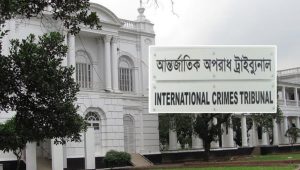
The ongoing investigation into allegations of crimes against humanity and terrorism against the Awami League, whose activities as a political organisation are banned, has not gone into “cold storage,” International Crimes Tribunal (ICT) Prosecutor Gazi MH Tamim has said.
He added that the appointed investigating officer is collecting and reviewing direct evidence and case data from across the country.
Briefing journalists on the premises of the International Crimes Tribunal on Sunday, Tamim said that the collection of evidence regarding crimes committed nationwide by the Awami League is currently under way.
He added that finishing the investigation against the party as a political organisation would take time.
Massive and time-consuming probe
Tamim made these remarks in response to questions from journalists regarding whether the ongoing investigation against the Awami League as a party had entered “cold storage” despite earlier statements by Chief Prosecutor Md Aminul Islam and former Chief Prosecutor Md Tajul Islam.

Reaffirming that the probe against the Awami League as a political organisation has already begun, Tamim explained that completing an investigation against an organisation like the Awami League is a massive and time-consuming process.
He noted that a comprehensive report must be prepared after gathering data from every district and upazila in Bangladesh, as well as various operational branches and sub-branches of the party.
Highlighting the unprecedented nature of the trial process, Tamim stated that no judicial proceeding of this kind against a political organisation has ever occurred in the country’s history, making it a rare event.


Consequently, the investigating officer is taking adequate time and advancing the probe with the assistance and advice of the prosecution.
Although Tamim did not specify an exact timeframe for receiving the investigation report – explaining that setting a deadline is difficult because offences occurred across the country at different times – he expressed hope that the report would be received within a stipulated timeframe.
Earlier legal steps and provisions
Earlier, in the first week of July, ICT Chief Prosecutor Md Aminul Islam mentioned that the investigation against the Awami League under the International Crimes Tribunal Act and the Anti-Terrorism Act was ongoing, adding that if found guilty, the party could be banned and its assets confiscated under provisions of the law enacted by the Awami League regime itself.
Prior to that, on 7 October last year, then Chief Prosecutor Md Tajul Islam announced that the ICT investigation agency had launched a formal probe to try the Awami League as an organisation for crimes against humanity committed to suppress the student-people mass movement, assigning an officer to lead the inquiry.
Mass movement and ban on activities
The nearly 15-year rule of the Awami League ended on 5 August 2024 amidst a student-people uprising, when Awami League President Sheikh Hasina resigned from the premiership and fled to seek refuge in India.
Three days later, an interim government led by Muhammad Yunus assumed office.
Following this, a series of cases were filed against Sheikh Hasina, Awami League ministers, members of parliament, and leaders and activists at various levels regarding casualties during the July-August mass uprising.
The interim government initiated trial proceedings against Sheikh Hasina and her associates at the International Crimes Tribunal, which was originally established during the tenure of the Awami League government.
Currently, trial proceedings are under way at the tribunal against Sheikh Hasina, Awami League leaders, activists, and allies on charges of genocide and crimes against humanity committed while attempting to suppress the uprising.
Since the fall of the party, leaders of the Anti-Discrimination Student Movement, who led the uprising, had been demanding a ban on the Awami League.
In response, the government issued a notification prohibiting all activities of the Awami League and its affiliate organisations until trial proceedings at the International Crimes Tribunal are concluded.