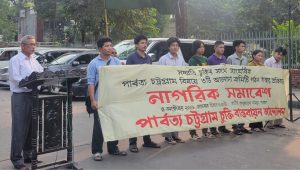
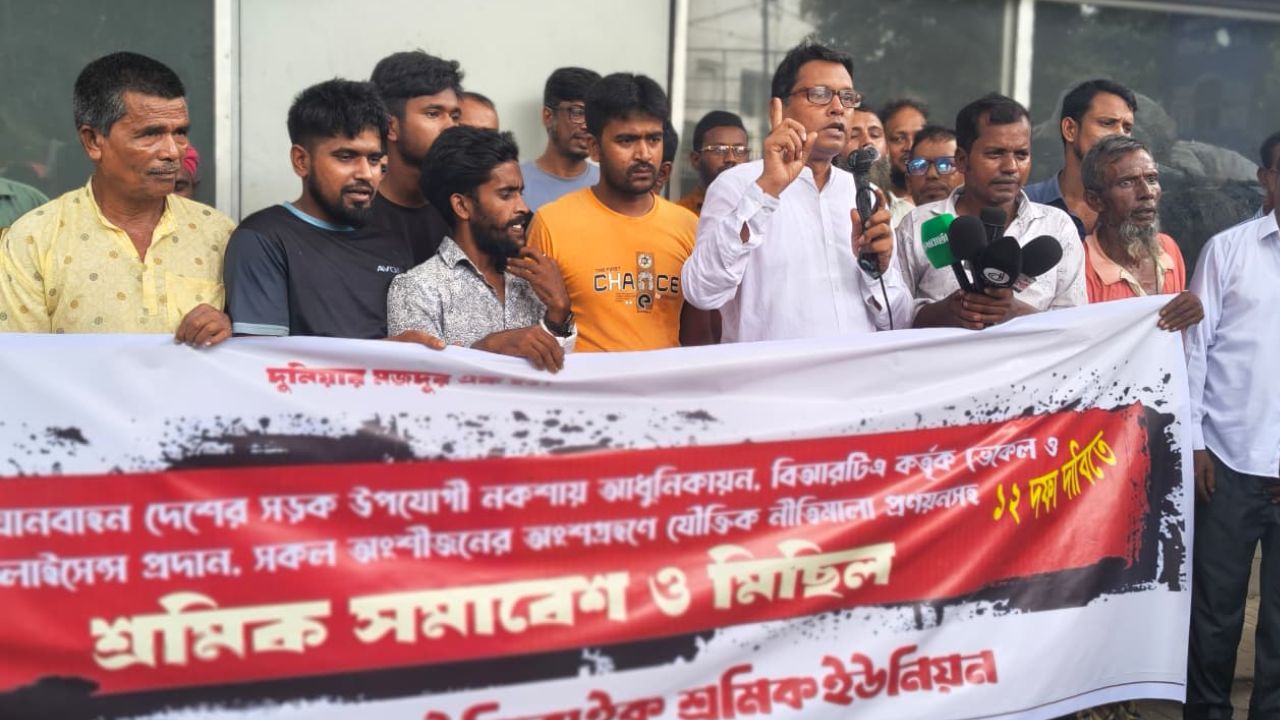
Drivers of battery-powered rickshaws, vans, and easy-bikes gathered outside the National Press Club in Dhaka on Tuesday to demand official Bangladesh Road Transport Authority (BRTA) licences, route permits, and an immediate end to police harassment and extortion.
Organised under the banner of Rickshaw-Van-Easy bike Workers Union, the demonstrators urged the government to establish clear guidelines for their movement rather than evicting them, warning that displacement would destroy the livelihoods of thousands of low-income workers.
Speaking at the rally, Mohammad Nuruzzaman, central committee vice-president of the union, cautioned authorities against provoking auto-rickshaw drivers and rejected any attempts to turn Dhaka into an exclusive city for the wealthy through vehicle evictions.
He stressed that drivers operate these vehicles out of sheer economic necessity and called for formal regulation, including the issuance of vehicle licences and driver training permits.

Nuruzzaman also demanded an immediate end to the harassment of garage owners, insisted that legitimate electricity connections must not be disconnected, and affirmed that workers seek peaceful solutions from the government rather than conflict.
Abdullah Kafi Ratan, general secretary of the Communist Party of Bangladesh (CPB) central committee, revealed that a charter of demands had been submitted to the DMP commissioner following 5 August, calling for mandatory licences for all auto-rickshaws and an end to extortion conducted under the guise of cards.



He alleged that in Kamrangirchar, a single rickshaw driver was previously forced to pay Tk3,000 per month in extortion, amounting to an annual burden of Tk36,000 per worker.
Kafi Ratan calculated that if the government collected a nominal annual licence fee of Tk1,000 per rickshaw, it could generate Tk500 crore in public revenue annually from 50 lakh rickshaws across the country.
Responding to criticisms regarding tax contributions, he clarified that while rickshaw pullers do not earn enough to pay income tax, poor citizens consistently pay Value Added Tax (VAT) whenever they purchase goods or services.
Abdul Kuddus, president of the Rickshaw-Van-Easy bike Workers Union, observed that transport workers often fail to realise their collective strength, noting that had they understood their rights, they would not have had to struggle for so long to attain their demands.
He highlighted that the city relies on the sweat of individuals operating rickshaws, vans, and easy bikes, yet these workers are ignored whenever policy decisions are taken. Asserting that the workers are demanding their fundamental rights rather than seeking charity, Kuddus urged authorities to formulate official policies that consider the livelihoods, families, and earnings of poor people.
The workers’ 12-point charter of demands includes:
- BRTA licences and route permits for battery-powered vehicles.
- Driving licences for vehicle operators.
- Formulation of rational policies and movement guidelines.
- An immediate end to extortion and harassment.
- Construction of dedicated charging stations and service lanes.
- Official recognition of battery-powered vehicles as public transport and industry.
- Enactment of legislation to protect workers’ livelihoods.