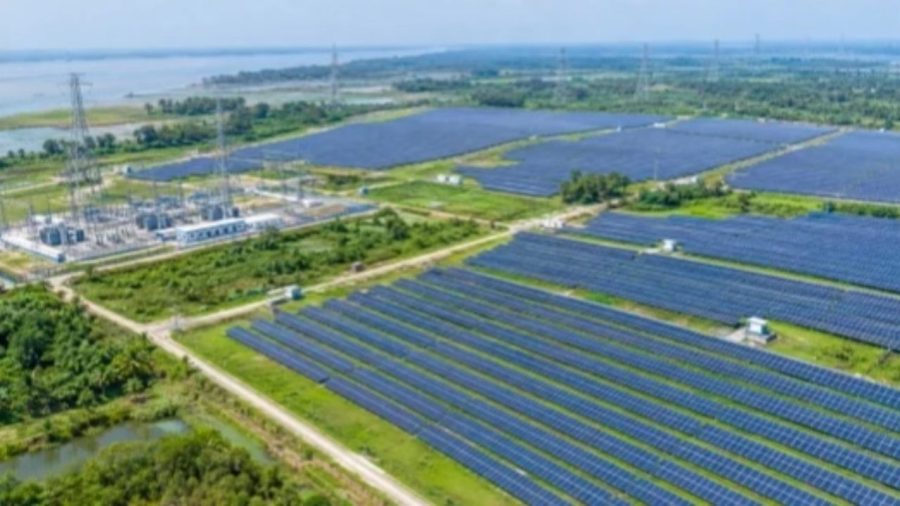



The government has planned a Tk2,502.39 crore project to set up a 442-megawatt-peak (DC) solar photovoltaic grid-connected power plant at Rampal in Bagerhat, aiming to increase renewable power generation and reduce dependence on fossil fuels.
Titled “Construction of 442 MWp (DC) Solar Photovoltaic Grid-Connected Power Plant at Block-B, Rampal”, the project will be implemented by the Bangladesh Power Development Board (BPDB) under the Power Division from July 2026 to December 2029.
The project proposal is scheduled to be placed before the Executive Committee of the National Economic Council (ECNEC) on Wednesday for final approval, following scrutiny by the Project Evaluation Committee (PEC) of the Planning Commission.
Of the total estimated cost, Tk375.35 crore will come from BPDB’s own resources, whilst Tk2,127.03 crore will be financed from the Power Sector Development Fund.

Earlier, the Bangladesh Energy Regulatory Commission (BERC) gave in-principle approval on 22 May 2022 for financing Tk2,380 crore – equivalent to 85 per cent of the project’s then-estimated cost – from the Power Sector Development Fund.
The project will be implemented on 685 acres of usable land in Block-B of the Rampal power plant complex. BPDB originally acquired 1,834 acres of land in Rampal in 2012, dividing it into Block-A (915.50 acres) and Block-B (918.50 acres).
Whilst Block-A houses the 1,320MW Maitree Super Thermal Power Plant, Block-B remains under BPDB, where land development, preservation work, and construction of a boundary wall have already been completed.




According to the project proposal, 76.63 acres of Block-B have been kept as a green belt, 32.87 acres for flood protection embankments, 94 acres as low-lying land, and around 30 acres as a lake.
The proposed solar plant will feature solar panels, inverter stations, a pooling substation, power evacuation facilities, and associated civil works. The project will engage foreign consultants for 32 person-months and local consultants for 52 person-months.
Electricity generated by the plant will be converted to 230kV through 0.8/33kV and 33/230kV substations and evacuated through an approximately three-kilometre 230kV double-circuit transmission line to the adjacent Bangladesh-India Friendship Power Company Ltd (BIFPCL) 400/230kV substation. Three new 230kV bays, including one spare, will have to be constructed at the BIFPCL substation for connecting the solar plant to the national grid.
The project proposal notes that the plant is intended to support the government’s renewable energy target, fuel diversification, and reduction of carbon emissions. Bangladesh’s power generation capacity currently stands at 32,332MW, with renewable sources accounting for 1,216MW, or 3.76 per cent.
The government has set a target of raising the share of renewable energy in the overall energy mix to 20 per cent by 2030. The project is also aligned with Sustainable Development Goal 7, which seeks affordable, reliable, sustainable, and modern energy for all.
The proposal states that the solar plant will help reduce reliance on gas, oil, and coal and avoid emissions of carbon dioxide, sulphur oxides, nitrogen oxides, and particulate matter associated with fossil-fuel-based generation.
The project was initially examined through an in-house feasibility study by BPDB in March 2022. However, the Planning Commission raised an issue over the feasibility study, noting that relevant government guidelines require investment projects costing more than Tk50 crore to undergo feasibility studies by experienced, independent, and professional institutions or consultants.
A detailed feasibility study by the state-owned Infrastructure Investment Facilitation Company (IIFC) was subsequently completed in May 2025. Based on its recommendations, the draft Development Project Proposal (DPP) was sent to the Power Division on 4 June 2025.
The project scrutiny committee held a meeting on 25 February 2026, after which the Power Division sent the DPP to the Planning Commission.