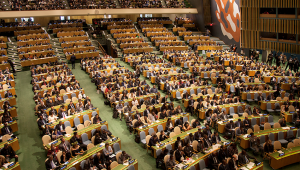



On 16 July 2026, over two hundred people – mostly Nobel laureates, scientists, diplomats, tech experts, and so on – met on Rome’s Capitoline Hill. They signed a major document: the Rome Declaration for an Unarmed and Disarming Peace, which speaks about peace in an age of artificial intelligence, nuclear and autonomous weapons, new digital protocols, and fast-changing digital development. This gathering was inspired by Pope Leo XIV’s appeal for a strong ethical framework to guide the rapid – and often reckless – growth of artificial intelligence.
For a country like Bangladesh, the Declaration is very close to home. Bangladesh is young, full of digital ambition, and highly exposed to global instability. It is a mirror, showing our own duties as a nation stepping deeper into the digital and geopolitical age.
The Declaration starts from a stark truth: humanity is now in two dangerous races at the same time. One is a worsening nuclear arms race. The other is a race to build ever more powerful artificial intelligence. Its subtitle, “Toward an Unarmed and Disarming Peace,” echoes words from Pope Leo XIV’s encyclical Magnifica Humanitas. That text focuses on protecting the human person in the age of AI. At its heart, the Declaration says one clear thing. Decisions about using lethal force must never be left fully to machines.

The signatories urge governments, companies, and international bodies to act together. They call for slowing down the most advanced AI development. This pause is needed so ethics, safety, and proper rules can catch up with technology, instead of always lagging behind. They also call for renewed global work on nuclear disarmament. They demand stronger rules for emerging technologies. Most importantly, they want a digital future built around human dignity, not just power politics or corporate profit.
The Declaration admits that AI can help in medicine, education, science, and protecting the environment. But it warns that using AI in military systems and autonomous weapons is dangerous. If AI enters nuclear command and control, the risk of unintended or accidental conflict could grow sharply. In simple terms, some of the world’s most respected scientific and moral leaders are sounding an alarm. They say that nuclear weapons and AI are coming together in ways that are not hypothetical, but already active and speeding up.




Bangladesh has no nuclear weapons and has no programme for autonomous weapons too. So, it is easy to think that a declaration signed in the Vatican by Nobel laureates has little to do with policy in Dhaka. That would be a mistake, for at least three reasons. First, global insecurity crosses borders. Bangladesh lives in a region shaped by the choices of nuclear‑armed neighbours and big powers. If nuclear restraint weakens anywhere, or if AI causes a serious miscalculation in a crisis, the shock will travel. It can bring economic turmoil, refugee movements, and communal unrest and disrupted trade routes that reach South Asia. A world with fewer weapons and stronger rules is directly in Bangladesh’s interest, even if it is not at the nuclear table itself. Second, Bangladesh is becoming a fast‑moving digital and AI nation. AI is entering government services, banking, farming, health care, and, increasingly, policing and surveillance. The Declaration’s key warning is simple: AI systems must stay under real human control. They must never be allowed to make final, irreversible life‑and‑death choices on their own. Third, Bangladesh has a strong record of moral leadership on peace and disarmament. It has been an early and vocal supporter of the Comprehensive Nuclear‑Test‑Ban Treaty and the Treaty on the Prohibition of nuclear weapons. In global forums, Bangladesh has often spoken with a bigger voice than its size would suggest. The Rome Declaration offers a natural way to carry that tradition forward into the age of AI.
Given this context, Bangladesh has several clear responsibilities. These belong both to the state and to society. Bangladesh should use its voice in global and regional bodies. This includes the United Nations, the Non‑Aligned Movement, SAARC, BIMSTEC and other related organisations. There, it can support a coordinated slowing of risky frontier AI development and a renewed push for nuclear disarmament. Because Bangladesh has moral credibility on humanitarian and peace issues, it can help carry this message into rooms where major powers often refuse to listen to each other. Educational institutions need to teach AI ethics and digital literacy. The next generation of engineers, officials, and citizens must understand both the power and the danger of the tools they will use. A society that is digitally skilled but ethically blind is exactly what the Rome Declaration warns against. Bangladesh can promote the spirit of the Declaration. It can encourage confidence‑building steps among neighbors on nuclear restraint and responsible use of AI in defense. In a region where mistrust often moves faster than dialogue, such efforts matter greatly.
The Rome Declaration reminds us that the most powerful technologies humans have created – from the atomic bomb to complex algorithms – must stay under the guidance of human conscience. Bangladesh may not build nuclear weapons or frontier AI models, but as a nation embracing digital transformation while carrying a proud legacy of peace advocacy, it has every reason to stand firmly behind the Declaration’s vision. In doing so, Bangladesh would not merely be endorsing a foreign document; it would be renewing its own long-standing commitment to a world where technology serves human dignity rather than threatens it.
The views expressed in this article are solely those of the author
The writer is the Editor, GOLPOKAR & Board Member, PEN Bangladesh