
The widespread use of banned “China duari” fishing traps is accelerating the decline of native fish species in Chapainawabganj, with fisheries experts warning that the district’s aquatic biodiversity could face severe long-term damage unless strict enforcement is introduced.
The fine-mesh traps, widely used in rivers, canals and wetlands during the monsoon breeding season, are catching fish fry, egg-bearing brood fish and other aquatic species before they can reproduce, threatening the sustainability of natural fish stocks.
Once renowned for abundant native fish in the Padma, Mahananda, Punarbhaba and Pagla rivers, as well as numerous canals and wetlands, Chapainawabganj has witnessed a steady decline in indigenous species in recent years.
Fisheries experts attribute the trend to shrinking natural water bodies, river siltation, pollution, climate change and, above all, the indiscriminate use of the banned traps.
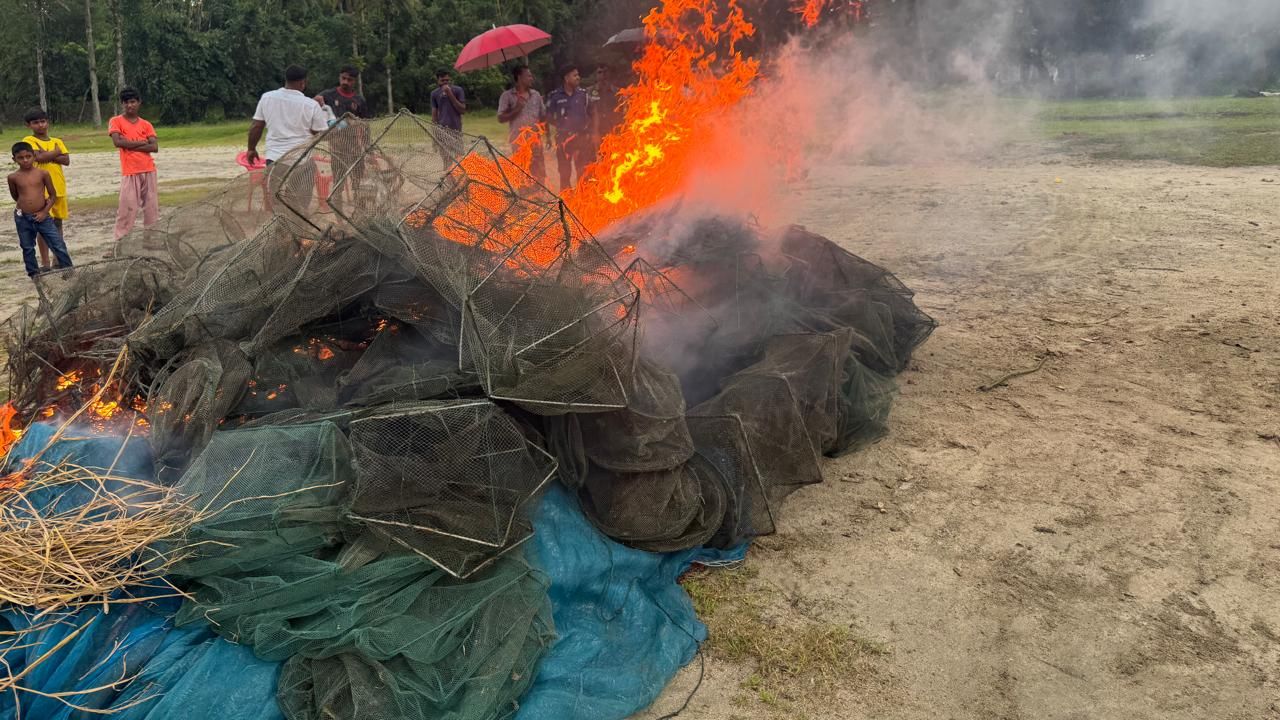
During visits to rivers, canals and wetlands in Sadar, Shibganj, Gomastapur, Nachol and Bholahat upazilas, hundreds of “China duari” traps made of bamboo, plastic and fine nylon mesh were found installed across water channels. The traps catch fish of all sizes as well as crabs, freshwater eels, snails and shellfish.
The monsoon is the peak breeding season for native fish, with species such as tengra, puti, koi, shing, magur, taki, shoal, gojar and boal spawning in rivers, floodplains and wetlands. However, the traps prevent juvenile fish from reaching maturity, reducing natural recruitment each year.

Fisher Abdur Razzaq of Shibganj said the mesh openings were so small that even tiny fry could not escape. “Brood fish, eggs and fry are all trapped together. If this continues, native fish will become extremely scarce within a few years,” he said.
Environmental activist Moniruzzaman Monir said the district had already lost much of its once-rich diversity of indigenous fish. “Illegal fishing gear, river encroachment, pollution and climate change have reduced natural habitats. The widespread use of ‘China duari’ has made the situation even worse,” he said.
Chapainawabganj is home to four major rivers, numerous wetlands and floodplains that serve as important breeding grounds for native fish during the rainy season.
Significant wetlands include Ramdas Beel in Gomastapur, along with Beel Bhatia, Ajaipur Beel, Churail Beel, Kujain Beel, Singra Beel, Hogla Beel, Putimari Beel, Anail Beel, Morichadah Beel and Kumiradah Beel.




According to the district fisheries office, Chapainawabganj has more than 11,350 ponds suitable for aquaculture, including around 2,500 to 3,000 government-owned ponds and water bodies.
Nachole upazila alone has nearly 1,600 government ponds and water bodies, while another 8,000 to 8,500 privately owned ponds are used for commercial fish farming.
Besides ponds, the district has four rivers, around 13 major wetlands, 37 floodplains and 11 canals. Despite these abundant water resources, the availability of native fish in open waters continues to decline.
Senior lawyer Hamidul Haque said indigenous species that were once common in local rivers and wetlands had become increasingly rare. “Species such as shail, goti air, gojar, kakila, bheda, kholsha and baila are no longer seen as frequently as they once were,” he said.
Former Ward No 2 commissioner Arman Ali said artificial breeding and commercial farming of exotic and hybrid fish had expanded rapidly across the district through hatcheries and in-pond raceway systems (IPRS).
Fisher Abdul Baten of Sadar Upazila said commercially farmed hybrid species, including Thai pangas, African magur, Thai koi, hybrid shing, silver carp, grass carp, common carp, bighead carp, black carp and monosex tilapia, had become increasingly popular because of their fast growth and high yields, further reducing the prominence of native species.
Residents alleged that “China duari” traps are openly sold in local markets and continue to be used in rivers and wetlands due to weak enforcement. District Fisheries Officer Md Shahinur Rahman said the use of the banned traps was prohibited under all circumstances.
“The mesh is extremely fine, trapping fish fry, brood fish and other aquatic organisms. This seriously disrupts the natural breeding cycle of indigenous fish and threatens biodiversity,” he said.
He said the fisheries department was conducting regular drives across the district during the monsoon, confiscating illegal traps and taking legal action under the Fish Conservation and Protection Act while also raising awareness among fishermen.
Shibganj Senior Upazila Fisheries Officer Sanjoy Kumar Sarkar warned that using the traps during the breeding season would significantly reduce fish production in the coming years. “We are carrying out regular monitoring and working with local representatives, fishermen and communities to eliminate illegal fishing gear,” he said.
Sadar Senior Upazila Fisheries Officer (additional charge) Md Imrul Kayes said using the banned traps was not only illegal but also posed a serious threat to native fish populations and natural fisheries resources.
District Commissioner Abu Saleh Md Musha said he had recently instructed fisheries officials and upazila executive officers to intensify monitoring and enforcement to protect native fish.
He said conserving natural water bodies, restoring rivers and canals, eliminating the use of banned “China duari” traps, conducting regular mobile court drives and increasing public awareness were essential to preserving the district’s native fish resources.
“Otherwise, the rich heritage of indigenous fish in the rivers, canals and wetlands of Chapainawabganj may survive only in memory,” he said.