There are some lives that not only pass-through history, they make it. One such life was Begum Khaleda Zia. Born on 15 August 1945 and bidding adieu to this world on 30 December 2025, her life was a ride through eight turbulent decades of political developments in Bangladesh. With her death, it is not only a former Prime Minister of a country who is being mourned, it is an era, a resistance, and an ideology referred to as a moral force who is bidding her final goodbyes.
There was no preparation for politics, no rehearsal of politics. She did not take up politics through ambition or legacy. History called her at its most trying time. Following the assassination of President Ziaur Rahman, during which time she could have been forever silenced through grief, she opted to be counted. It was from this moment that Begum Khaleda Zia was no longer merely the widow of history, but the leader of destiny. In a political culture often shaped by compromise and convenience, she stood apart for her unyielding position on democracy. She did not see power as an end but as a responsibility derived from the people’s mandate. When democratic rights were threatened, she chose resistance over submission, hardship over silence. Prison bars, political isolation, physical suffering, and prolonged injustice failed to break her resolve. Her politics was rooted in belief, not benefit.
As Prime Minister on three occasions, her most defining achievement was the restoration of parliamentary democracy in 1991. At a time when executive dominance could have been easily justified, she instead returned power to Parliament, strengthening democratic institutions over personal authority. This single act placed her firmly in history as a stateswoman who understood that leadership is strongest when it limits itself.
Her governance reflected balance rather than spectacle. Education reform, food security, rural development, women’s participation, and economic self-reliance shaped her policy priorities. As a woman leading a deeply patriarchal political space, she did not merely occupy office; she redefined possibility. She proved that leadership is not gendered, but grounded in courage, patience, and conviction.

Yet her life was far from a smooth arc of success. It was marked by relentless struggle. Years of incarceration, denial of proper medical care, and systematic political marginalisation took a heavy toll on her body. But what history will remember most is her restraint. Even when wronged, she resisted the language of vengeance. Her silence, at times, spoke louder than slogans. It was the silence of dignity.
Beyond politics, Begum Khaleda Zia was known to her followers as a motherly figure. To countless party workers, she was simply “Ma.” She listened more than she spoke, helped without announcement, and carried the burdens of others quietly. Power never distanced her from people; it humanised her leadership. That rare combination of authority and empathy made her beloved far beyond party lines.




Whenever democracy in Bangladesh faced its darkest hours, her name resurfaced as a symbol of defiance. She understood a fundamental truth: democracy is never permanently secured; it must be defended repeatedly. This belief kept her politically relevant even when she was physically frail. Though illness confined her body, her presence continued to unsettle authoritarian comfort.
On 30 December 2025, her passing marked more than the end of a life. It signaled the closing of a chapter when politics was openly ideological, when leaders endured suffering rather than negotiate away principles. In an age increasingly defined by convenience and calculation, her absence feels profound.
History has its own logic. Some figures grow smaller with time; others grow larger. Begum Khaleda Zia belongs to the latter. In death, she has become more than a former Prime Minister. She has become a narrative of endurance, a lesson in political morality, an epic written across decades of sacrifice.
To the people of Bangladesh, she now stands as a symbol of what it means to remain steadfast. Her life reads like a chronicle of struggle against odds, against injustice, against the slow erosion of democratic norms. She became an epic of time, not because she always won, but because she never surrendered.
Time will move on. Political language will change. New leaders will rise. Yet the question she leaves behind remains deeply relevant: are we protecting democracy, or merely invoking its name? That question is her final gift to the nation.
Begum Khaleda Zia has departed, but her ideals endure. In the conscience of Bangladesh, she remains uncompromising, compassionate, and eternally aligned with the cause of democracy.
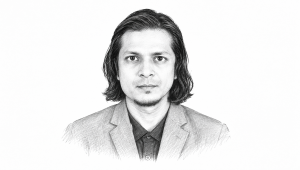
The writer is a Marketing Management Expert, Policy Consultant & Political Analyst