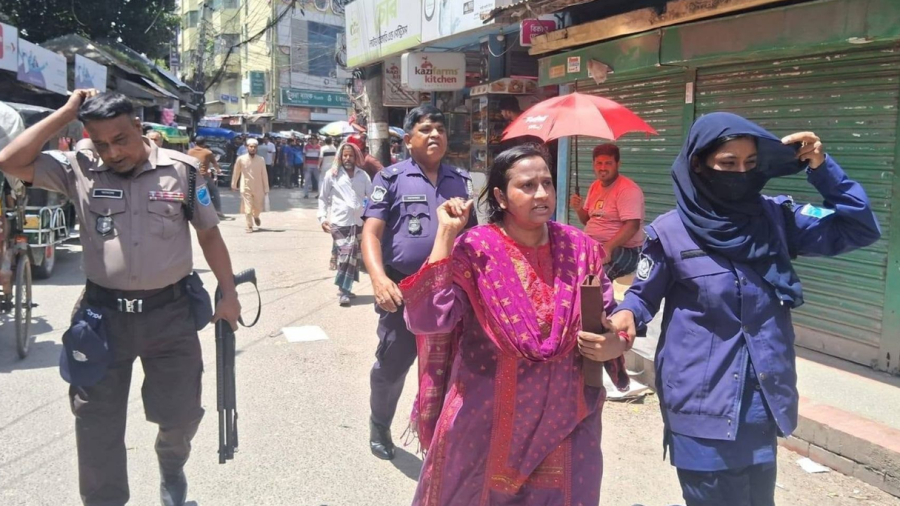

The video was shocking not only because of the violence it captured, but because of what it revealed. A woman entrepreneur in Rajbari, Bangladesh, was reportedly attacked while being escorted by police officers. Several men allegedly broke through the security line and kicked her repeatedly. The incident, recorded and widely circulated on social media, was not merely an attack on one person. It exposed a deeper concern: while women in Bangladesh are increasingly entering economic life, their right to participate safely and equally in public spaces remain fragile.
The incident involving entrepreneur Zakia Sultana has reportedly been linked to a dispute over business and local market issues. The facts must be established through proper investigation and legal procedures. But one fact is beyond dispute: no accusation, disagreement or commercial conflict can justify public humiliation and physical violence.
The larger question Bangladesh must confront is why such violence continues to be possible.
Over the past decade, Bangladesh has made significant progress in women’s economic participation. Women have transformed the country’s labour market through the garment sector, agriculture, small enterprises and digital entrepreneurship. Their contribution has strengthened families, communities and the national economy.
The COVID-19 pandemic accelerated a new wave of women-led businesses. As employment opportunities declined, many women turned to online entrepreneurship, selling food, clothing, handmade products, beauty services and other goods through digital platforms. For many, business became a pathway to financial independence and personal dignity.

However, economic participation has not automatically changed traditional power structures. A woman entering a marketplace does not enter only a commercial environment. She enters a social space where authority has historically been controlled by men. When women negotiate, compete, challenge decisions or demand their rights, they may face resistance that male entrepreneurs often avoid.
A business dispute involving men is usually seen as a normal commercial disagreement. The same dispute involving a woman can become a challenge to social expectations about how women should behave. This is where women’s economic empowerment clashes with deeply rooted patriarchal attitudes.
The Rajbari incident reflects a wider pattern of violence against women in Bangladesh. Surveys by the Bangladesh Bureau of Statistics have shown that a large number of ever-married women have experienced violence during their lifetime, including physical abuse, sexual violence, emotional abuse and controlling behaviour.




Human rights organisations have also repeatedly documented cases of domestic violence, sexual harassment, assault and other forms of gender-based violence. Yet reported figures likely represent only a portion of the actual situation. Many women do not report abuse because of social stigma, financial dependence, fear of retaliation or a lack of trust in justice institutions.
The problem is not only the violence itself. It is also the social environment that allows violence to become a response to disagreement. One of the most disturbing aspects of the Rajbari assault is that it reportedly happened in the presence of law enforcement. Police protection represents state authority and citizens’ safety. When attackers feel confident enough to commit violence despite that presence, it raises serious concerns about respect for legal institutions.
Mob violence is the opposite of justice. A mob does not depend on evidence, investigation or due process. It is driven by anger, rumours and collective pressure. A modern society depends on a basic principle: individuals cannot become judges and punishers themselves. If someone is accused of wrongdoing, courts and lawful authorities must determine responsibility.
The assault on Zakia Sultana highlights a broader reality: women who challenge established authority are often judged more harshly. A successful woman entrepreneur is often expected to be capable but not intimidating, confident but not demanding, competitive but not confrontational. When she breaks these invisible boundaries, society may attempt to silence her. Therefore, violence against women in public spaces is not only about individual aggression. It is also about power-about who is allowed to speak, negotiate, lead and compete.
Protecting women entrepreneurs is not simply a gender issue. It is an economic necessity. Bangladesh’s economic progress increasingly depends on women’s contribution. Millions of women work in industries, run businesses, manage farms and provide essential services. But economic growth cannot be sustainable if women participate under fear and insecurity. When a woman entrepreneur is publicly attacked, the impact extends beyond the victim. It sends a message to every woman considering entrepreneurship or leadership: Success may bring opportunity, but it may also bring hostility. This creates a hidden economic cost. Fear discourages innovation, limits entrepreneurship and prevents many women from fully contributing to national development.
The response cannot end with arrests after a violent incident. Accountability is necessary, but prevention requires stronger institutions. Law enforcement agencies must ensure that women under state protection are genuinely protected. Any failure that allows attackers to breach security must be investigated seriously.
Business organisations and local authorities must create fair systems for resolving commercial disputes. Market committees cannot become informal courts where social pressure replaces legal procedures. Society must also reject the normalisation of violence. Anger, accusations or rumours cannot justify physical punishment. Political or social influence must never protect perpetrators from justice.
The Rajbari incident should not be dismissed as an isolated act. It should be recognised as a warning. A society that encourages women to become entrepreneurs but fails to protect them from violence sends a contradictory message-it celebrates their contribution while denying their dignity. Women need more than symbolic encouragement. They need institutions that protect their rights, laws that are enforced fairly and a culture that recognises them as equal participants in every sphere of life.
Bangladesh’s economic future will depend increasingly on women’s participation. The future of its democracy and rule of law will depend on whether that participation can happen without fear. The true measure of progress is not how many women enter the marketplace. It is whether they can remain there-with dignity, security and equal respect.
The views expressed in the article are solely those of the author
The writer is an Associate Professor, Department of Public Administration, University of Rajshahi. E-mail: [email protected]