


Mujtoba Ahmed Murshed
A standing ovation is certainly due for U.S. President Donald Trump’s announcement of a ceasefire in Gaza, yet it also warrants a note of caution regarding its sustainability. This moment, long awaited amid the world’s deep yearning for peace, marks a significant milestone. On October 9, President Trump declared what he termed a historic breakthrough, announcing that Israel and Hamas had reached an agreement on the first phase of a ceasefire deal in Gaza.
This declaration came just weeks after the high-profile summit in Washington on September 23, 2025, which gathered leaders from across the Middle East and parts of Asia to discuss ways to end the war in Gaza. Trump described the dialogue as a new beginning, one that would finally end the bloodshed and bring stability to the region.
Yet within hours of his post, the Gaza Health Ministry reported that at least ten Palestinians were killed and dozens were injured in new Israeli strikes. Israel’s war on Gaza has killed at least 67,194 people and wounded 169,890 since October 2023. Thousands more are believed to be buried under the rubble of destroyed buildings. A total of 1,139 people were killed in Israel during the October 7, 2023, attacks, and about 200 were taken captive. For those who have watched the conflict evolve, this grim update did not come as a surprise. The question now is not whether Trump’s branded peace diplomacy can truly sustain.

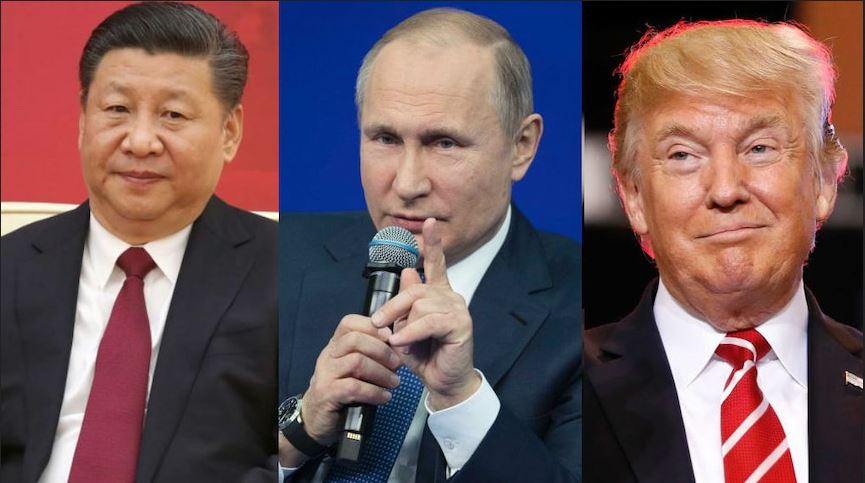
The question underlines that the Gaza crisis sits at the center of a global geopolitical web, where every move by one player ripples across continents. Trump’s summit was attended by leaders from Saudi Arabia, the United Arab Emirates, Egypt, Jordan, Qatar, Türkiye, Indonesia, and Pakistan. It was widely praised for including the major Muslim-majority states that have long held influence in regional affairs. But it was equally criticised for excluding two global powers that have shaped international diplomacy for decades, Russia and China as they view it Washington’s orthodox habit of defining peace on its own terms.
For years, both Moscow and Beijing have argued that sustainable peace cannot come from unilateral leadership but through collective international effort. Their approach is rooted in the belief that no single nation should dominate the peace process in a conflict that involves global security, trade, and humanitarian consequences. Russia’s President Vladimir Putin said earlier this year that lasting peace in the Middle East will remain elusive unless “all parties, including those who have traditionally been left out of the conversation, are involved.” China’s Foreign Minister Wang Yi echoed a similar sentiment, saying that “a fair and inclusive dialogue” is necessary to end the Gaza conflict.
The Trump initiative appears to prioritise regional partners while keeping control over the final narrative. This design may serve short-term optics but risks alienating other major powers whose participation could give the deal broader legitimacy. Both Russia and China have significant diplomatic relationships in the region. Moscow has long maintained contact with Palestinian leaders, while Beijing’s Belt and Road investments have deepened its influence in the Arab world. Their participation could offer an important balance, providing confidence to both sides that the peace process is not a Western-dominated project but a global one.



The essence of a durable peace process lies when one power sets the rules, others will test them. History has repeatedly shown this. The Oslo Accords began with optimism but collapsed under the weight of unilateral interpretations. Trump’s Gaza Dialogue risks following the same path if it does not embrace a genuinely multilateral framework.
The United States argues that too many players slow progress. That logic may work in trade deals but not in conflicts driven by generations of mistrust. The Middle East does not lack agreements. It lacks trust. That trust can only be rebuilt through a platform that treats all stakeholders as equals, not subordinates. In this scenario, both Moscow and Beijing have, in recent years, demonstrated their ability to mediate complex conflicts. Russia helped broker local truces in Syria that reduced civilian casualties, while China played a central role in restoring diplomatic ties between Iran and Saudi Arabia. These experiences have given them a tested understanding of Middle Eastern dynamics. By integrating their diplomatic methods of patient, gradual, and rooted in mutual concessions, the Gaza peace process could evolve into something more credible.
Critics of Trump’s approach warn that the United States’ tendency to frame peace through military or transactional lenses could undermine genuine reconciliation. Washington’s foreign policy often blends moral rhetoric with strategic interest. That makes it difficult for either side to see the U.S. as an impartial mediator. Trump’s recent 21-point peace framework includes security guarantees, economic incentives, and commitments to humanitarian reconstruction. On paper, it looks comprehensive. But its effectiveness depends on whether both sides believe that the mediators represent everyone’s interests, not just one camp’s vision of order.
Peace cannot be built on the perception of bias; it requires legitimacy born from inclusion. U.S. Secretary of State Antony Blinken admitted in his statement that “no single nation or group can solve this alone.” The real test for Washington is whether it is willing to share the diplomatic stage with others. That means inviting Russia and China not as rivals but as partners in a process that affects the entire world.
Russia and China offer something that no other players can: an alternative vision of the world order. They advocate sovereignty, non-interference, and respect for international law. These principles resonate deeply in a region exhausted by interventions and shifting alliances. If harnessed properly, their diplomatic presence could help bridge ideological divides and encourage both Israel and Palestine to reimagine coexistence. As Putin said recently, peace must protect “the rights of both Israelis and Palestinians while ensuring the stability of the region.” China’s foreign ministry similarly called for “a political solution that puts the people of Gaza first.” These are not empty phrases but hint at an understanding that peace cannot simply be declared; it must be owned by those who live it.
Beyond question, the humanitarian crisis in Gaza continues to worsen. Entire neighbourhoods lie in ruins, and the psychological wounds are deeper than any treaty can heal. Any peace plan that fails to address the humanitarian dimension will collapse under the weight of despair. Russia and China’s involvement could also help channel resources for reconstruction through neutral international frameworks, reducing dependency on Western aid models that often come with political strings attached. A shared responsibility for rebuilding Gaza could transform the peace process from a diplomatic performance into a human project.
The road to peace in Gaza is not paved with speeches or social media declarations, it requires an architecture that recognizes every nation’s stake in stability. Trump’s initiative, despite its fanfare, remains fragile until it opens its doors to a truly global partnership. The future of the Gaza ceasefire will depend not on who signs the document but on who feels represented by it.
The writer is a poet, political analyst, and litterateur