


The government is open to discussing changes to parts of the July National Charter if the opposition joins talks, Home Minister Salahuddin Ahmed said on Tuesday.
He, however, said the government wants to implement the charter in the form in which it was drafted and signed, including the notes of dissent.
“If the opposition comes to the discussion and wants to make changes to some parts of the July National Charter, that can also be discussed,” Salahuddin told reporters after a meeting of the Special Parliamentary Committee on Constitutional Amendment.
“But we want to implement the July National Charter as it was drafted and signed, including the notes of dissent,” he said.
Salahuddin, who chairs the committee, said any concerns raised by the opposition could be considered through discussion and consensus.
“But they have to come to the discussion,” he added.

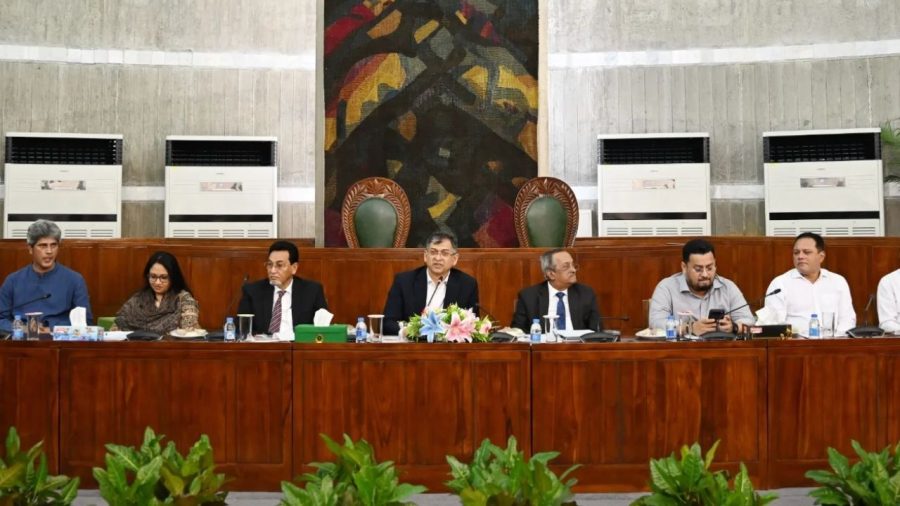
The fourth meeting of the 13th Parliament’s Special Committee on Constitutional Amendments was held at the Cabinet Room of the Parliament Complex, chaired by Salahuddin.
Representatives of electronic, television and online media, as well as talk-show participants, presented proposals on constitutional reforms at the meeting.
The committee also invited written proposals from other stakeholders and said those submissions would be considered.
Wider consultations planned
The committee plans to hold consultations with representatives from various sections of society and professions during its upcoming meetings.
They include women leaders, constitutional experts, academics, people and organisations involved in the July uprising, those involved in drafting the July National Charter, Supreme Court judges and lawyers, teachers and workers.



Salahuddin said the committee received several important suggestions during Tuesday’s meeting.
“We received many valuable opinions, some of which are significant and can be considered,” he said, adding that the committee would discuss them in its meetings.
After hearing from different groups and consulting constitutional experts, the committee will prepare a report, he said.
The report will then be placed before parliament, followed by the introduction of a bill based on its recommendations. Discussions will continue both inside and outside parliament at that stage, he added.
The committee will also consult those who contributed to the National Consensus Commission and the drafting of the July National Charter, Salahuddin said.
Bicameral parliament under discussion
The meeting also discussed the proposal for a bicameral parliament.
Salahuddin said some participants questioned the need for a second chamber, given that Bangladesh is a unitary state.
However, he said the committee intends to proceed with the provision for a bicameral parliament in the July National Charter, as consensus had been reached on the issue.
Decentralisation and independence of the judiciary were also discussed.
Regarding the caretaker government system, Salahuddin said the committee had not yet decided how such a government would be formed, who would be included or what process would be followed.
10-year limit for PM’s tenure
The proposal to limit an individual’s tenure as prime minister to 10 years also came up for discussion.
Salahuddin said some participants viewed the proposal as conflicting with democratic rights. However, he said his party had not withdrawn the proposal.
He said the proposal was put forward by his party during the drafting of the July National Charter based on a proposal by its chairman and was later included in the party’s election manifesto.
The meeting also received proposals to amend the Constitution’s preamble and fundamental principles of state policy.
These proposals will be compiled and published later, Salahuddin said.
He said implementation of the July National Charter was based on the reports of six reform commissions.
The government could form reform commissions for other sectors in response to public demands in the future, he said, but their recommendations would not be binding for implementation of the July National Charter.