


Let me begin with a personal experience. In 2009, while travelling in Meghalaya, India, I met an Italian tourist at a resort in Cherrapunji. During our conversation, he told me that he visited the north-eastern states of India almost every year. Pointing towards Bangladesh, which was only a short distance away from the hill resort, I invited him to visit our country. He said he would come to Bangladesh the following year. True to his word, he did visit Bangladesh the next year.
But what he told me after arriving in Dhaka was rather embarrassing.
He said he had gone to the Bangladesh embassy in Rome to obtain a visa. When he told the visa officer that he wanted to visit Bangladesh simply as a tourist, the officer had reportedly been astonished. Why, the officer asked, would he want to visit a country where there was supposedly nothing to see? After a series of questions, he was eventually granted a tourist visa. The man did not know that Europeans could obtain a visa on arrival in Bangladesh, which was why he had gone to the embassy in the first place.
During his stay, he visited the Sundarbans, Cumilla, Bandarban and Cox’s Bazar. Before leaving, he repeatedly told me: “Your country is so beautiful, yet there is hardly any promotion! Even your own people discourage foreigners from visiting.”
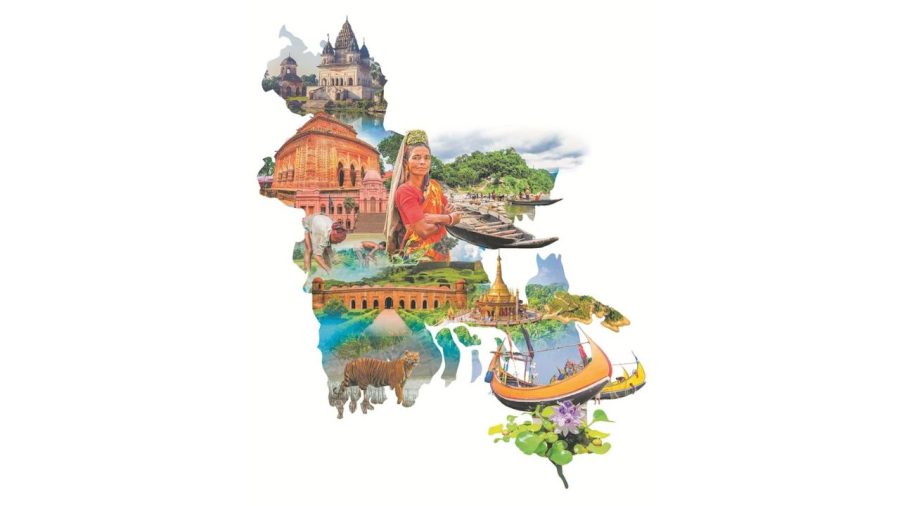
From the vast expanse of the blue sea and clouds playing hide-and-seek across the hills to the mysteries of the Sundarbans, the world’s largest mangrove forest, and the green carpets of tea gardens, nature seems to have fashioned Bangladesh with an extraordinary variety of attractions.
The country lacks none of the natural diversity needed to become an appealing tourist destination. Yet Bangladesh remains almost an unknown name on the global tourism map.
One reason Bangladesh remains largely absent from the international tourism map is the lack of interest among government agencies – or, more specifically, government officials. Perhaps many of them are simply unaware of the importance of tourism as a powerful economic sector in many countries.
While Bangladesh has made significant progress in other areas of the economy, particularly in ready-made garment exports, its backwardness in tourism is equally striking. At a time when many developing countries are relying heavily on tourism to keep their economies moving, Bangladesh’s tourism sector continues to struggle despite its enormous potential. Much of what progress has been made has come from the private sector.

The tourism industry currently provides employment to around 2.3 million people in Bangladesh and contributes roughly 3 per cent to the country’s gross domestic product (GDP). With proper planning, effective implementation, policy support for the private sector and greater public awareness, tourism could become one of the country’s major economic sectors.
Bangladesh possesses an extraordinary range of attractions. On one hand, there is Cox’s Bazar, home to one of the world’s longest natural sandy sea beaches, Kuakata, renowned for its views of both sunrise and sunset, and St Martin’s Island, the country’s coral island. On the other hand, there are ancient archaeological and historical sites such as Paharpur, Mahasthangarh, the Shaat Gambuj Mosque and Panam Nagar.
The hill communities of the Chittagong Hill Tracts and the tea-garden communities of greater Sylhet also offer significant opportunities for community-based tourism and eco-tourism. The potential of Bangladesh’s tourism sector can broadly be divided into several categories:
Nature-based and eco-tourism: The Sundarbans, Tanguar Haor, Sajek Valley and the three hill districts of the Chittagong Hill Tracts – Bandarban, Rangamati and Khagrachhari – offer enormous opportunities for environmentally responsible tourism. If developed sustainably, while protecting fragile ecosystems, these destinations could attract international visitors looking for nature-based experiences.
Coastal and island tourism: Alongside Cox’s Bazar’s approximately 100-kilometre-long beach, Bangladesh has Kuakata, St Martin’s Island, the Naf River, Sonadia and Nijhum Dwip. Other destinations could include Char Hair, Sonar Char and Char Kukri-Mukri along the Patuakhali and Bhola coast.



Historical and cultural tourism: Bangladesh is home to archaeological treasures such as Somapura Mahavihara at Paharpur, Mahasthangarh, Lalbagh Fort, the Shaat Gambuj Mosque and Panam Nagar. These sites could attract large numbers of visitors from across South Asia. The country’s ancient Buddhist heritage could appeal to tourists from countries such as Japan and South Korea.
Community-based tourism: Community-based tourism centred on Sylhet’s tea gardens and the cultures of ethnic communities in the hill regions is becoming increasingly popular. Such tourism can directly contribute to local economies. There are also numerous small hill streams and rivers along the Meghalaya border, stretching from Sylhet to Netrokona. These places have long attracted nature lovers.
Given Bangladesh’s extraordinary natural and geographical diversity, a fundamental question remains: why have we failed to turn tourism into a major source of national income? At a time when tourism’s contribution to GDP could potentially approach 10 percent, Bangladesh remains stuck at around 3 percent. The sector’s principal weaknesses are structural mismanagement and the absence of long-term, integrated planning.
The number of domestic tourists has increased dramatically in recent years. During public holidays, millions of people travel to different tourist destinations across the country. Yet we have still failed to develop the quality infrastructure necessary to accommodate this growing demand.
A tourist’s journey begins with transportation. Yet travelling to many tourist destinations remains relatively expensive, and transport systems are not sufficiently tourist-friendly. The opening of the railway to Cox’s Bazar and improvements in connectivity through several mega-projects have brought progress, but there remains a serious shortage of modern and safe public transport overall.
There is also a chronic lack of basic facilities at tourist destinations, including quality rest areas, clean toilets and proper information centres. These shortcomings subject visitors to inconvenience at almost every stage of their journey.
Another major concern is the safety and harassment of tourists. When people travel, they are primarily looking for relaxation and peace of mind. Yet at tourist destinations in Bangladesh, overcharging, poor-quality food sold at inflated prices and various forms of deception are common complaints. We are also still far behind in ensuring a safe and comfortable environment for women travellers. In some places, there have even been reports of young couples being harassed and asked to produce marriage certificates.
Although the Tourist Police have been established, they continue to face shortcomings in manpower, modern technology and the ability to operate effectively across all tourist areas. There is also a need for greater understanding of the contribution tourism can make to both local and national economies. Many local communities, meanwhile, remain unaware of how much tourism can contribute to their livelihoods and local economies.
As a result, negative experiences in different parts of the country discourage not only domestic tourists but also international visitors, while damaging Bangladesh’s reputation abroad.
Our stagnation in attracting international tourists is equally disappointing. Around 650,000 foreign visitors reportedly come to Bangladesh every year. But there is no clear breakdown of how many of them come for leisure. People arriving for work, business or to visit relatives – particularly visitors from neighbouring India – are also often counted as tourists.
We have yet to establish the ‘Beautiful Bangladesh’ slogan as an effective international tourism brand capable of attracting large numbers of leisure travellers.
The visa process for foreign tourists also remains complicated, particularly regarding visa-on-arrival and e-visa facilities. There appears to be no sufficiently aggressive international marketing strategy promoting Bangladesh’s tourism through influential global media or digital platforms.
As noted earlier, our diplomatic missions have also been largely inactive when it comes to tourism diplomacy. With effective promotion, however, Bangladesh could attract tourists from Western countries as well as from across Asia.
Tourism is a service industry in which hospitality and professionalism are crucial. Although Bangladeshis are naturally known for their hospitality, the country faces an acute shortage of professional tour guides, internationally trained chefs and skilled hospitality-management personnel. If the tourism industry is to be strengthened, opportunities for training in these areas must be expanded and a skilled workforce developed.
For many years, the Bangladesh Parjatan Corporation was the country’s only government institution dedicated to tourism. Its role, however, remains largely confined to providing hotel and motel services.
The Bangladesh Tourism Board was established in 2010 to promote the tourism industry. Yet, disappointingly, it has few, if any, career tourism professionals. Officials are often transferred there from other government departments, remain for a limited period and then move on to another posting.
Despite these disappointments, there have occasionally been government initiatives aimed at developing tourism. During the tenure of the previous Awami League government, an initiative was taken to establish a tourism park on a char in the Naf River near Teknaf. The project, however, has stalled amid instability in Myanmar.
The current government has prepared a master plan for tourism development covering the period from 2026 to 2029. Under the plan, the entire country would be divided into eight tourism zones. Five-star hotels, resorts, amusement parks, cable cars, houseboats, traditional villages showcasing ethnic communities, river-based tourism facilities and environmentally friendly eco-tourism centres would be developed. The proposed projects would require an estimated Tk26,390 crore in investment.
If the Planning Commission and the Executive Committee of the National Economic Council (ECNEC) ultimately approve the master plan, it could give the tourism industry considerable momentum.
Bangladesh’s tourism industry can be much more than a means of leisure and recreation. It can become an engine of transformation. It can stimulate rural economies, create employment and generate foreign exchange. After the ready-made garment industry and remittances, tourism could potentially emerge as one of the country’s major economic drivers. Nature has already given Bangladesh an extraordinary foundation. What is needed now is proper conservation, modern management and effective implementation of long-term plans.
With the right policies and investment, Bangladesh has the potential to become a sought-after tourism destination alongside countries such as Nepal, Thailand and Vietnam. But for that to happen, the first requirement is political and administrative commitment to implementing plans effectively – backed by genuine seriousness and sustained effort.