



In 2021, Simon Kofe, Tuvalu’s foreign minister, wearing a suit and standing knee-deep in the ocean, recorded a dramatic video speech and delivered it at the COP26 Climate Summit in Glasgow.
His message was blunt: “We are sinking, but so is everyone else.” Tuvalu, a small Pacific Island nation of 12,000 people, is barely 6.6 feet above sea level and is literally sinking.
Threatened by rising sea levels, a direct consequence of climate change, Kofe was compelled to appeal to the world to save his country, its people, and its culture.
Hardly any foreign minister resorts to such theatricality for a global audience, but he had to, as Tuvalu is projected to cease to exist as a nation by 2050 to 2100. And it is not alone.
Many other island nations – Kiribati, the Marshall Islands, Vanuatu, Fiji, and Samoa – are in a similar situation. They face existential crises due to excessive emissions dumped into the environment, mostly from the Global North.
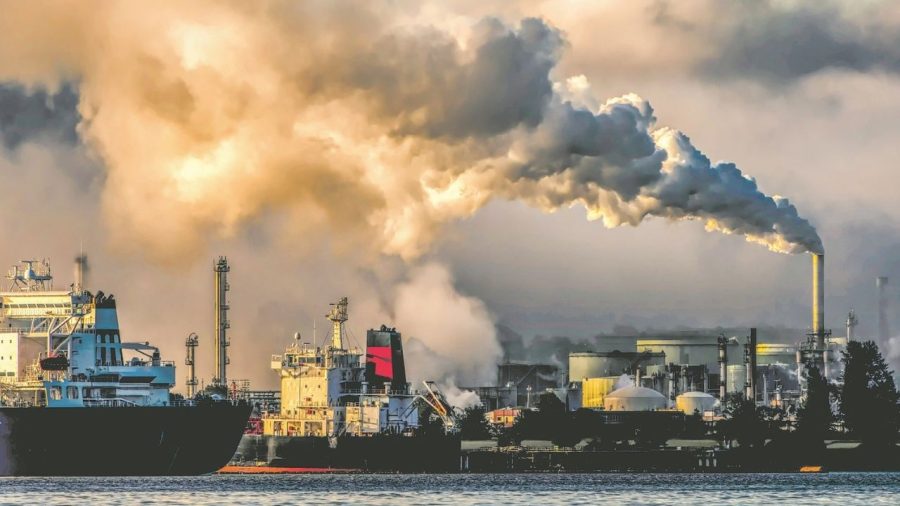
Of these emissions, 31% came from the energy sector (electricity and heat); 24% from industrial manufacturing; 22% from agriculture and forestry; 15% from transportation; and 3% from the waste sector.
The Global North is also responsible for 92% of excess carbon emissions. Since 1750, the top 5 emitters have accounted for 24% (U.S.), 15% (China), 6.7% (Russia), 5.2% (Germany), and 4.4% (UK) of global emissions.
These shares have driven global warming, deforestation, thermal expansion of seawater, melting glaciers and ice sheets, and rising sea levels.

Rising sea levels cause coastal erosion, flooding, and salinisation of land, which hinder agriculture, devastate housing, and contaminate freshwater aquifers. Climate change deniers might argue that protective measures are sufficient to remedy the issues.
However, some irreparable damage has already been done. As a result, for example, two of Kiribati’s islands, Tebua Tarawa and Abanuea, have been completely submerged. Hence, the debate should not revolve around whether the effects of climate change are real; instead, it should focus on what can be done to redress the consequences.
Dialogue for reparations from the Global North has been lacklustre, and the matter remains politically contested; the immediate priority, therefore, should be to offer citizens in atoll nations a dignified life now.
An international resettlement programme with the following framework would significantly help achieve that goal.
First, the world’s top 5 emitting countries should bear primary responsibility; each country should accept climate migrants each year in proportion to its share of global emissions.
Second, developed countries should enter into bilateral agreements with these island nations.




Third, the UN should protect climate migrants fleeing their country of origin or nationality, just as the 1967 Protocol accords protection to victims of race, religion, political views, or gender-related persecution.
The Protocol’s non-refoulement clause states that a person cannot be sent back to their country of origin if there is a reasonable fear of persecution upon deportation. Therefore, the non-refoulement clause should include climate migrants.
Critics may argue that economic migrants would take advantage of such UN protection. However, rigorous UN vetting of places where climate change has actually forced external displacement can address this concern.
With sheer willingness and proper gumption, all these options are implementable, and precedents exist.
For example, the U.S. had TPS (Temporary Protected Status) for nationals of certain countries affected by environmental disasters; unfortunately, the Trump administration recently rescinded it, but it can be reinstated to include climate migrants.
The Biden administration also considered moving in this direction, but it did not materialise due to inaction. So, the idea of including climate migrants in TPS has some foundational support.
Another example is that in 2024, Australia and Tuvalu signed the Australia-Tuvalu Falepili Union Treaty, under which Australia will accept 280 Tuvaluans each year to live permanently in Australia; nearly 90% of Tuvaluans have applied to relocate.
Other crisis-stricken island nations should be offered a similar opportunity elsewhere.
Furthermore, courts can play an active role in accepting the rights of climate migrants, and some already have.
For instance, in 2020, a French court found that expelling the claimant to Bangladesh would exacerbate his respiratory disease and jeopardise his life; the court approved his request to remain.
Another Bangladeshi citizen claimed that he was from a low-lying, eroding area, had been displaced multiple times, and had no residence there to return to; in 2024, an Italian court also vindicated the case.
Lastly, a Kiribati citizen persuaded a New Zealand court that his life and livelihood would be threatened by coastal erosion if he were deported to his country; the court did not grant him a stay, but it recognised the principle of his claim.
These instances indicate the need for a universal law that protects climate migrants in general and offers a practical remedy to address the predicaments of citizens of littoral nations in particular.
When crimes do not harm us directly and immediately, we tend to ignore them, discarding them as someone else’s problem. Some slow-onset crimes, like flagrant environmental destruction, never relent; they entangle and prey on us, whether we fathom it or not.
Accordingly, in 2019, Vanuatu’s ambassador to the European Union pleaded with the International Criminal Court in The Hague to take an extreme measure: to make environmental destruction a crime.
Many countries, including Vanuatu, Fiji, and Samoa, which are struggling with sea-level rise, supported his plea; it deserves support from other countries as well.
Additionally, a growing environmental campaign went even further, seeking to add Ecocide, meaning killing the environment, to the Rome Statute. If incorporated, it would be a game changer for all countries.
Higher-emitting countries have long prioritised profits over the environment.
Their wanton use of energy and the manufacturing sector has worsened global warming, rising sea levels, and other consequences of environmental degradation that have affected millions, especially those in low-lying countries.
It is our solemn duty to preserve the environment for future generations.
Therefore, the foreign minister’s stern warning that “We are sinking… and no matter if we feel the effects today, like Tuvalu, or in a hundred years, we will all still feel the dire effects of this global crisis” must be heeded for humanity’s sake.
Author is Doctoral researcher in International Relations at Universiti Sains Malaysia (USM).