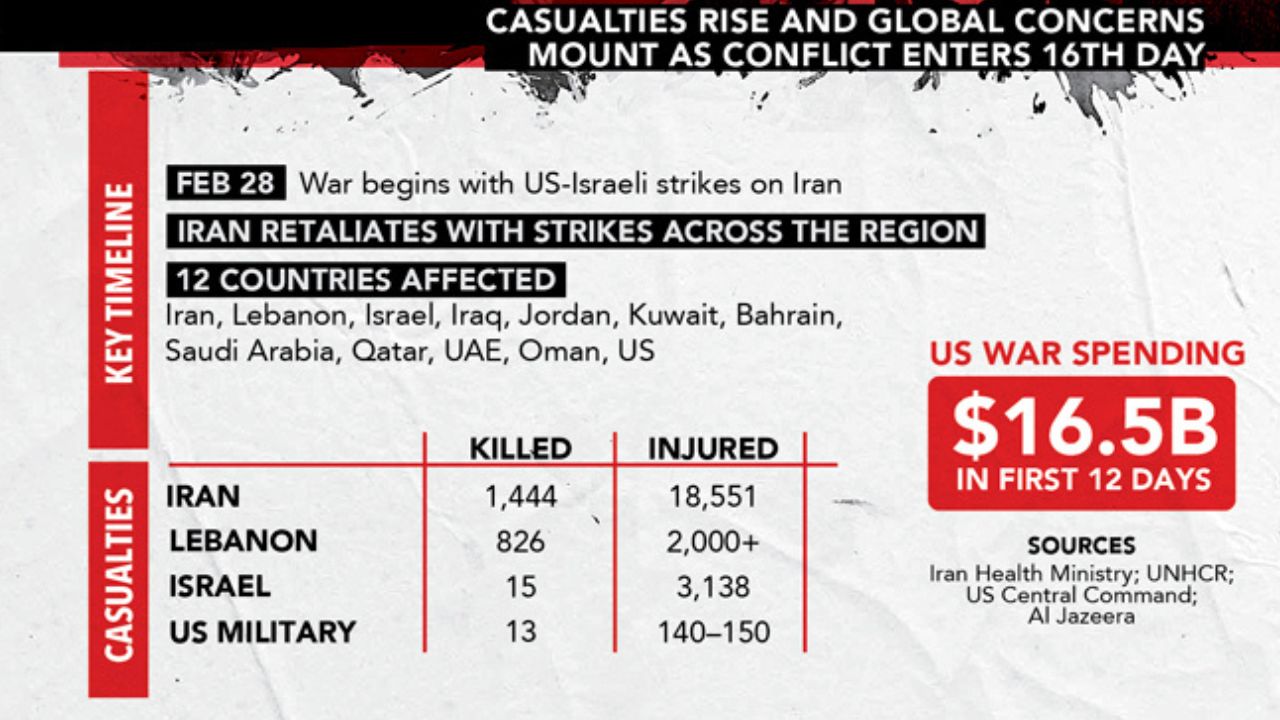
The Middle East conflict involving the United States, Israel and Iran has entered its 16th day, with casualties rising and no clear sign of de-escalation. The war has already caused widespread destruction, mounting human losses and growing concern over its global economic impact.
Available estimates suggest nearly 2,400 people have been killed so far, while the number of injured has reached almost ten times that figure. In Iran alone, more than 1,400 people have died since the United States and Israel launched their military campaign on February 28.
The strikes have also caused extensive infrastructure damage. Iranian authorities say at least 10,000 residential buildings have been damaged or destroyed in US-Israeli attacks targeting multiple areas across the country.
Israel has reported 15 deaths and more than 3,000 injuries from Iranian missile and drone attacks. The United States has also suffered casualties, with 13 military personnel killed and about 150 others injured since the conflict began.
Despite the rising toll, both sides have vowed to continue retaliatory strikes.
US President Donald Trump has repeatedly said Washington is close to winning the war, although his estimates for when the conflict might end have ranged from a few days to several weeks.
In a phone interview with NBC News, Trump said Iran “wants to make a deal,” but added that he is not prepared to negotiate yet because “the terms aren’t good enough.”

He also said the United States is working with partner nations on a plan to secure maritime passage through the strategically important Strait of Hormuz.
Iran’s Foreign Minister Abbas Araghchi said Tehran remains determined to defend its sovereignty and national security. He said Iran’s military operations have targeted only the military facilities of what he described as “aggressor states.”
Hundreds of ships wait near Strait of Hormuz
The war has severely disrupted global shipping routes, particularly around the Strait of Hormuz — one of the world’s most critical oil transit chokepoints.
Reports indicate that around 1,000 vessels are currently waiting to pass through the narrow waterway, including roughly 200 oil tankers carrying energy supplies to global markets.
Iranian forces continue to maintain a strong military presence near the strait, and several vessels have reportedly received warnings while attempting to approach the passage.




The uncertainty has already triggered volatility in global oil markets, pushing prices higher and raising fuel costs in many countries.
Support for war declines in the US
Public support for the conflict appears to be weakening within the United States.
A recent poll conducted by Quinnipiac University found that 53 per cent of American voters oppose the attacks on Iran, while nearly three-quarters said they do not support deploying US ground forces in the conflict.
The Trump administration has also warned media outlets over their coverage of the war, suggesting broadcasting licences could be revoked if reporting is deemed misleading.
Trump also claimed that US airstrikes on Iran’s strategic Kharg Island had “totally demolished” much of the facility and said additional strikes could follow “just for fun.”
Analysts say such remarks risk undermining Washington’s image as a responsible global security partner.
Samir Puri, a visiting lecturer in war studies at King’s College London, told Al Jazeera that security alliances depend not only on military strength but also on strategic judgement and responsible leadership.
Damage in Iran and Israel
US Defence Secretary Pete Hegseth said American forces have struck more than 15,000 targets in Iran since the start of the war — an average of more than 1,000 strikes per day.
Iran’s Islamic Revolutionary Guard Corps said it has launched its “50th wave” of operations targeting US bases in the region, including installations in the United Arab Emirates, Bahrain and Kuwait.
Iranian officials have also warned US-linked companies operating in the Middle East, urging civilians to stay away from facilities associated with American businesses after strikes that reportedly killed several civilian workers in Iran.
At the same time, Iran’s naval commander Alireza Tangsiri said Tehran has not formally closed the Strait of Hormuz but is “controlling” access to the strategic waterway.
Israel continues to face missile and rocket attacks. The Israeli Health Ministry said 108 people were injured in the latest round of strikes within a 24-hour period.
Air raid sirens sounded across several Israeli cities overnight as missiles launched by Iran and Hezbollah triggered emergency alerts. Falling debris from intercepted missiles also caused fires in parts of the city of Holon.
Uncertainty over long-term strategy
Questions are also emerging about the broader strategic objectives of the US-Israel military campaign.
Norwegian Prime Minister Jonas Gahr Støre said the conflict appears to be escalating and warned that the long-term plan behind the military operation remains unclear.
Norway has criticised Israel’s initial “pre-emptive” strikes on Iran, arguing they violated international law and risk further destabilising the region.
The conflict has also drawn the attention of other global actors.
Ukrainian President Volodymyr Zelenskyy said Kyiv has sent technical teams to several Middle Eastern countries to assist with drone defence assessments, adding that Ukraine expects financial compensation for the support.
With hostilities continuing and diplomatic efforts stalled, the war shows little sign of easing, raising fears that the conflict could further destabilise the Middle East and disrupt the global economy.