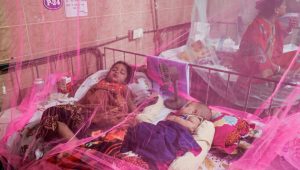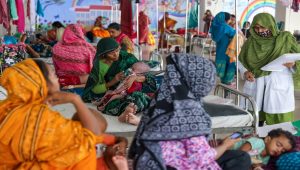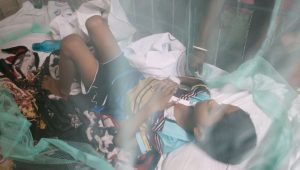




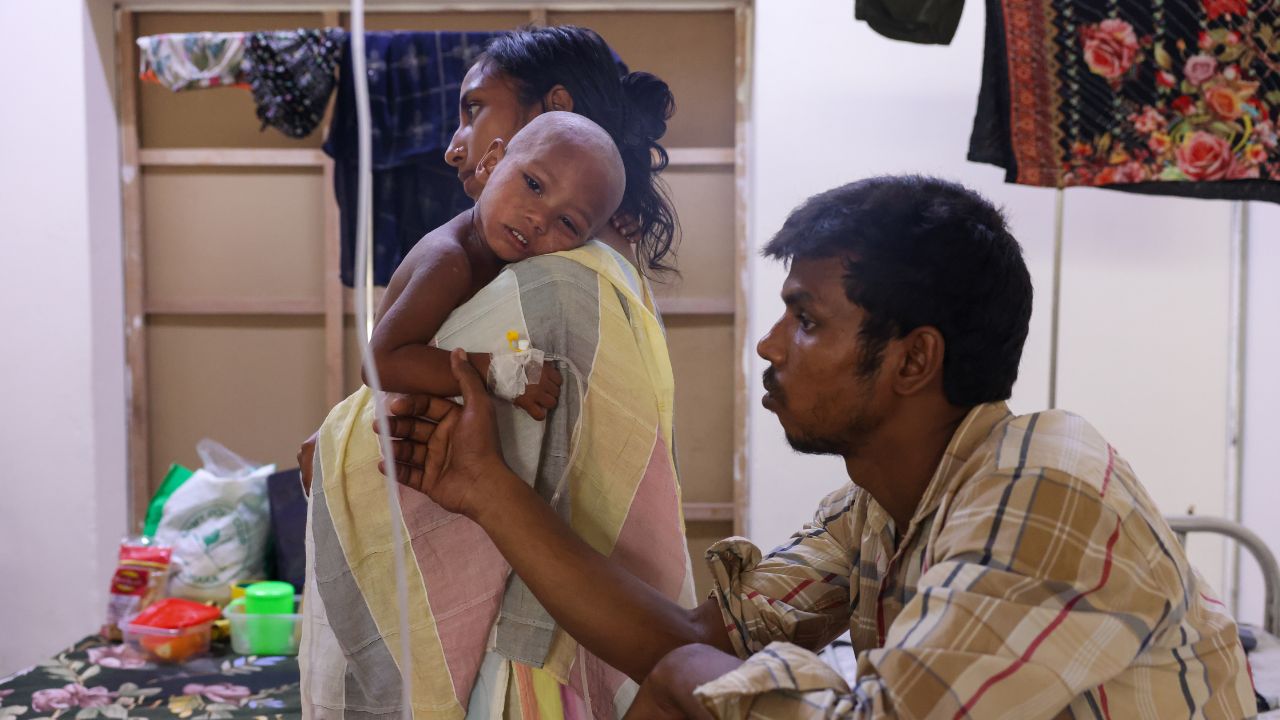
Children suffering from measles are lying on hospital floors and overcrowded corridors across the country, as a preventable disease surges amid what experts describe as a failure of policy, planning and governance.
At the Infectious Diseases Hospital in Mohakhali, a facility designed for 100 patients is now treating more than 150, many of them children in serious condition. Doctors say the situation reflects not a new viral mutation, but a breakdown in the country’s immunisation system.
The crisis extends well beyond the capital. At Rajshahi Medical College Hospital, between 600 and 800 children with measles are being admitted every day. Paediatric wards in specialised hospitals, including the National Heart Foundation Hospital, are also overwhelmed, forcing disruptions to other critical treatments.
Data highlights the scale of the outbreak. Last year, only 69 measles patients were admitted to the Infectious Diseases Hospital. This year, nearly 400 patients were admitted between 1 January and 22 March alone. Over the past five days, more than 30 patients have been admitted daily, with at least 11 reported deaths.
In the Rajshahi division, the situation is even more severe. On 18 March, testing of 153 samples with support from the World Health Organization found 29% positive for measles. Since 1 March, 84 children have been recommended for intensive care, but due to shortages, nine have died without access to ICU facilities and three more died while waiting.
Hospitals themselves are contributing to the spread. In Chapainawabganj District Hospital, where a dedicated “measles corner” was claimed to exist, on-site observations by TIMES of Bangladesh found no effective isolation system. In one case, a child admitted with pneumonia later contracted measles inside the hospital.
Public health experts say the roots of the crisis lie in decisions taken by successive governments.

A major turning point came on 19 March 2025, when the interim government scrapped the proposed Fifth Health, Population and Nutrition Sector Programme (HPNSP), valued at approximately Tk 1.06 trillion. The programme was intended to continue a long-standing sector-wide approach that included immunisation under the Expanded Programme on Immunization (EPI).
Instead, the government shifted to a fragmented, project-based approach. Experts say this disrupted continuity and weakened coordination across the health system.
The impact was structural. A 27-year-old programme framework collapsed, and in September 2025, key leadership positions — including line directors and programme managers — were abolished. As a result, field-level health services were left without clear direction or coordination.
Funding disruptions compounded the problem. Since mid-2024, financing for community clinics, union-level health centres and vaccine procurement has effectively been stalled.
Syed Abdul Hamid, a public health analyst, told TIMES that the current crisis is the result of “hasty decisions taken without understanding administrative realities,” calling it a clear policy failure.


However, responsibility does not lie with the interim government alone.
Experts also criticise the previous Awami League government for failing to implement the fifth EPI programme, despite plans to introduce it. While immunisation coverage appeared strong on paper, key expansions and follow-up campaigns were not carried out.
According to a 2024 UNICEF WUENIC report, first-dose measles vaccine coverage (MCV1) rose steadily from 88% in 2012 to 97% between 2015 and 2023. Second-dose coverage (MCV2) also improved, reaching 93% from 2017 onwards.
Despite these gains, structural weaknesses remained. Experts say gaps in reaching vulnerable populations and the failure to conduct nationwide measles-rubella campaigns after 2019 left a significant number of children unprotected.
Nizam Uddin, a public health expert, said that 10–20% of children miss routine immunisation each year. Over five years, this dropout rate can accumulate to as much as 80%, creating the conditions for a major outbreak.
That vulnerability is now being exposed.
An official from the EPI programme, speaking anonymously, told TIMES that central vaccine stocks for routine immunisation are effectively depleted. However, EPI Deputy Director Mohammad Shahariar Sazzad said more than 20 million doses are available, though currently allocated for campaigns rather than routine use. Authorities are considering reallocating these doses.
He added that the programme depends heavily on funding from the Global Alliance for Vaccines and Immunization (Gavi), which is currently stalled. This has halted vaccine procurement, syringe supply, staff training and field-level allowances. International supply disruptions have further delayed shipments.
At the same time, bureaucratic procedures have slowed response efforts. Procurement above Tk 1 billion requires approval from multiple cabinet committees, including the Cabinet Committee on Government Purchase (CCGP) and the Cabinet Committee on Economic Affairs (CCEA). Although funds are allocated, delays in approving procurement plans and new rules introduced in September 2025 have created further bottlenecks.
Experts say these overlapping administrative delays have paralysed the immunisation system.
The human impact is stark. Around 90% of those infected are children under one year old who have not yet been vaccinated. With routine vaccination scheduled at nine months, many are being infected earlier, prompting consideration of lowering the vaccination age to six months.
Health officials also acknowledge that disruptions to Vitamin A campaigns and routine immunisation over the past two years have weakened children’s immunity, making them more vulnerable.
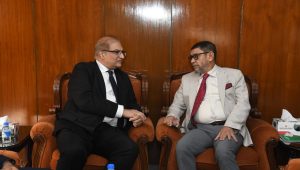
In response, Health Minister Sardar Md Sakhawat Hossain said that the government has allocated Tk 6.04 billion to procure measles vaccines and plans to launch a special campaign targeting children from six months of age. Experts are also calling for an immediate nationwide “catch-up” immunisation programme.
Yet concerns over accountability persist.
“No one is taking responsibility,” said Syed Abdul Hamid, criticising what he described as a culture of weak governance and lack of coordination. He also pointed to inexperienced leadership and dual administrative structures as obstacles to effective implementation.
Attempts to contact former interim government health adviser Nurjahan Begum for comment were unsuccessful.
As the country faces a deepening measles outbreak, experts warn that the consequences of policy missteps — from scrapping key programmes to failing to implement planned reforms — are now being borne by the country’s most vulnerable population: its children.