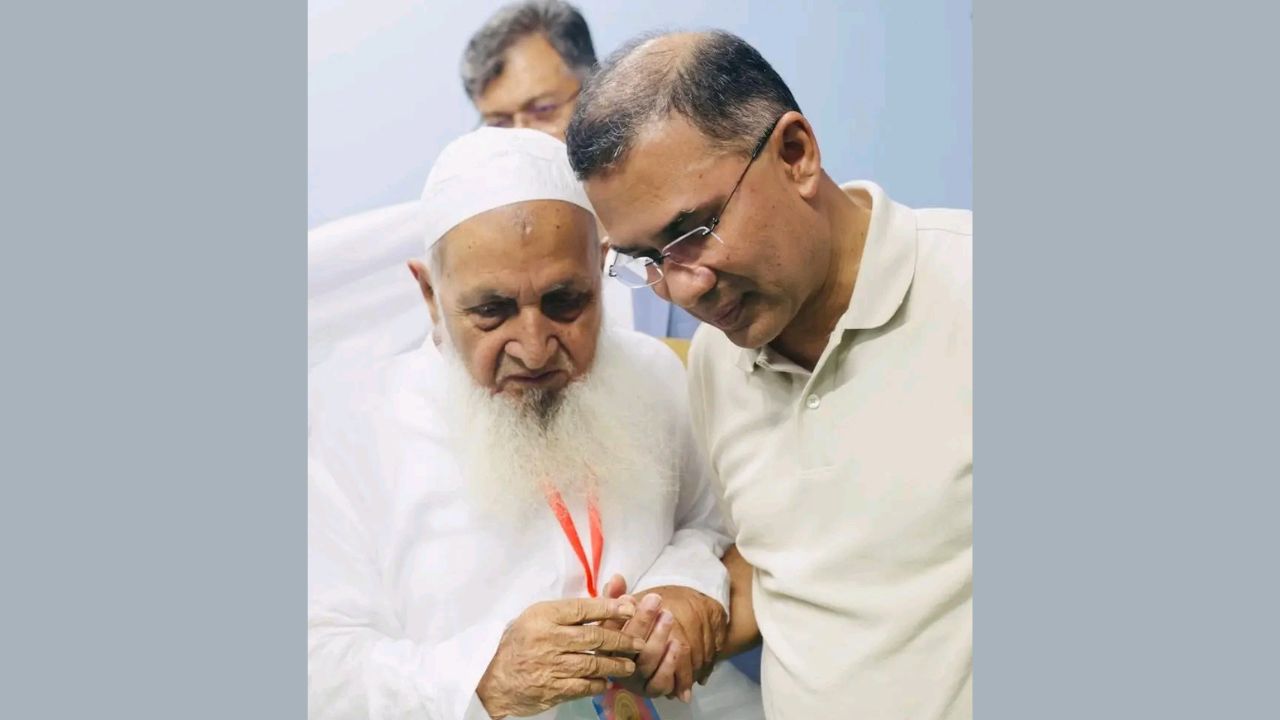



Prime Minister Tarique Rahman on Sunday said ulema would remain government partners in safeguarding national stability, warning that opposition conspiracies threaten the country’s future following the BNP’s landslide election victory.
He said ulema would remain key partners of the government, even without formal administrative roles.
Speaking to scholars and leaders of Hefazat-e-Islam — a “non-political”, Qawmi madrasa-based organisation — at Al Jamiatul Islamia Azizul Uloom in Babunagar, Fatikchhari, Tarique directly linked national political stability to cooperation between the state and religious leaders, with Hefazat supremo Muhibbullah Babunagari in the chair.
“During the last election, we worked together and managed to save the country from grave danger. However, our challenges are far from over,” Tarique said.
In an oblique reference to opposition Jamaat-e-Islami, he warned that political opponents were actively orchestrating conspiracies. “We saw them in 1971, 1986, 1996, and during the last election. They are sowing confusion. We must work together to prevent them from causing disorder,” he added.

Directly addressing the ulema, Tarique emphasised their vital societal role. “You may not be part of the government, but you are partners of it. We will properly fulfil the responsibilities entrusted to us, and I wish to leave here with your prayers,” he said.
He also called for interfaith harmony, urging citizens of all faiths to practise their religions peacefully.
At the event, Finance and Planning Minister Amir Khosru Mahmud Chowdhury assured Hefazat leaders of continued political engagement, saying, “We shall carry on working together as we have previously done. For as long as we remain in active politics, our partnership with you will remain steadfast.”




However, Home Minister Salahuddin Ahmed framed the relationship as spiritual rather than tactical. “Our relationship with you is not political; it is a religious one. We follow the path of Madinah and the Prophet’s Companions, and have no association with any other sect,” he said.
Hefazat Secretary General Maulana Sajidur Rahman presented a nine-point demand list, including stringent parliamentary legislation against religious defamation, declaring the Ahmadiyya community non-Muslim, and securing justice for the killings and alleged persecution of Hefazat activists under the previous Awami League administration.
In response, Home Minister Salahuddin indicated the government’s receptive stance, saying it was willing to consider the organisation’s key demands.
Vision for Chattogram coastal industrial corridor
On Sunday, Prime Minister Tarique unveiled an ambitious economic vision for Chattogram, proposing to transform its coastal belt into a major industrial corridor driven by investment, marine resources, energy security and job creation.
Speaking at a public rally in Banshkhali during his first official visit to Chattogram since taking office, Tarique outlined plans to develop the Matarbari-Mirsarai coastal strip. The proposed corridor will link emerging maritime and energy hubs in Matarbari and Maheshkhali with Chattogram Port and nearby economic zones, opening new opportunities, particularly for young people.
“I have viewed the coastal area from above. This vast sea is not merely a body of water; it is a vital resource belonging to the people of Bangladesh,” he said, emphasising plans for marine-based industries.
To support this industrial expansion, Tarique announced that a 10-year power and energy sector plan would be presented to parliament to ensure uninterrupted electricity and gas supplies. He also prioritised smooth supply chains for raw material imports and product exports.
Addressing infrastructure and climate resilience, the prime minister promised long-term investment in coastal embankments for vulnerable areas such as Banshkhali. “Everything will be done; we simply require some patience,” he assured residents.
Additionally, Tarique announced targeted support for Banshkhali’s salt farmers through social safety nets, a dedicated Farmers’ Card and fair pricing mechanisms.
Finally, he confirmed that nationwide distribution of Family Cards would begin on 16 August, targeting approximately 4.1 million women during the 2026–27 fiscal year. The government also intends to upgrade all 503 upazila hospitals into 101-bed facilities within five years.