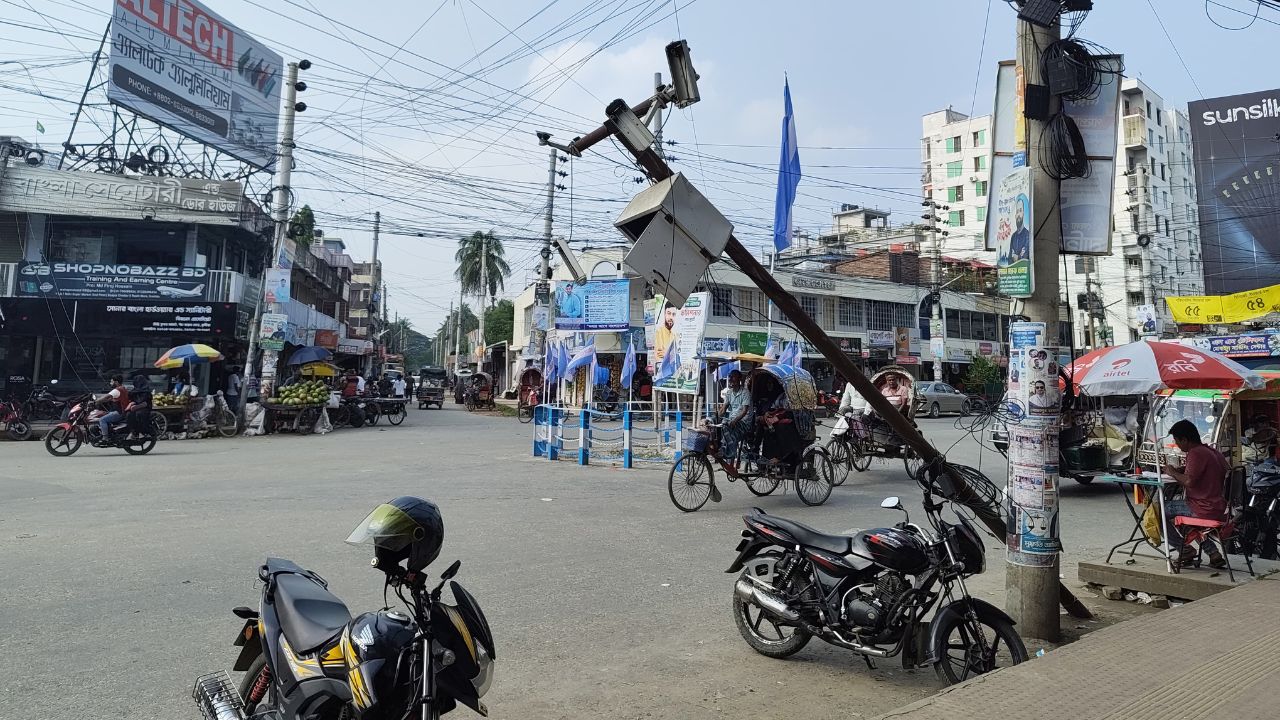



A network of 64 CCTV cameras installed across Kushtia town has remained out of operation for nearly two years, creating significant challenges for crime prevention, criminal identification and police investigations.
The cameras, installed at 23 key locations across the town, once formed the backbone of the district’s technology-based surveillance system. Their prolonged closure has raised concerns among residents, business owners and security experts, who say the absence of round-the-clock monitoring has weakened public safety.
Local people allege that criminal activity was comparatively lower when the cameras were operational because offenders knew their movements were being recorded. With the surveillance system inactive for an extended period, that deterrent effect has largely disappeared.
Residents also claim that the movement of suspicious individuals has increased in several parts of the town, particularly at night, heightening concerns over the safety of businesses, financial institutions and the public.
Many residents said the presence of CCTV cameras at major intersections and busy public areas had previously given them a sense of security. They now believe it has become far more difficult for law enforcement agencies to identify suspects involved in theft, robbery and other crimes.

According to local sources, the Kushtia District Police installed the 64 high-resolution CCTV cameras in early 2017 at 23 strategic locations, including Mojompur Traffic Office, Shapla Chattar, Thana Traffic Intersection, Ektara Chattar, Boro Bazar, Kataikhana Intersection, Hospital Intersection, Chhoy Rasta Intersection, Trimohoni, Chourhas, Lahini Bottola and NS Road.
The camera feeds were monitored around the clock from the District Detective Branch (DB) office and were regularly used to identify suspects, monitor vehicle movements and assist criminal investigations.




Local sources said most of the cameras were vandalised or damaged during the 2024 student-led mass uprising and the subsequent unrest. Some cameras were also removed. Despite the passage of nearly two years, there has been no visible progress in repairing or reinstalling the surveillance system.
It has also emerged that the CCTV project was not financed through a direct government allocation. Instead, it was established with financial contributions from local political leaders, businesspeople and members of the community. As a result, local stakeholders believe restoring the network will require coordinated efforts involving the government, business community, elected representatives and other sections of society.
Businessman Abdur Razzak said the CCTV network had previously given traders greater confidence.
“Now, if theft or robbery occurs, identifying the offenders has become much more difficult. The cameras should be restored without delay,” he said.
Ashikur Rahman, a resident of Thanapara, said suspicious movement had increased in different parts of the town at night.
“If CCTV cameras were operating, criminals would at least think twice before committing offences. A modern town cannot ensure public safety without this system,” he said.
Members of the local civil society said technology-based surveillance has become essential for effective policing. They noted that CCTV footage not only helps prevent crime but also plays a crucial role in investigations, evidence collection and ensuring speedy justice.
Kushtia Superintendent of Police Mohammad Jasim Uddin acknowledged that the absence of the CCTV network had complicated policing.
“In many cases, we now have to rely on footage collected from cameras installed at businesses, homes and private establishments. At the same time, field-level intelligence surveillance has been strengthened. Police are making every effort to maintain law and order,” he said.
He added that restoring the CCTV network remained a priority and said efforts were under way to reinstall the cameras through government funding and coordinated support from all relevant stakeholders.