Favourable weather has resulted in a bumper yield of Aman paddy in Tangail this year, with the district surpassing its cultivation target.
According to the Department of Agricultural Extension, the cultivation target for transplanted Aman paddy across the district’s 12 upazilas was set at 1,02,000 hectares this season. However, due to government incentives and the availability of high-yield seed varieties, farmers ended up cultivating 1,04,583 hectares.
With the start of Bangla month Agrahayon, farmers across the district have begun harvesting and storing their paddy.
According to the district agriculture department, nearly 63 percent of the cultivated land has already been harvested, and activities around threshing and drying newly cut rice are in full swing.

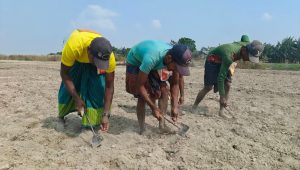
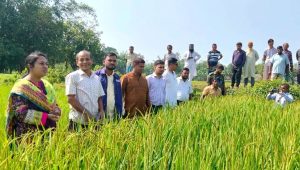
A visit to Digar village in Shahadebpur Union of Kalihati Upazila found an atmosphere of festivity across the fields. Many farmers are using modern machinery such as combine harvesters for quicker cutting and threshing, while around 80–85 percent still prefer harvesting by hand to secure better straw.
Farmers said that in previous years they would harvest 14–16 maunds of paddy per bigha. This year, the yield has increased to 18–20 maunds per bigha. bringing smiles to their faces.


Abu Bakkar, a farmer from Digar village, said he cultivated Aman paddy on two bighas of land this year.
“Despite natural disasters and some grain turning chaff, I still expect to get 18–20 maunds,” he said.
Another farmer, Abdur Jabbar, said the yield was generally good, though storms and rain caused significant damage.
“Many plants lodged onto the ground during the storm and some grain became chaff. Still, given the cost of fertiliser, seeds and pesticides, I hope I can make a profit after selling the new crop,” he said.
Tangail DAE Deputy Director Ashak Parves said the target was achieved due to regular field-level supervision, farmer training, the use of modern cultivation techniques, improved seed management and awareness of disease control.
He said farmers have already harvested paddy on 62,750 hectares and the process is progressing fast through both manual and machine-based methods.
“Hybrid and high-yielding varieties were planted across most areas, while local varieties were cultivated in a few pockets. Fewer disease outbreaks ensured strong yields across all varieties,” he added.