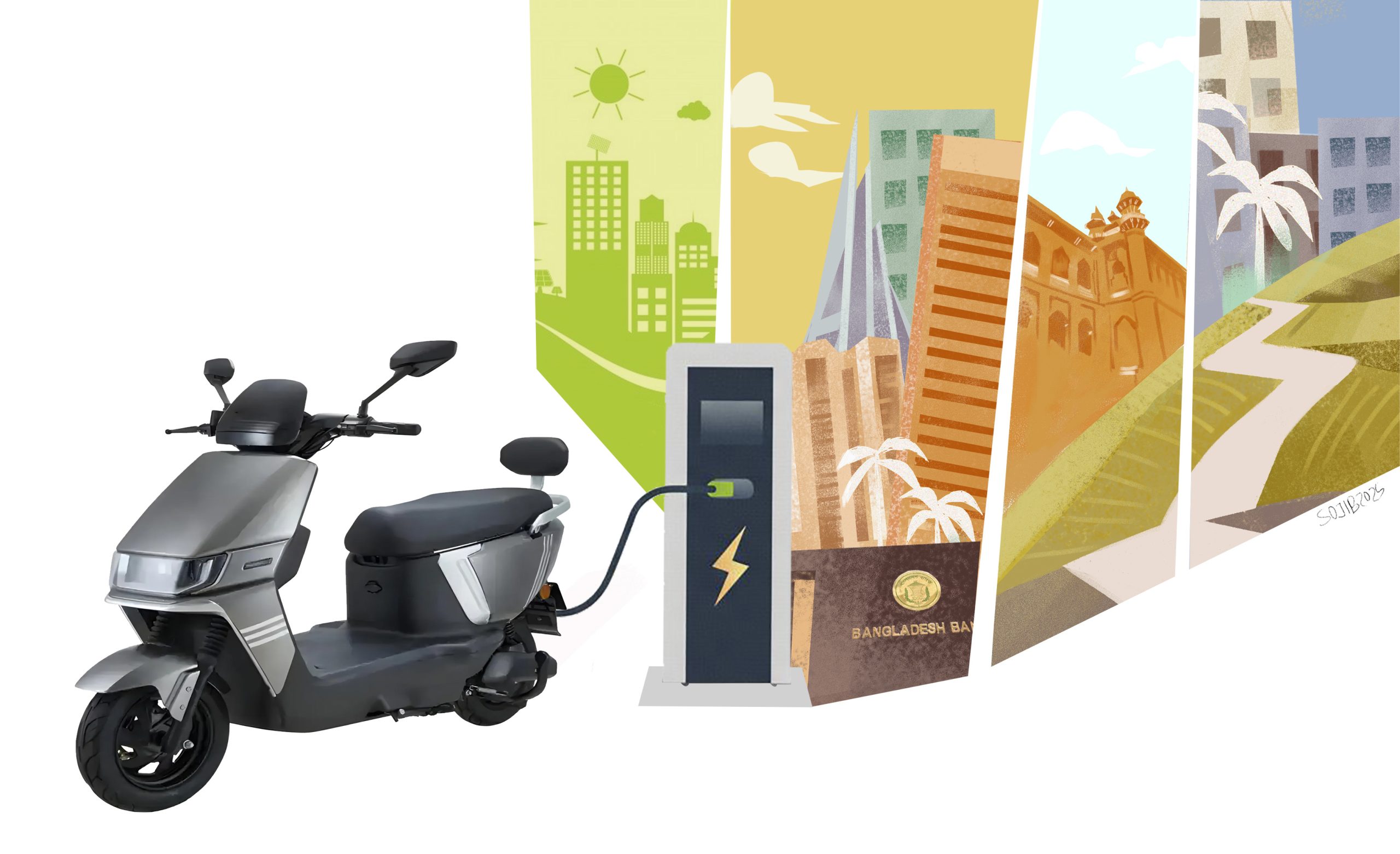



For Bangladesh, e-bikes, lightweight two-wheelers powered by rechargeable batteries, are more than a passing trend. As fuel prices rise and cities choke on traffic and air pollution, they represent a shift toward cleaner, cheaper and smarter urban mobility.
In just two decades, the price of octane in Bangladesh has soared from Tk 35 to Tk 125 per litre. Hence, commuters are seeking cost-effective and eco-friendly alternatives, and electric bikes (e-bikes) are fast emerging as a popular solution.
In 2022, the Bangladesh Road Transport Authority (BRTA) officially legalised e-bike registration, a regulatory green light that has transformed e-bikes from a fringe option into a mainstream contender. Since then, both local and international brands have flooded the market, offering a range of models for city commuters.
Among the local pioneers is Walton Takyon, available at Walton outlets, with prices ranging between Tk 80,000 to Tk 140,000. Akij Motors has also introduced its own line of models at similar price points. On the international front, Chinese brands are making a strong impression, with Revoo leading the charge.

Revoo has officially entered the Bangladeshi market with nine models. The entry-level A04 costs Tk 55,000 and offers a 45 km range per charge, while the flagship E52, priced at Tk 225,000, travels up to 130 km on a single charge and reaches a top speed of 75 km/h. Other models fall in the Tk 80,000 to Tk 180,000 range. Charging typically takes 4–6 hours, and most riders can recharge conveniently at home.
For many Dhaka residents, the appeal goes beyond savings. E-bikes allow riders to weave through traffic jams more easily, avoid long queues at petrol pumps, and park in tight spaces where conventional motorbikes struggle. For officegoers, students, and delivery workers, these small conveniences are proving just as valuable as the lower running costs.




Early adopters are already seeing the benefits. Mohammad Jishan, 32, a long-time motorbike rider, shared, “I’ve been riding bikes for more than five years and bought a Revoo A01 last year alongside my Suzuki GSXR. For daily commutes, I don’t have to worry about fuel costs at all. It can’t replace my main bike for speed and long trips, but for the city, it’s perfect.”
It’s not just long-time riders who are benefiting. University students are also turning to e-bikes in increasing numbers. For students, they provide an affordable way to travel between campus, tuition, and part-time jobs without the burden of rising fuel prices.
Sabbir Rahman, an employee at Revoo, said, “People used to worry about registration and battery life. But now that BRTA has legalised e-bikes and we offer an 18-month battery warranty, customers are much more confident and enthusiastic about our bikes.”
Other global brands like Yadea and Tailg are also gaining traction. Yadea models including the Velax, T5, Ruibin, and M6, are priced between Tk120,000 and Tk 250,000, while Tailg’s F72 Leopard, SAIBEI F71, and Greenbird A1 cost Tk 115,000 to 185,000.
The cost advantage is clear: travelling 100 km on an e-bike costs roughly Tk 15 in electricity, compared with about Tk 350 on a conventional motorbike with 35 km per litre mileage. Unlike petrol bikes, e-bikes also produce zero tailpipe emissions, offering a cleaner ride for Bangladesh’s already polluted cities.
E-bike points to a future where electric two-wheelers will play a central role in sustainable transport.